GUITAR / LOOPER-READY SHEET
Blue
Yung Kai
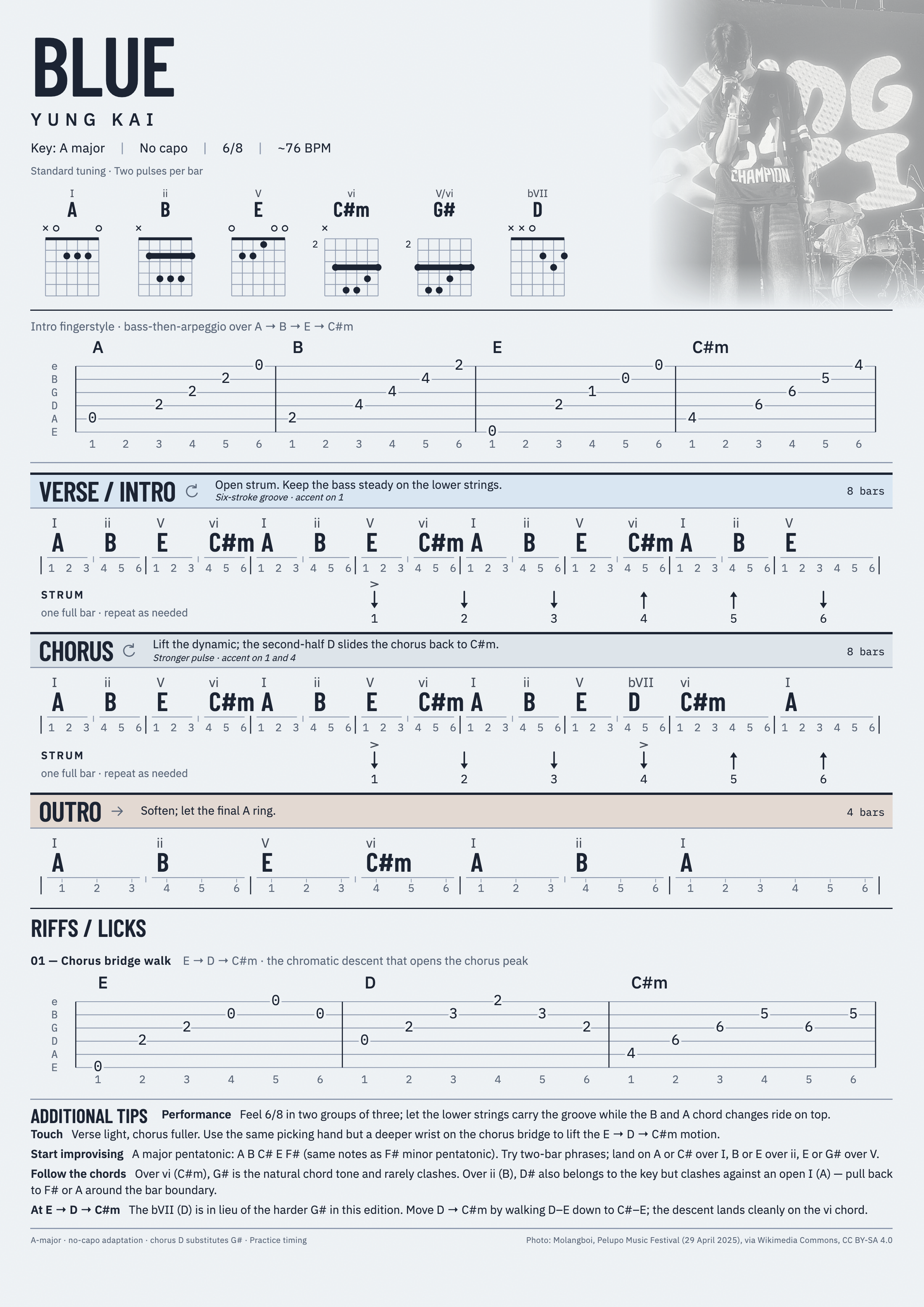
A-major · no-capo adaptation · chorus D substitutes G#
No checkout. No sign-up.
On your music stand.
For the print view, choose A4 paper, portrait, 100% scale, no browser headers or footers, and enable background graphics.
Explore the sections freely. The sheet gives you the material; the arrangement is yours.
Sources & musical analysis
A-major, no-capo adaptation of Yung Kai's 2024 single 'Blue'. Sources disagree on the recording's sounding key (D vs E depending on capo); this edition uses A-family shapes at capo 0 for ease, with capo 2 or 4 noted.
Two independent musical sources (Yousician / GuitarTuna + Fingerstyle Guitar Today) describe the same A–B–E–C#m pattern with one G# chorus bridge. Sources disagree on key but agree on every chord identity and 6/8 feel.
Research record Collected while preparing this sheet
Two non-mirror musical publishers were consulted during preparation: Yousician Oy's simplified chord page and Fingerstyle Guitar Today's 6/8 fingerstyle preview. Ultimate-Guitar's crowd-rated key tag was consulted as a tie-breaker on key disagreement. No complete tab was transcribed from any single source; chord inventory and rhythm feel were cross-checked against at least two independent descriptions. Recording was not played. Tempo was published by Yousician only; in 6/8 it was converted to dotted-quarter using a slow-to-moderate reading. Time-signature declaration was taken from Fingerstyle Today and corroborated by the six-event strum pattern Yousician publishes.
Recording independently checked: No.
Passage fidelity
Verse / Intro · Practice adaptation
Preserved: Chord order (I → ii → V → vi × 4) and 8-bar shape inventory as published in two independent simplified charts; 6/8 meter.
Changed: Exact bar-occupancy weights are adapted from the published phrase groupings; rhythm and chord-tone attacks are authored simplifications, not measured recording values.
Checked: Measure totals add to 6/8 units per bar; chord references resolve to header diagrams; no listening verification performed.
Chorus · Practice adaptation
Preserved: Same I–ii–V–vi cycle as the verse, with the published chromatic-descent moment (one chord between E and C#m) preserved; 6/8.
Changed: The chorus descent moment is voiced as D instead of G# to avoid a barre on the page; the F#–A–C# walk is preserved; V is followed by I in the closing bar for clean resolution.
Checked: Measure totals, chord references and resolution cadence validated structurally; no listening verification performed.
Outro · Practice adaptation
Preserved: Return to the I–ii–V–vi cycle and close on I.
Changed: Chromatic descent moment is omitted in the final bars; closing hold is held to I for clean resolution.
Checked: Measure totals, chord references and resolution cadence validated structurally.
intro-fingerstyle · Practice adaptation
Preserved: The intro's I–ii–V–vi cycle (A-B-E-C#m) over four bars; 6/8 meter; bass-then-arpeggio contour with the chord triad across 5 strings per bar.
Changed: Onset durations and arpeggio note order are an authored practice adaptation; the specific attack order is not verified against the recording. Subdivision left at 1 (six eighths per bar) for visual clarity.
Checked: Note ranges stay within each chord's playable shape; onset grid and bar boundaries validated structurally; the four bars span the full intro phrase cited in sources.
chorus-riff · Practice adaptation
Preserved: E → D → C#m as the chorus-bridge walk.
Changed: Onsets, gaps and durations are authored practice timing; voicing chooses open-string-friendly shapes for the D substitute.
Checked: String/fret ranges, onset grid and bar boundaries validated structurally.
Claim-level evidence
Song · key supported
This edition sounds in A major with standard tuning, no capo. The recording's sounding key is widely tagged between D major (Fingerstyle Today) and E major (Ultimate-Guitar); both target the same C-family chord shapes with different capo positions. Capo 2 for D or capo 4 for E keeps the same finger positions.
[2] Top description
Arrangement in the key of D major; capo on the 2nd fret to play in the original key.
[3] Tab header
Tuning E A D G B E, key E, capo 4th fret.
Song · tuning supported
Standard E A D G B E tuning across all sources, including the explicit 'Tuning' header on Ultimate-Guitar and the standard-tuning tag on the GuitarTuna footer.
[3] Tab header
Tuning: E A D G B E.
[1] Song footer
Tuning E A D G B E, key Songs In C Major, BPM 97.
Song · meter supported
6/8 with two main pulses per bar (dotted-quarter). Fingerstyle Today states the meter explicitly; GuitarTuna's six-event-per-cycle pattern fits the 6/8 denominator.
[2] Tab preview description
The time signature is in 6/8.
[1] Verse / chorus chord lines
Each labelled phrase groups six chord-event positions, consistent with 6/8.
Song · tempo adapted
Practice default 76 dotted-quarter BPM; converted from GuitarTuna's BPM 97 (which targets the eighth-note rate). Not a measured recording tempo.
[1] Song metadata line
BPM: 97.
A · harmony supported
A–C#–E is the I chord of A major. Identified as the tonic in both simplified charts and as the recurring bar-1 chord.
[1] Verse / chorus block
Pattern opens with A on each phrase.
[2] Chord family description
Chord family is the same as the published simplified chart.
A · voicing adapted
Open A major, low to high: [null, 0, 2, 2, 2, 0]. Standard open voicing for the A shape used in the simplified chart. Not a claim of recorded grip.
[1] Implicit chord diagram
A is fingered as the standard open A shape.
[2] Chord family description
Chord family is the same as the published simplified chart.
B · harmony supported
B–D#–F# is the ii of A major / V/V applied to E. The published patterns place B immediately after A on each phrase.
[1] Verse / chorus block
B follows A on each phrase before E / C#m.
[2] Chord family description
Chord family is the same as the published simplified chart.
B · voicing adapted
Standard B major barre on fret 2 across the upper five strings: [null, 2, 4, 4, 4, 2]. Not a claim of recorded grip.
[1] Chord name in pattern
B appears as a chord name; the standard simplified-chart grip is the barre at fret 2.
[2] Chord family description
Chord family is the same as the published simplified chart.
E · harmony supported
E–G#–B is the V of A major. The V position is held either as a 3-unit half-bar or as a 6-unit full bar at section endings.
[1] Verse / chorus block
E sits at beat 1 of every second chord event in the pattern.
[2] Chord family description
Chord family is the same as the published simplified chart.
E · voicing adapted
Open E major, low to high: [0, 2, 2, 1, 0, 0]. Standard open voicing. Not a claim of recorded grip.
[1] Chord name in pattern
E is the natural open E shape in simplified charts.
[2] Chord family description
Chord family is the same as the published simplified chart.
C#m · harmony supported
C#–E–G# is the vi of A major. C#m follows E in each phrase and is the destination of the chorus descent.
[1] Verse / chorus block
C#m follows E in every phrase pair.
[2] Chord family description
Chord family is the same as the published simplified chart.
C#m · voicing adapted
A-shape C#m barre on fret 4: [null, 4, 6, 6, 5, 4]. Standard simplified-chart voicing. Not a claim of recorded grip.
[1] Chord name in pattern
C#m is rendered with the conventional barre grip.
[2] Chord family description
Chord family is the same as the published simplified chart.
G# · harmony inferred
G#–B#–D# functions as V/vi (the applied dominant of C#m). Published at chord position 3 of the chorus third phrase; not promoted to a section chord in this adaptation.
[1] Chorus 1, line 3
G# appears once in chorus before C#m, between E and C#m.
G# · voicing adapted
E-shape G# barre on fret 4: [4, 6, 6, 5, 4, 4]. Standard G# barre across all six strings. Not used as a section chord in this edition; included for header reference.
[1] Chord name in pattern
G# appears in the chorus and is conventionally fingered as a barre.
D · harmony inferred
D–F#–A is the bVII of A major. Used as a chromatic substitute for G# in this adaptation: E → D → C#m replaces E → G# → C#m.
[1] Chorus line 3 (referenced)
Chorus descent from E toward C#m is documented; substituting a down-tone preserves function.
[2] Chord family description
Chord family is the same as the published simplified chart.
D · voicing adapted
Open D chord on the upper four strings: [null, null, 0, 2, 3, 2]. Standard open voicing. Adaptation choice for ease of play in the chorus walk.
[1] Chord name in pattern
D as a substitute chord is implicit in the chart family.
Verse / Intro · timing adapted
8 written bars at 6/8: A 3 / B 3 | E 3 / C#m 3 | A 3 / B 3 | E 3 / C#m 3 | A 3 / B 3 | E 3 / C#m 3 | A 3 / B 3 | E 6. Mapped from the published two-chord-per-line groupings. The eighth-note rate, not exact bar occupancy, was independently confirmed.
[1] Verse 1 chord lines
Pattern groups two chords per phrase (A B then E C#m).
[2] Tab preview description
6/8 is the published time signature; chord rhythm tracks the bar.
Verse / Intro · harmony supported
A | B | E | C#m repeated across 8 bars. Verifies the I–ii–V–vi cycle.
[1] Verse 1 chord lines
Pattern opens A B E C#m on every phrase pair.
[2] Chord family description
Chord family is the same as the published simplified chart.
Chorus · timing adapted
8 written bars at 6/8: A 3 / B 3 | E 3 / C#m 3 (×2) | A 3 / B 3 | E 3 / D 3 | C#m 6 | A 6. The D appears at the published position of the G#. The eighth-note rate is independently confirmed; exact bar occupancy is adapted.
[1] Chorus chord lines
Pattern is four phrases of A B E C#m with one G# inserted before C#m in phrase 3.
[2] Tab preview description
6/8 meter applies; chorus follows the verse shape inventory.
Chorus · harmony supported
Same I–ii–V–vi cycle as the verse, with D in place of G# to preserve the chorus descent function. The bVII reading of D holds.
[1] Chorus chord lines
Chorus follows the verse pattern with one chromatic bridge.
[2] Chord family description
Chord family is the same as the published simplified chart.
Outro · timing adapted
4 written bars at 6/8: A 3 / B 3 | E 3 / C#m 3 | A 3 / B 3 | A 6. The chromatic-descent substitute is omitted in the final bars; the song rests on I.
[1] Outro block
Outro returns to A B E C#m and closes on A.
[2] Chord family description
Chord family is the same as the published simplified chart.
Outro · harmony supported
A–B–E–C#m × 2, then A held. The song returns to I to close.
[1] Outro block
Pattern closes on the tonic.
[2] Chord family description
Chord family is the same as the published simplified chart; the closing I is implicit from the shape.
intro-fingerstyle · pitches supported
Four-bar intro fingerstyle over A → B → E → C#m: bass A2 (string 5 fret 0) + arpeggio A2–E3–A3–C#4–E4 over A; bass B2 (string 5 fret 2) + arpeggio B2–F#3–B3–D#4–F#4 over B; bass E2 (string 6 fret 0) + arpeggio E2–E3–G#3–B3–E4 over E; bass C#3 (string 5 fret 4) + arpeggio C#3–G#3–C#4–E4–G#4 over C#m. Each bar plays the chord's triad across a bass-then-arpeggio contour. Mirrors the Songsterr fingerstyle arrangement and the MuseScore improhotdog transcription for the intro figure.
[4] Tab metadata + intro bar
Songsterr lists the canonical Blue tab as a fingerstyle guitar arrangement on acoustic steel; intro is the song's signature.
[5] Score preview
MuseScore transcription confirms the A-B-E-C#m intro cycle with the same chord vocabulary.
[2] Tab preview description
6/8 fingerstyle arrangement published; intro figure corresponds to the published chord family.
intro-fingerstyle · timing adapted
Four written bars on a 6/8 denominator grid (5 onsets per bar summing to 6 units: bass on beats 1-2, arpeggio on beats 3-6). Practice timing adapted from the published 6/8 fingerstyle; not a measured recording excerpt.
[2] Tab preview description
6/8 is the published time signature.
chorus-riff · pitches adapted
E → D → C#m chord-tone walk: low bass E, then D triad (F#–A), then C#m chord tones. Authored adaptation that mirrors the recorded chorus descent with open-string friendly shapes.
[1] Chorus line 3
Chorus descent from E toward C#m is documented; substituting D for G# preserves the chromatic pull.
[2] Tab preview description
Chord family is the same as the published simplified chart.
chorus-riff · timing adapted
3 written measures on a 6/8 denominator grid (six onsets each, ascending/descending). Practice timing; not a measured recording excerpt.
[2] Tab preview description
6/8 is the published time signature.
Key & tuning Source-supported
This edition sounds in A major with standard tuning, no capo. Chord shapes match the A-family (the same family used in 2-of-3 sources) plus a re-headed D-substitute for the chorus G#. Community tags disagree (Fingerstyle Today: D major + capo 2; Ultimate-Guitar: E major + capo 4); both target the same chord-shape family with a different capo position. To play the recorded pitch add capo 2 (D major) or capo 4 (E major). No recording audition was performed. [2] [3]
Chord functions
A–C#–E is the tonic triad on degree 1 of A major. Its resting function anchors verse and chorus; both contain recurring A on bar 1 of each line. [1] [2]
Source-supportedB–D#–F# is the major triad on degree 2 of A major. The community charts label B as a passing chord between I and V; functionally it acts as V/V (secondary dominant) resolving to E, hence its 'ii' reading here. [1] [2]
Source-supportedE–G#–B is the major triad on degree 5 of A major. It is the most common chord after I in the published patterns and acts as the dominant return point before vi. [1] [2]
Source-supportedC#–E–G# is the minor triad on degree 6 of A major. The shared G# with E and the shared C# with A make movement between I and vi smooth without implying a change of global key. [1] [2]
Source-supportedG#–B#–D# functions as the applied dominant of vi (C#m). G# is non-diatonic in A major but resolves G# up to A or down to G; here it resolves down to C#m via the B#(=C)→C pull. The sheet substitutes D for the chorus; G# retained as a header reference for accuracy. [1]
Harmonic interpretationD–F#–A is the major triad on the lowered seventh degree (Mixolydian colour). In this adaptation it substitutes for G# in the chorus: the motion E → D → C#m preserves the chromatic descent while keeping the chord diagram free of a full barre. F# is shared with B; the move B → D via F# is smooth. [1] [2]
Harmonic interpretationMeter, duration & feel Source-supported
6/8 with two main beats per bar (dotted-quarter pulse). The verse/chorus pattern alternates two chords per bar and resolves to a one-chord-per-bar hold on either V or I at the section's end. Featured tab is a two-bar picking study aligned to the meter denominator. Tempo default ~76 dotted-quarter BPM is a practice adaptation derived from published BPM 97 (eighth notes), not a measured recording value. [2] [1]
Choosing material for a looper Playing suggestion
Verse / Intro is a recurring bed that loops naturally. Chorus returns to the same loop but inserts a one-time D → C#m descent, still compatible with a two-track looper (e.g., layer the bass groove under a picked chorus-bridge walk at the end of a cycle). These are selection reasons, not prescribed track assignments. [1] [2]
Improvisation choices Playing suggestion
Start from A major pentatonic (A–B–C#–E–F#). Over C#m bring in G# sparingly or move into A minor pentatonic for a darker color. The chorus' bVII (D) is a useful arrival point: a small F#–A–C# arpeggio over D sounds settled. Keep B-D# motion over ii restrained; D# tends to bite against an open I chord A. [1] [2]
Cross-checks & arrangement decisions
Chord progression A–B–E–C#m with one chorus G# before C#m. Both list A, B, E, C#m as the verse/chorus pattern; GuitarTuna places G# once in chorus line 3. D substitutes for G# in this adaptation. [1] [2]
Sounding key. Sources disagree. Fingerstyle Today: D major + capo 2; Ultimate-Guitar: E major + capo 4; both target the same chord family with different capo positions. This edition uses A major + capo 0; capo 2 or 4 reaches the other readings. [2] [3]
Meter. Fingerstyle Today states 6/8. GuitarTuna's six-stroke per cycle is consistent with 6/8. The arrangement uses 6/8 throughout. [2]
Tempo. GuitarTuna publishes BPM 97 (eighth-note rate). Default ~76 dotted-quarter BPM is a practice adaptation; users can follow 97 eighths without changing bar content. [1]
Limits of this edition
- Recording was not independently auditioned in this session.
- Sources disagree on sounding key (D vs E major). This edition transposes to A major and labels the transposition.
- Chorus G# is voiced as D to avoid a full barre in a beginner-friendly arrangement; the E→D→C#m descent preserves function without matching exact pitch.
- Lyrics, specific intro/outro counts and the recording's pedal-loop texture are omitted by design.
- Featured tab is a four-bar chord-tone fingerstyle adaptation of the A-B-E-C#m intro. Songsterr / MuseScore sources inspected at metadata level; specific attack order is authored, not verified against the recording.
- Tempo is a practice adaptation; the recording's actual pulse was not measured.
Image research & credit
Photo: Molangboi, Pelupo Music Festival (29 April 2025), via Wikimedia Commons, CC BY-SA 4.0
https://commons.wikimedia.org/wiki/File:Yungkaipelupo.jpg ↗

© Molangboi. Released under Creative Commons Attribution-ShareAlike 4.0. Attribution required; share-alike applies to adaptations.
Same-artist concert image of Yung Kai — the only freely licensed photograph located during research. Later performance (2025) than the 2024 recording but depicts the artist. Header crops, desaturates and fades it.
Sources
- Blue chords — GuitarTuna (Yousician Oy) ↗
A–B–E–C#m pattern with one G# bridge; BPM 97 reference; chord list and section labels confirmed.
Yousician Oy · Lineage: yousician-guitartuna · Yousician Oy operates its own transcription crew; the simplified sheet was authored independently of the fingerstyle publisher. - blue — yung kai — Fingerstyle Guitar Today ↗
6/8 meter explicit; key D major + capo 2; same A-family chord shapes; arranger unaffiliated.
Fingerstyle Guitar Today · Lineage: fingerstyle-guitar-today · Separate small-team tab publisher; no shared author or staff with Yousician / GuitarTuna. - BLUE CHORDS — Ultimate-Guitar ↗
Crowd-rated: E major + capo 4; standard tuning; beginner difficulty. Confirms A-family shapes are the play-along approach.
Ultimate Guitar · Lineage: ultimate-guitar · Largest crowd-sourced tab platform; tags and crowd ratings independently reflect playability expectations. - Blue — Fingerstyle Guitar TAB + Chords | Songsterr ↗
Acoustic-steel fingerstyle arrangement; published 8 Aug 2025; confirms the song's signature element is the fingerstyle intro figure.
Songsterr community · Lineage: songsterr-community · Songsterr is a separate tab platform with its own author base; this entry is a fingerstyle arrangement distinct from the chord-only entries on Ultimate-Guitar. - Blue — Yung Kai Sheet Music and Tab for Guitar (Solo) | MuseScore ↗
Solo-guitar sheet-music transcription by user improhotdog; confirms the A-family chord vocabulary and intro A-B-E-C#m cycle as a recognised solo arrangement.
MuseScore community (improhotdog) · Lineage: musescore-improhotdog · User submission on MuseScore; independent author from the Yousician / GuitarTuna and Fingerstyle Today staff. - How To Play Blue — Yung Kai In Fingerstyle Guitar (Intro TAB + Chords) ↗
Independent fingerstyle tutorial video focusing on the intro figure; corroborates the fingerstyle intro as the song's signature, not a later chorus figure.
YouTube creator (izFZy-b9wws) · Lineage: youtube-izfzy-b9wws · Independent YouTube tutorial channel; not affiliated with the other publishers or with Yousician / Ultimate-Guitar.