GUITAR / LOOPER-READY SHEET
What Katie Did
The Libertines
2004 album · community-chart practice study
No checkout. No sign-up.
On your music stand.
For the print view, choose A4 paper, portrait, 100% scale, no browser headers or footers, and enable background graphics.
Explore the sections freely. The sheet gives you the material; the arrangement is yours.
Sources & musical analysis
The Libertines, self-titled 2004 album; standard-tuning study, not a note-for-note studio transcription.
Independent community charts synthesized into a complete harmonic practice map; adapted rhythm, voicings and contrasting cadence.
Research record Collected while preparing this sheet
Inspected the Songsterr shared chord chart, self-described independently tabbed high-position intro, and detailed Cifra chart. Grouped unclear mirrors conservatively. Compared chord order and conflicting cadence, derived Roman degrees and pitch sets, selected explicit practice timing, and inspected licensed artist artwork. No recording audition or video-lesson consultation is claimed. Revised after feedback: distinct credited photograph; first five diagrams now match featured triads; identical intro/verse/refrain cycle consolidated; a short solo-opening fragment researched and added with adapted timing. Corrected the misleading seven-note solo exercise against user-selected UG tab 141014: preserved the opening phrase and articulation; removed invented timing and hold. The solo excerpt was subsequently removed at Mathias’s request: this page prioritizes usable improvisation guidance over a short solo transcription.
Recording independently checked: No.
Passage fidelity
Verse / Refrain · Practice adaptation
Preserved: Complete recurring chord order and major-to-minor IV contrast. Printed once for intro, verse, refrain and solo accompaniment; section identities remain in the label/technique.
Changed: 4 bars: A4 | C#m4 | F#m4 | D2 Dm2 quarter units. Even, repeatable practice bars replace unspecified chart timing.
Checked: Compared located chord sequences and conflicting variants; calculated chord tones and denominator-unit totals. Recording not auditioned; no exact barline verification.
Chromatic link · Practice adaptation
Preserved: Chromatic approach where present and contrasting F# major cadence.
Changed: 5 bars: A2 G#1 G1 | F#4 | Bm4 | E7 4 | A4. E7/plain A replace cadence variants; free timing regularized where applicable.
Checked: Compared located chord sequences and conflicting variants; calculated chord tones and denominator-unit totals. Recording not auditioned; no exact barline verification.
Free-time ending · Practice adaptation
Preserved: Chromatic approach where present and contrasting F# major cadence.
Changed: 5 bars: A4 | F#4 | Bm4 | E7 4 | A4. E7/plain A replace cadence variants; free timing regularized where applicable.
Checked: Compared located chord sequences and conflicting variants; calculated chord tones and denominator-unit totals. Recording not auditioned; no exact barline verification.
upper-chord-cycle · Practice adaptation
Preserved: All five harmonic stops and the top-string voicing changes from the high-position intro.
Changed: Omit lower strings; replace source stroke sequence with uniform offbeat brushes; D and Dm receive two quarter units each.
Checked: Calculated each triad pitch and all onsets; retained the full four-bar cycle including Dm. No recording audition or independent exact-timing confirmation.
Claim-level evidence
Song · key inferred
A major is the tonal frame: recurring A closure, iii C#m and vi F#m. Dm is borrowed iv, not evidence that the whole song is minor.
[1] Chorus and Verse
A–C#m–F#m–D–Dm order.
[2] Intro: A, C#m, F#m, D/Dm systems
Same sequence with upper-neck voicings; D and Dm share a system.
Song · tuning adapted
Standard EADGBE with no capo selected; all displayed pitches are sounding pitches. No recording tuning check was performed.
[1] Tuning and capo controls above chart
Standard EADGBE; capo off.
[2] Intro string labels and fret stacks
Six-string e B G D A E notation is consistent with standard tuning.
Song · meter adapted
A regular 4/4 practice grid is selected. These text charts do not establish exact recorded barlines or free-time timing; BPM is intentionally omitted.
[1] Chorus and Verse
A–C#m–F#m–D–Dm order.
[2] Intro: A, C#m, F#m, D/Dm systems
Same sequence with upper-neck voicings; D and Dm share a system.
A · harmony supported
A is common to the independent cycle charts. A C# E: tonic I.
[1] Chorus and Verse
A–C#m–F#m–D–Dm order.
[2] Intro: A, C#m, F#m, D/Dm systems
Same sequence with upper-neck voicings; D and Dm share a system.
A · voicing adapted
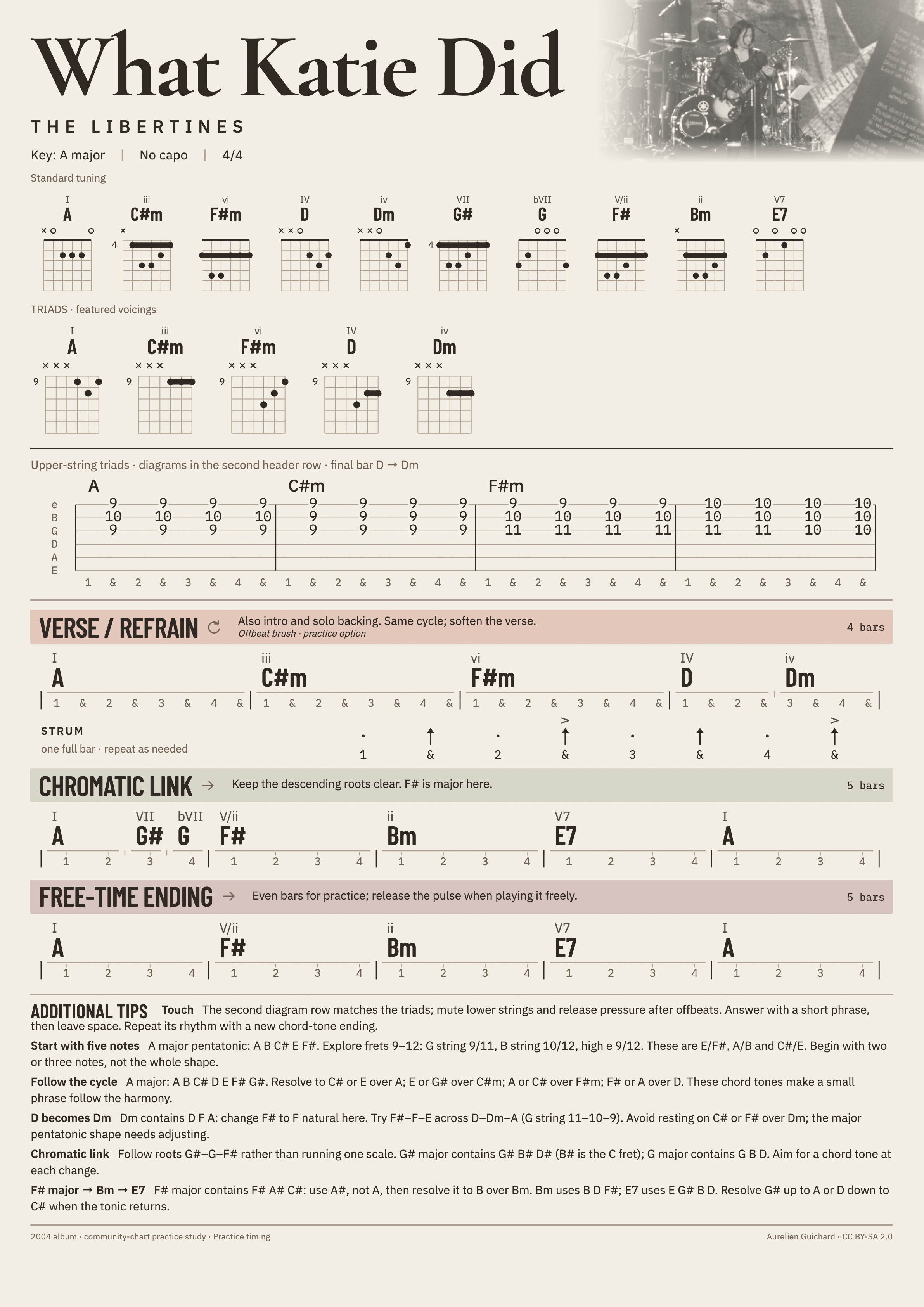
Upper-three-string A triad matching the featured tab: [None, None, None, 9, 10, 9] low to high. Lower strings muted; chord symbol identifies harmony, not a bass part. Pitches checked in standard tuning. Header also supplies full accompaniment grip [None, 0, 2, 2, 2, 0], low to high, independently checked against chord tones; the separate triad row retains the upper-string shape.
[2] Intro, A fret stack
The displayed three highest string frets are retained from the full chord stack; lower strings omitted.
C#m · harmony supported
C#m is common to the independent cycle charts. C# E G#: mediant iii.
[1] Chorus and Verse
A–C#m–F#m–D–Dm order.
[2] Intro: A, C#m, F#m, D/Dm systems
Same sequence with upper-neck voicings; D and Dm share a system.
C#m · voicing adapted
Upper-three-string C#m triad matching the featured tab: [None, None, None, 9, 9, 9] low to high. Lower strings muted; chord symbol identifies harmony, not a bass part. Pitches checked in standard tuning. Header also supplies full accompaniment grip [None, 4, 6, 6, 5, 4], low to high, independently checked against chord tones; the separate triad row retains the upper-string shape.
[2] Intro, C#m fret stack
The displayed three highest string frets are retained from the full chord stack; lower strings omitted.
F#m · harmony supported
F#m is common to the independent cycle charts. F# A C#: submediant vi; distinct from F# major in the link.
[1] Chorus and Verse
A–C#m–F#m–D–Dm order.
[2] Intro: A, C#m, F#m, D/Dm systems
Same sequence with upper-neck voicings; D and Dm share a system.
F#m · voicing adapted
Upper-three-string F#m triad matching the featured tab: [None, None, None, 11, 10, 9] low to high. Lower strings muted; chord symbol identifies harmony, not a bass part. Pitches checked in standard tuning. Header also supplies full accompaniment grip [2, 4, 4, 2, 2, 2], low to high, independently checked against chord tones; the separate triad row retains the upper-string shape.
[2] Intro, F#m fret stack
The displayed three highest string frets are retained from the full chord stack; lower strings omitted.
D · harmony supported
D is common to the independent cycle charts. D F# A: subdominant IV.
[1] Chorus and Verse
A–C#m–F#m–D–Dm order.
[2] Intro: A, C#m, F#m, D/Dm systems
Same sequence with upper-neck voicings; D and Dm share a system.
D · voicing adapted
Upper-three-string D triad matching the featured tab: [None, None, None, 11, 10, 10] low to high. Lower strings muted; chord symbol identifies harmony, not a bass part. Pitches checked in standard tuning. Header also supplies full accompaniment grip [None, None, 0, 2, 3, 2], low to high, independently checked against chord tones; the separate triad row retains the upper-string shape.
[2] Intro, D fret stack
The displayed three highest string frets are retained from the full chord stack; lower strings omitted.
Dm · harmony supported
Dm is common to the independent cycle charts. D F A: borrowed minor iv; F natural supplies the chromatic return to E.
[1] Chorus and Verse
A–C#m–F#m–D–Dm order.
[2] Intro: A, C#m, F#m, D/Dm systems
Same sequence with upper-neck voicings; D and Dm share a system.
Dm · voicing adapted
Upper-three-string Dm triad matching the featured tab: [None, None, None, 10, 10, 10] low to high. Lower strings muted; chord symbol identifies harmony, not a bass part. Pitches checked in standard tuning. Header also supplies full accompaniment grip [None, None, 0, 2, 3, 1], low to high, independently checked against chord tones; the separate triad row retains the upper-string shape.
[2] Intro, Dm fret stack
The displayed three highest string frets are retained from the full chord stack; lower strings omitted.
G# · harmony adapted
Selected practice harmony: G# B# D#: major VII passing chord. B# sounds C; chromatic descent, not diatonic vii°.
[1] Pre Chorus and Free Time
Ab–G–F#–Bm–Esus4–A; later A–F#–Bm–E7–A6.
[3] First chromatic link, after second verse phrase
A–G#–G–F# followed by D/E; differs from Bm/Esus4.
G# · voicing adapted
Authored playable standard-tuning diagram [4,6,6,5,4,4] low to high. Non-muted pitches reduce to G# B# D#; no recorded fingering claim.
[1] Pre Chorus and Free Time
Ab–G–F#–Bm–Esus4–A; later A–F#–Bm–E7–A6.
[3] First chromatic link, after second verse phrase
A–G#–G–F# followed by D/E; differs from Bm/Esus4.
G · harmony adapted
Selected practice harmony: G B D: bVII passing major chord.
[1] Pre Chorus and Free Time
Ab–G–F#–Bm–Esus4–A; later A–F#–Bm–E7–A6.
[3] First chromatic link, after second verse phrase
A–G#–G–F# followed by D/E; differs from Bm/Esus4.
G · voicing adapted
Authored playable standard-tuning diagram [3,2,0,0,0,3] low to high. Non-muted pitches reduce to G B D; no recorded fingering claim.
[1] Pre Chorus and Free Time
Ab–G–F#–Bm–Esus4–A; later A–F#–Bm–E7–A6.
[3] First chromatic link, after second verse phrase
A–G#–G–F# followed by D/E; differs from Bm/Esus4.
F# · harmony adapted
Selected practice harmony: F# A# C#: V/ii in the selected F#–Bm version; A# resolves toward B.
[1] Pre Chorus and Free Time
Ab–G–F#–Bm–Esus4–A; later A–F#–Bm–E7–A6.
[3] First chromatic link, after second verse phrase
A–G#–G–F# followed by D/E; differs from Bm/Esus4.
F# · voicing adapted
Authored playable standard-tuning diagram [2,4,4,3,2,2] low to high. Non-muted pitches reduce to F# A# C#; no recorded fingering claim.
[1] Pre Chorus and Free Time
Ab–G–F#–Bm–Esus4–A; later A–F#–Bm–E7–A6.
[3] First chromatic link, after second verse phrase
A–G#–G–F# followed by D/E; differs from Bm/Esus4.
Bm · harmony adapted
Selected practice harmony: B D F#: ii, selected instead of the conflicting D chart.
[1] Pre Chorus and Free Time
Ab–G–F#–Bm–Esus4–A; later A–F#–Bm–E7–A6.
[3] First chromatic link, after second verse phrase
A–G#–G–F# followed by D/E; differs from Bm/Esus4.
Bm · voicing adapted
Authored playable standard-tuning diagram [null,2,4,4,3,2] low to high. Non-muted pitches reduce to B D F#; no recorded fingering claim.
[1] Pre Chorus and Free Time
Ab–G–F#–Bm–Esus4–A; later A–F#–Bm–E7–A6.
[3] First chromatic link, after second verse phrase
A–G#–G–F# followed by D/E; differs from Bm/Esus4.
E7 · harmony adapted
Selected practice harmony: E G# B D: dominant V7; selected as a consistent practice cadence in place of E/Esus4 variants.
[1] Pre Chorus and Free Time
Ab–G–F#–Bm–Esus4–A; later A–F#–Bm–E7–A6.
[3] First chromatic link, after second verse phrase
A–G#–G–F# followed by D/E; differs from Bm/Esus4.
E7 · voicing adapted
Authored playable standard-tuning diagram [0,2,0,1,0,0] low to high. Non-muted pitches reduce to E G# B D; no recorded fingering claim.
[1] Pre Chorus and Free Time
Ab–G–F#–Bm–Esus4–A; later A–F#–Bm–E7–A6.
[3] First chromatic link, after second verse phrase
A–G#–G–F# followed by D/E; differs from Bm/Esus4.
Verse / Refrain · harmony supported
The common A–C#m–F#m–D–Dm cycle is retained.
[1] Chorus and Verse
A–C#m–F#m–D–Dm order.
[2] Intro: A, C#m, F#m, D/Dm systems
Same sequence with upper-neck voicings; D and Dm share a system.
Verse / Refrain · timing adapted
4 bars: A4 | C#m4 | F#m4 | D2 Dm2 quarter units. This is selected practice timing, not a recording transcription. Offbeat up-brushes at 0.5, 1.5, 2.5, 3.5 are an authored option.
[1] Chorus and Verse
A–C#m–F#m–D–Dm order.
[2] Intro: A, C#m, F#m, D/Dm systems
Same sequence with upper-neck voicings; D and Dm share a system.
Chromatic link · harmony adapted
Select Bm after F# from Songsterr; use E7 and plain A as consistent simplified cadence. Cifra’s D/E and the chart’s Esus4/A6/Bm7 variants are not asserted equivalent.
[1] Pre Chorus and Free Time
Ab–G–F#–Bm–Esus4–A; later A–F#–Bm–E7–A6.
[3] First chromatic link, after second verse phrase
A–G#–G–F# followed by D/E; differs from Bm/Esus4.
Chromatic link · timing adapted
5 bars: A2 G#1 G1 | F#4 | Bm4 | E7 4 | A4. This is selected practice timing, not a recording transcription.
[1] Pre Chorus and Free Time
Ab–G–F#–Bm–Esus4–A; later A–F#–Bm–E7–A6.
[3] First chromatic link, after second verse phrase
A–G#–G–F# followed by D/E; differs from Bm/Esus4.
Free-time ending · harmony adapted
Select Bm after F# from Songsterr; use E7 and plain A as consistent simplified cadence. Cifra’s D/E and the chart’s Esus4/A6/Bm7 variants are not asserted equivalent.
[1] Pre Chorus and Free Time
Ab–G–F#–Bm–Esus4–A; later A–F#–Bm–E7–A6.
[3] First chromatic link, after second verse phrase
A–G#–G–F# followed by D/E; differs from Bm/Esus4.
Free-time ending · timing adapted
5 bars: A4 | F#4 | Bm4 | E7 4 | A4. This is selected practice timing, not a recording transcription.
[1] Pre Chorus and Free Time
Ab–G–F#–Bm–Esus4–A; later A–F#–Bm–E7–A6.
[3] First chromatic link, after second verse phrase
A–G#–G–F# followed by D/E; differs from Bm/Esus4.
upper-chord-cycle · pitches adapted
Reduce the alternate intro to its top three strings: high-to-low A 9/10/9, C#m 9/9/9, F#m 9/10/11, D 10/10/11, Dm 10/10/10. Complete chord cycle retained, not the published strum transcription.
[2] Intro fret stacks for all five chords
Upper three strings provide the five displayed triads.
[1] Chorus
Confirms underlying chord order, not specific fret positions.
upper-chord-cycle · timing adapted
Four 4/4 bars; offbeat half-unit triad attacks at .5, 1.5, 2.5, 3.5. Last bar changes D to Dm at beat 3. This replaces unmetered source attacks with a complete playable practice cycle.
[1] Chorus and Verse
A–C#m–F#m–D–Dm order.
[2] Intro: A, C#m, F#m, D/Dm systems
Same sequence with upper-neck voicings; D and Dm share a system.
Key & tuning Harmonic interpretation
A major is inferred from A-centered harmony, C#m/F#m and returns to A. Standard EADGBE, no capo; sounding and shape key match. Dm is borrowed iv, and the major F# cadence is a separate local dominant. [1] [2]
Chord functions
D F A: borrowed minor iv; F natural supplies the chromatic return to E. [1] [2]
Harmonic interpretationG# B# D#: major VII passing chord. B# sounds C; chromatic descent, not diatonic vii°. [1] [3]
Harmonic interpretationMeter, duration & feel Playing suggestion
Meter and durations are explicit practice adaptations: recurring 4 bars, D/Dm split 2+2; chromatic link and ending each 5 bars. Offbeat brushes are suggested, not claimed recorded attacks. BPM omitted; free-time ending regularized. [1] [2] [3]
Choosing material for a looper Playing suggestion
The four-bar intro/refrain and verse share A–C#m–F#m–D–Dm; Dm returns directly to A at the loop boundary. Use compatible chord-tone ideas over that cycle. Chromatic link and free-time ending are navigation passages marked once; their altered harmony cannot sit indiscriminately over the main cycle. No track sequence is prescribed. The shared main-cycle panel supports freely chosen short improvised answers; no solo transcription is included. [1] [2]
Improvisation choices Playing suggestion
Authored suggestions, not a recorded solo: start with A major pentatonic A B C# E F# on upper-string frets 9–12; expand to A major A B C# D E F# G# and land on each chord’s tones. Adapt over borrowed Dm (D F A): F#–F–E leads through D–Dm–A; avoid resting on C# or F# over Dm. Use short call-and-response phrases and silence. The chromatic link needs local G# major (G# B# D#), G major (G B D), F# major (F# A# C#), Bm (B D F#) and E7 (E G# B D) tones. Resolve A# to B and G# to A, or D to C#, at the selected cadences. [1] [2] [3]
Cross-checks & arrangement decisions
Independent evidence, not multiple mirrors. Count shared-prose chart and self-authored alternate intro as two lineages. Cifra is supplementary and conservatively grouped with the shared family. [1] [2] [3]
Conflicting contrasting cadence. Select Bm after F# from Songsterr instead of Cifra’s D. Normalize E/Esus4/E7 to E7 and A6 to A. These are explicit practice choices, not resolved recording facts. [1] [3]
Exact rhythm and BPM. Text spacing cannot verify bar durations. Use labelled 4/4 practice bars, complete four-bar cycle, and regularized ending. Omit BPM. [1] [2]
Incorrect solo excerpt in the previous sheet. Previous version cut the opening after seven notes, omitted articulation and invented a two-bar rhythm/final hold. Replaced with the user-linked opening phrase in explicitly unspecified-rhythm notation; no claim of studio verification. [4]
Limits of this edition
- Recording was not independently auditioned. Charts can describe differing arrangements.
- The contrasting cadence deliberately selects Bm and E7; some charts give D and E/Esus4 instead.
- Progressions and featured attacks use adapted practice timing. No solo transcription is included; improvisation guidance is authored from the selected harmony.
Image research & credit
Aurelien Guichard · CC BY-SA 2.0
https://commons.wikimedia.org/wiki/File:The_Libertines_2014.jpg ↗

Aurelien Guichard, 5 July 2014. CC BY-SA 2.0: https://creativecommons.org/licenses/by-sa/2.0/. Original retained; display crop, grayscale and fade are adaptations shared under the same license.
A different photograph from the HMV Forum image on the other Libertines sheet. Inspected full original; the crop centers the guitarist on stage. This is a 2014 concert, not the 2004 recording.
Sources
- What Katie Did — community chord chart ↗
Standard tuning/no capo display; recurring harmony, chromatic link and free-time ending variants.
Songsterr · Lineage: shared-shoop-community-chart · Anonymous chart widely mirrored with identical introductory prose. Mirrors count as this one lineage, not independent confirmations. - What Katie Did — alternate high-position intro, tab version 2 ↗
Distinct upper-position voicings; A–C#m–F#m–D–Dm sequence and D/Dm on the same written line.
Guitar Tab Universe · Lineage: self-authored-high-position-intro-v2 · Author explicitly describes tabbing a different intro themselves. Distinct fret/strum presentation from the shared prose chart; anonymous authorship limits assurance. - What Katie Did — detailed dyad and chord chart ↗
A tonal label and main cycle; conflicting D/E link instead of Bm/Esus4; unmetered lead dyads.
Cifra Club · Lineage: shared-shoop-community-chart · Different detailed notation, but upstream authorship is unclear. Conservatively grouped with the shared chart family; not counted as extra independent corroboration. - What Katie Did — alexthebeatle tab 141014 ↗
User-selected reference; opening solo phrase and its slide/bend marks. Text tab does not specify beat durations.
Ultimate Guitar · Lineage: shared-shoop-community-chart · Identical alexthebeatle transcription to the previously consulted Cifra mirror. One lineage, not independent corroboration.