GUITAR / LOOPER-READY SHEET
Treasure
Bruno Mars
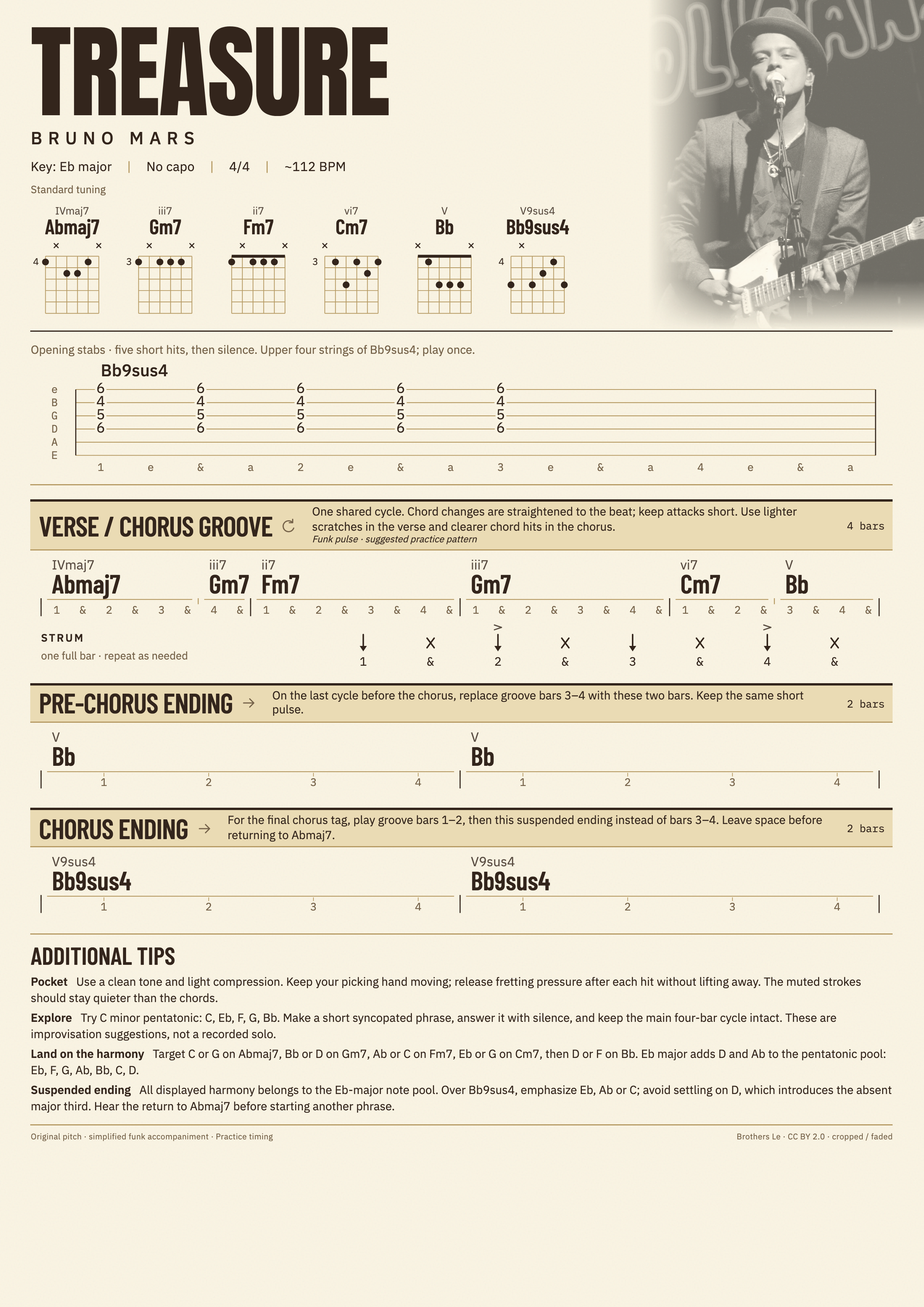
Original pitch · simplified funk accompaniment
No checkout. No sign-up.
On your music stand.
For the print view, choose A4 paper, portrait, 100% scale, no browser headers or footers, and enable background graphics.
Explore the sections freely. The sheet gives you the material; the arrangement is yours.
Sources & musical analysis
Unorthodox Jukebox studio song (2012); guitar practice adaptation
A compact accompaniment study with one core loop, ending substitutions and the opening gesture. Exact recording timing is not claimed.
Research record Collected while preparing this sheet
Collected and visually compared two engraved teaching sources, a section chart and a community grip chart on 2026-09-12. Chose one core loop plus genuine ending substitutions. RSL and Bonedo differ in scratches and extensions, so timing stays an explicit practice adaptation. Rejected the distant stadium artwork after inspection and chose an attributed guitar portrait.
Recording independently checked: No.
Passage fidelity
Verse / chorus groove · Practice adaptation
Preserved: Main harmonic order or distinct ending function.
Changed: Straight beat-boundary chord changes, consistent seventh voicings; suggested eighth-note pulse on the main cycle.
Checked: Read chord chart and compared score visually; counted four units in every bar and checked ending-to-main-cycle boundary. No recording audition.
Pre-chorus ending · Practice adaptation
Preserved: Main harmonic order or distinct ending function.
Changed: Straight beat-boundary chord changes, consistent seventh voicings; suggested eighth-note pulse on the main cycle.
Checked: Read chord chart and compared score visually; counted four units in every bar and checked ending-to-main-cycle boundary. No recording audition.
Chorus ending · Practice adaptation
Preserved: Main harmonic order or distinct ending function.
Changed: Straight beat-boundary chord changes, consistent seventh voicings; suggested eighth-note pulse on the main cycle.
Checked: Read chord chart and compared score visually; counted four units in every bar and checked ending-to-main-cycle boundary. No recording audition.
opening-stabs · Practice adaptation
Preserved: Complete five-attack opening gesture and upper sonority, including silence after the fifth attack.
Changed: Uniform short releases and bass omission; excludes preceding spoken pickup. It is a complete selected bar, not the entire intro timeline.
Checked: Visually compared both PDF opening bars; onset count agrees, release notation differs. Calculated standard-tuning pitches and final-to-next-bar space.
Claim-level evidence
Song · key inferred
Eb-major pitch collection; degrees are relative to Eb, although the loop begins on IV and never rests on I. This is a harmonic reference, not an assertion of an unambiguous tonic.
[1] PDF p.1, opening and section A
Five opening attacks; three-flat signature, 4/4, quarter = 112; syncopated chordal guitar.
[2] Verse / Bridge / Chorus analysis
Four-bar cycle with different final two-bar endings.
Song · tuning adapted
Choose standard E2 A2 D3 G3 B3 E4, no capo. All printed frets sound at the referenced pitch; no transposition.
[4] Chords Used
String labels e–B–G–D–A–E and root-position chord diagrams.
Song · meter inferred
Use four quarter-note units per bar.
[1] PDF p.1, opening and section A
Five opening attacks; three-flat signature, 4/4, quarter = 112; syncopated chordal guitar.
Song · tempo inferred
Use the score’s 112 quarter-note BPM as reference; no independent audio tempo measurement.
[1] PDF p.1, opening and section A
Five opening attacks; three-flat signature, 4/4, quarter = 112; syncopated chordal guitar.
Abmaj7 · harmony inferred
Ab–G–C–Eb; root, major seventh, third, fifth. Degree IVmaj7 uses Eb as I; Bb9sus4 normalizes the thirdless Bb11 / Ab-over-Bb sonority.
[1] PDF p.1, opening and section A
Five opening attacks; three-flat signature, 4/4, quarter = 112; syncopated chordal guitar.
Abmaj7 · voicing adapted
Selected grip low to high: [4, None, 5, 5, 4, None]. Ab–G–C–Eb; root, major seventh, third, fifth. Frets checked against standard tuning; these are playable accompaniment choices, not recorded fingering claims.
[4] Chords Used
String labels e–B–G–D–A–E and root-position chord diagrams.
Gm7 · harmony inferred
G–F–Bb–D; root, minor seventh, minor third, fifth. Degree iii7 uses Eb as I; Bb9sus4 normalizes the thirdless Bb11 / Ab-over-Bb sonority.
[1] PDF p.1, opening and section A
Five opening attacks; three-flat signature, 4/4, quarter = 112; syncopated chordal guitar.
Gm7 · voicing adapted
Selected grip low to high: [3, None, 3, 3, 3, None]. G–F–Bb–D; root, minor seventh, minor third, fifth. Frets checked against standard tuning; these are playable accompaniment choices, not recorded fingering claims.
[4] Chords Used
String labels e–B–G–D–A–E and root-position chord diagrams.
Fm7 · harmony inferred
F–Eb–Ab–C; root, minor seventh, minor third, fifth. Degree ii7 uses Eb as I; Bb9sus4 normalizes the thirdless Bb11 / Ab-over-Bb sonority.
[1] PDF p.1, opening and section A
Five opening attacks; three-flat signature, 4/4, quarter = 112; syncopated chordal guitar.
Fm7 · voicing adapted
Selected grip low to high: [1, None, 1, 1, 1, None]. F–Eb–Ab–C; root, minor seventh, minor third, fifth. Frets checked against standard tuning; these are playable accompaniment choices, not recorded fingering claims.
[4] Chords Used
String labels e–B–G–D–A–E and root-position chord diagrams.
Cm7 · harmony inferred
C–G–Bb–Eb–G; root-position minor seventh. Degree vi7 uses Eb as I; Bb9sus4 normalizes the thirdless Bb11 / Ab-over-Bb sonority.
[1] PDF p.1, opening and section A
Five opening attacks; three-flat signature, 4/4, quarter = 112; syncopated chordal guitar.
Cm7 · voicing adapted
Selected grip low to high: [None, 3, 5, 3, 4, 3]. C–G–Bb–Eb–G; root-position minor seventh. Frets checked against standard tuning; these are playable accompaniment choices, not recorded fingering claims.
[4] Chords Used
String labels e–B–G–D–A–E and root-position chord diagrams.
Bb · harmony inferred
Bb–F–Bb–D; root-position major triad. Degree V uses Eb as I; Bb9sus4 normalizes the thirdless Bb11 / Ab-over-Bb sonority.
[1] PDF p.1, opening and section A
Five opening attacks; three-flat signature, 4/4, quarter = 112; syncopated chordal guitar.
Bb · voicing adapted
Selected grip low to high: [None, 1, 3, 3, 3, None]. Bb–F–Bb–D; root-position major triad. Frets checked against standard tuning; these are playable accompaniment choices, not recorded fingering claims.
[4] Chords Used
String labels e–B–G–D–A–E and root-position chord diagrams.
Bb9sus4 · harmony inferred
Bb–Ab–C–Eb–Bb; root, minor seventh, ninth, fourth, root; third and fifth omitted. Degree V9sus4 uses Eb as I; Bb9sus4 normalizes the thirdless Bb11 / Ab-over-Bb sonority.
[2] Verse / Bridge / Chorus analysis
Four-bar cycle with different final two-bar endings.
Bb9sus4 · voicing adapted
Selected grip low to high: [6, None, 6, 5, 4, 6]. Bb–Ab–C–Eb–Bb; root, minor seventh, ninth, fourth, root; third and fifth omitted. Frets checked against standard tuning; these are playable accompaniment choices, not recorded fingering claims.
[3] Linked PDF, opening bar; article upper-structure paragraph
Five opening hits; upper four strings 6–5–4–6, low to high.
Verse / chorus groove · harmony adapted
Retain the selected harmonic function; standardize minor colors to sevenths and use Bb9sus4 for the suspended tag. Endings are substitutions, not additional loops.
[2] Verse / Bridge / Chorus analysis
Four-bar cycle with different final two-bar endings.
Verse / chorus groove · timing adapted
Practice timing: Abmaj7 3 beats, Gm7 1 beats; Fm7 4 beats; Gm7 4 beats; Cm7 2 beats, Bb 2 beats. Changes are moved to this explicit beat grid; source anticipations and detailed scratches are not transcribed.
[2] Verse / Bridge / Chorus analysis
Four-bar cycle with different final two-bar endings.
[1] PDF p.1, opening and section A
Five opening attacks; three-flat signature, 4/4, quarter = 112; syncopated chordal guitar.
Pre-chorus ending · harmony adapted
Retain the selected harmonic function; standardize minor colors to sevenths and use Bb9sus4 for the suspended tag. Endings are substitutions, not additional loops.
[2] Verse / Bridge / Chorus analysis
Four-bar cycle with different final two-bar endings.
Pre-chorus ending · timing adapted
Practice timing: Bb 4 beats; Bb 4 beats. Changes are moved to this explicit beat grid; source anticipations and detailed scratches are not transcribed.
[2] Verse / Bridge / Chorus analysis
Four-bar cycle with different final two-bar endings.
Chorus ending · harmony adapted
Retain the selected harmonic function; standardize minor colors to sevenths and use Bb9sus4 for the suspended tag. Endings are substitutions, not additional loops.
[2] Verse / Bridge / Chorus analysis
Four-bar cycle with different final two-bar endings.
Chorus ending · timing adapted
Practice timing: Bb9sus4 4 beats; Bb9sus4 4 beats. Changes are moved to this explicit beat grid; source anticipations and detailed scratches are not transcribed.
[2] Verse / Bridge / Chorus analysis
Four-bar cycle with different final two-bar endings.
opening-stabs · pitches adapted
Bb9sus4 upper structure Ab–C–Eb–Bb on strings 4–1; omit bass Bb in the tab, retain it in the accompaniment diagram.
[3] Linked PDF, opening bar; article upper-structure paragraph
Five opening hits; upper four strings 6–5–4–6, low to high.
[1] PDF p.1, opening and section A
Five opening attacks; three-flat signature, 4/4, quarter = 112; syncopated chordal guitar.
opening-stabs · timing adapted
Retain all five onsets at 0, 0.5, 1, 1.5, 2. Choose short 0.25-beat releases on each, then silence to the four-beat boundary. Omit preceding spoken/no-chord pickup.
[3] Linked PDF, opening bar; article upper-structure paragraph
Five opening hits; upper four strings 6–5–4–6, low to high.
[1] PDF p.1, opening and section A
Five opening attacks; three-flat signature, 4/4, quarter = 112; syncopated chordal guitar.
Key & tuning Harmonic interpretation
Use Eb major as the degree reference for this IV-led pitch collection. Standard tuning and no capo preserve concert pitch; tonic ambiguity is not resolved by the key signature alone. [1] [2]
Chord functions
Ab–G–C–Eb; root, major seventh, third, fifth. Degree IVmaj7 is derived from Eb major. [1] [2]
Harmonic interpretationG–F–Bb–D; root, minor seventh, minor third, fifth. Degree iii7 is derived from Eb major. [1] [2]
Harmonic interpretationF–Eb–Ab–C; root, minor seventh, minor third, fifth. Degree ii7 is derived from Eb major. [1] [2]
Harmonic interpretationC–G–Bb–Eb–G; root-position minor seventh. Degree vi7 is derived from Eb major. [1] [2]
Harmonic interpretationMeter, duration & feel Harmonic interpretation
4/4 at quarter = 112. Main cycle lasts sixteen quarters; each ending replaces its last eight quarters. Printed pulse is an authored practice choice, not the recorded strum. [1] [2]
Choosing material for a looper Playing suggestion
Repeat only the complete four-bar core by default. Ending substitutions change the harmony and should not be stacked over the unchanged final two bars. One accompaniment and one optional lead fit two simultaneous layers. [1] [2]
Improvisation choices Playing suggestion
Suggest C minor pentatonic C Eb F G Bb, adding D and Ab from Eb major. Resolve to current chord tones; favor Eb over D on the suspended dominant. No chromatic harmony is introduced by this arrangement. [1] [2]
Cross-checks & arrangement decisions
Chord extensions and tag placement differ across charts.. Use seventh-color accompaniment and Spy Tunes ending structure. Bb9sus4 names the thirdless suspended sound explicitly. Straightened timing remains adapted. [1] [2] [3] [4]
Limits of this edition
- Studio recording not independently auditioned; source scores and lesson text were inspected.
- Main groove anticipations and ghost notes are simplified; displayed practice timing is not a note-for-note transcription.
- Full four-bar guitar riff was researched in both PDFs. Their attacks differ; omitted in favor of the complete opening gesture and a compact harmony map.
- Seventh colors are retained across verse and chorus as an accompaniment choice; the sources vary their upper voices.
- Spoken pickup, exact repeat counts, later breakdown form and final studio ending are outside this compact reference.
Image research & credit
Brothers Le · CC BY 2.0 · cropped / faded
https://commons.wikimedia.org/wiki/File:Bruno_Mars_2010.jpg ↗

Brothers Le; CC BY 2.0 https://creativecommons.org/licenses/by/2.0/. Display cropped, desaturated and faded; attribution retained.
Inspected Houston 2010 concert portrait, before the album era. No same-artist sheet exists. Rejected a distant 2024 stadium view in favor of a readable guitar portrait.
Sources
- Guitar Grade 4 sample — Treasure ↗
Meter, tempo, intro and upper-register harmony.
RSL Awards · Lineage: rockschool-2018 · Published educational score; its arrangement differs from the Bonedo lesson. - Treasure — chord lesson ↗
Shared cycle and distinct phrase endings.
Spy Tunes · Lineage: spytunes-treasure · First-party teaching analysis and chart, with its own voicing discussion; no copying from RSL or Bonedo identified. - Haiko Heinz — Treasure guitar workshop ↗
Opening figure, upper structures and muting.
Bonedo · Lineage: haiko-heinz-treasure · Named teacher with original demonstration and engraved tab; different ghost-note detail from RSL. - Treasure v2 — chord chart ↗
Standard-string labels and accompaniment grips.
Gitaartabs · Lineage: community-treasure-v2 · Community chart of uncertain upstream authorship; used only for grip reference, not independent timing confirmation.