GUITAR / LOOPER-READY SHEET
Travelers
Andrew Prahlow
Outer Wilds · melody, octave voice & counter-melody
No checkout. No sign-up.
On your music stand.
For the print view, choose A4 paper, portrait, 100% scale, no browser headers or footers, and enable background graphics.
Explore the sections freely. The sheet gives you the material; the arrangement is yours.
Sources & musical analysis
Outer Wilds · melody, octave voice & counter-melody
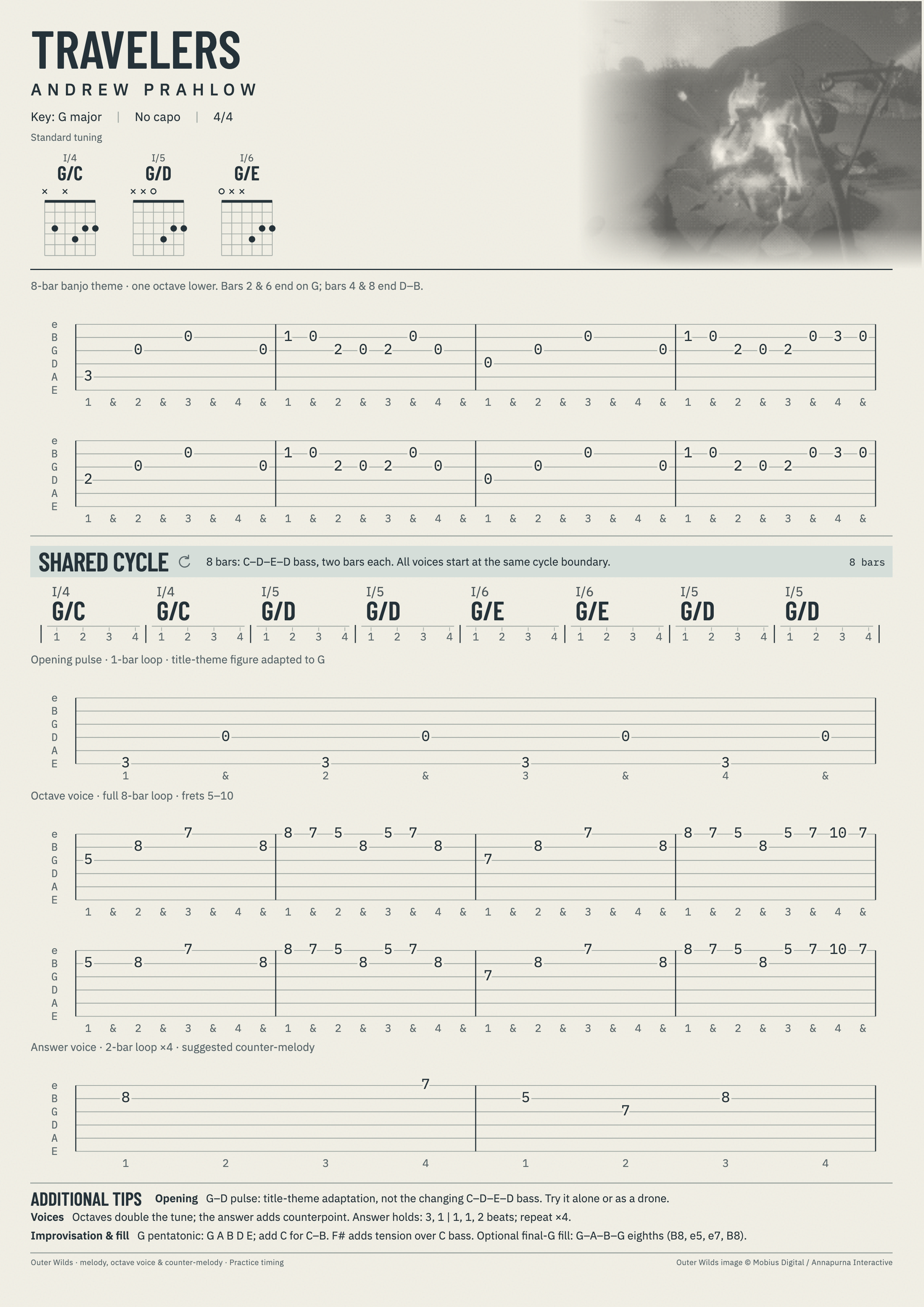
Complete theme in two guitar registers, with an original answering line for polyphonic loop practice.
Research record Collected while preparing this sheet
Compared the complete Riebeck uke pattern with Egglyberts piano medley page 5, bars 123–130, and the Harptabs higher variation. Preserved all eight theme bars and alternate G / D–B endings. The lower guitar tab shifts the source melody down an octave; the upper version restores that octave at frets 5–10. Added a clearly original two-bar counter-melody and a small optional fill, following the user’s request for polyphonic loop options. The bass order remains in one shared harmonic map rather than a redundant sparse tab. No exact Gabbro/Feldspar/Solanum transcription is claimed; these were not sufficiently corroborated. No recording audition was performed. Added the user-requested two-note opening after comparing VGJam title-track Intro with the piano medley Main theme bars 1–2. Source keys A and Ab differ; the common root/fifth figure is deliberately transposed to low G2/D3. This is a cross-theme study option, not verification of an official Travelers intro.
Recording independently checked: No.
Passage fidelity
Shared cycle · Practice adaptation
Preserved: Complete C/D/E/D bass order.
Changed: Optional sustained G-upper harmony and guitar grips.
Checked: Checked 32-beat loop and D→C return; did not equate different-theme A-major tabs with Travelers.
riebeck-theme · Practice adaptation
Preserved: All four source banjo phrases, including the E-start third phrase and alternate final G versus D–B.
Changed: Standard-guitar single-note reduction, source-arrangement timing used; original ringing bass not retained through the whole phrase. Entire melody lowered one octave, to frets 0–3.
Checked: Compared complete uke pitch sequence and medley page 5; checked guitar pitches, phrase endings and full cycle length.
upper-theme · Practice adaptation
Preserved: All eight theme bars, pitch order, alternate endings and onset/duration grid.
Changed: Each lower-tab note raised exactly one octave, using frets 5–10; no invented new instrument theme.
Checked: Calculated EADGBE MIDI pitches and compared every corresponding note at +12 semitones; checked exact rhythm identity.
answer-voice · Practice adaptation
Preserved: The theme’s G-major pitch collection and an eight-beat divisor of its full cycle.
Changed: Entire counter-melody and optional fill authored as study suggestions, not attributed to any in-game instrument.
Checked: Checked guitar pitches, 3+1 / 1+1+2 durations, four repeats per theme and pitch relationships over each two-bar bass region. Not auditioned against the recording.
opening-pulse · Practice adaptation
Preserved: Alternating root/fifth opening gesture and even eighth-note pulse.
Changed: Title-theme reference transposed and lowered to G2/D3 for this Travelers study; one repeatable bar shown, not a claimed recording introduction.
Checked: Compared VGJam intro and piano medley opening; checked A/E versus Ab/Eb source-key difference, G2/D3 guitar pitches, eight onsets and four-beat loop boundary.
Claim-level evidence
Song · key inferred
G-major framework derived from G/B melody and one-sharp score; C-starting bass is not a C-major cadence. Harmonica key label is not treated as tonal proof.
[1] Main four text-tab lines, before Repeat
Uke GCEA pitches give C G B G C B A G A B G; D-start answer ends D B; second half starts E then D. Four phrases repeat.
[2] PDF page 5, Travelers bars 123–130
One-sharp signature and 4/4; C/D/E/D bass spans two bars each. Phrase starts quarter, quarter, dotted quarter, eighth; next bar descends in eighths with alternate ending.
Song · tuning adapted
EADGBE, no capo, chosen for guitar; references are uke and piano. No banjo tuning is imposed.
[1] Main four text-tab lines, before Repeat
Uke GCEA pitches give C G B G C B A G A B G; D-start answer ends D B; second half starts E then D. Four phrases repeat.
[2] PDF page 5, Travelers bars 123–130
One-sharp signature and 4/4; C/D/E/D bass spans two bars each. Phrase starts quarter, quarter, dotted quarter, eighth; next bar descends in eighths with alternate ending.
Song · meter inferred
4/4 taken from piano score; eight-bar guitar phrase retains its bass-change grid.
[2] PDF page 5, Travelers bars 123–130
One-sharp signature and 4/4; C/D/E/D bass spans two bars each. Phrase starts quarter, quarter, dotted quarter, eighth; next bar descends in eighths with alternate ending.
G/C · harmony inferred
G/C: G-major upper triad over C bass; tones C G B D. I/4 means tonic harmony over that scale-degree bass, not an applied dominant. Suggested accompaniment inferred from the theme, not a recorded strummed chord.
[1] Main four text-tab lines, before Repeat
Uke GCEA pitches give C G B G C B A G A B G; D-start answer ends D B; second half starts E then D. Four phrases repeat.
[2] PDF page 5, Travelers bars 123–130
One-sharp signature and 4/4; C/D/E/D bass spans two bars each. Phrase starts quarter, quarter, dotted quarter, eighth; next bar descends in eighths with alternate ending.
G/C · voicing adapted
Guitar grip [None, 3, None, 4, 3, 3] low to high, sounding C G B D; unused strings muted. Full suggested slash-chord grip, no separate featured triad texture.
[1] Main four text-tab lines, before Repeat
Uke GCEA pitches give C G B G C B A G A B G; D-start answer ends D B; second half starts E then D. Four phrases repeat.
[2] PDF page 5, Travelers bars 123–130
One-sharp signature and 4/4; C/D/E/D bass spans two bars each. Phrase starts quarter, quarter, dotted quarter, eighth; next bar descends in eighths with alternate ending.
G/D · harmony inferred
G/D: G-major upper triad over D bass; tones D G B. I/5 means tonic harmony over that scale-degree bass, not an applied dominant. Suggested accompaniment inferred from the theme, not a recorded strummed chord.
[1] Main four text-tab lines, before Repeat
Uke GCEA pitches give C G B G C B A G A B G; D-start answer ends D B; second half starts E then D. Four phrases repeat.
[2] PDF page 5, Travelers bars 123–130
One-sharp signature and 4/4; C/D/E/D bass spans two bars each. Phrase starts quarter, quarter, dotted quarter, eighth; next bar descends in eighths with alternate ending.
G/D · voicing adapted
Guitar grip [None, None, 0, 4, 3, 3] low to high, sounding D G B; unused strings muted. Full suggested slash-chord grip, no separate featured triad texture.
[1] Main four text-tab lines, before Repeat
Uke GCEA pitches give C G B G C B A G A B G; D-start answer ends D B; second half starts E then D. Four phrases repeat.
[2] PDF page 5, Travelers bars 123–130
One-sharp signature and 4/4; C/D/E/D bass spans two bars each. Phrase starts quarter, quarter, dotted quarter, eighth; next bar descends in eighths with alternate ending.
G/E · harmony inferred
G/E: G-major upper triad over E bass; tones E G B D. I/6 means tonic harmony over that scale-degree bass, not an applied dominant. Suggested accompaniment inferred from the theme, not a recorded strummed chord.
[1] Main four text-tab lines, before Repeat
Uke GCEA pitches give C G B G C B A G A B G; D-start answer ends D B; second half starts E then D. Four phrases repeat.
[2] PDF page 5, Travelers bars 123–130
One-sharp signature and 4/4; C/D/E/D bass spans two bars each. Phrase starts quarter, quarter, dotted quarter, eighth; next bar descends in eighths with alternate ending.
G/E · voicing adapted
Guitar grip [0, None, None, 4, 3, 3] low to high, sounding E G B D; unused strings muted. Full suggested slash-chord grip, no separate featured triad texture.
[1] Main four text-tab lines, before Repeat
Uke GCEA pitches give C G B G C B A G A B G; D-start answer ends D B; second half starts E then D. Four phrases repeat.
[2] PDF page 5, Travelers bars 123–130
One-sharp signature and 4/4; C/D/E/D bass spans two bars each. Phrase starts quarter, quarter, dotted quarter, eighth; next bar descends in eighths with alternate ending.
Shared cycle · harmony inferred
C–D–E–D two-bar bass spans are retained; optional G/C–G/D–G/E–G/D upper-triad harmony is an editorial reduction.
[1] Main four text-tab lines, before Repeat
Uke GCEA pitches give C G B G C B A G A B G; D-start answer ends D B; second half starts E then D. Four phrases repeat.
[2] PDF page 5, Travelers bars 123–130
One-sharp signature and 4/4; C/D/E/D bass spans two bars each. Phrase starts quarter, quarter, dotted quarter, eighth; next bar descends in eighths with alternate ending.
Shared cycle · timing adapted
Two 4/4 measures for each bass, eight bars total. This is the chosen guitar grid based on the piano arrangement, not independently verified recording timing.
[1] Main four text-tab lines, before Repeat
Uke GCEA pitches give C G B G C B A G A B G; D-start answer ends D B; second half starts E then D. Four phrases repeat.
[2] PDF page 5, Travelers bars 123–130
One-sharp signature and 4/4; C/D/E/D bass spans two bars each. Phrase starts quarter, quarter, dotted quarter, eighth; next bar descends in eighths with alternate ending.
riebeck-theme · pitches adapted
All four source banjo phrases, including the E-start third phrase and alternate final G versus D–B. Standard-guitar single-note reduction, source-arrangement timing used; original ringing bass not retained through the whole phrase. The complete melody is lowered one octave for frets 0–3; pitch classes and rhythm are unchanged by this register shift.
[1] Main four text-tab lines, before Repeat
Uke GCEA pitches give C G B G C B A G A B G; D-start answer ends D B; second half starts E then D. Four phrases repeat.
[2] PDF page 5, Travelers bars 123–130
One-sharp signature and 4/4; C/D/E/D bass spans two bars each. Phrase starts quarter, quarter, dotted quarter, eighth; next bar descends in eighths with alternate ending.
riebeck-theme · timing adapted
Standard-guitar single-note reduction, source-arrangement timing used; original ringing bass not retained through the whole phrase. Complete eight-bar / 32-beat cycle, with no added final pause. The complete melody is lowered one octave for frets 0–3; pitch classes and rhythm are unchanged by this register shift.
[1] Main four text-tab lines, before Repeat
Uke GCEA pitches give C G B G C B A G A B G; D-start answer ends D B; second half starts E then D. Four phrases repeat.
[2] PDF page 5, Travelers bars 123–130
One-sharp signature and 4/4; C/D/E/D bass spans two bars each. Phrase starts quarter, quarter, dotted quarter, eighth; next bar descends in eighths with alternate ending.
upper-theme · pitches adapted
Every upper-theme MIDI pitch is exactly 12 semitones above the lower featured tab, restoring the source melody register. Same complete four phrases and alternate endings; fingering at frets 5–10 is our EADGBE choice.
[1] Main four text-tab lines, before Repeat
Uke GCEA pitches give C G B G C B A G A B G; D-start answer ends D B; second half starts E then D. Four phrases repeat.
[2] PDF page 5, Travelers bars 123–130
One-sharp signature and 4/4; C/D/E/D bass spans two bars each. Phrase starts quarter, quarter, dotted quarter, eighth; next bar descends in eighths with alternate ending.
upper-theme · timing adapted
Exact copy of all eight lower-theme measures and every onset/duration. Register change does not alter the 32-beat loop or final-to-first boundary. Source arrangement timing remains an adapted guitar presentation.
[1] Main four text-tab lines, before Repeat
Uke GCEA pitches give C G B G C B A G A B G; D-start answer ends D B; second half starts E then D. Four phrases repeat.
[2] PDF page 5, Travelers bars 123–130
One-sharp signature and 4/4; C/D/E/D bass spans two bars each. Phrase starts quarter, quarter, dotted quarter, eighth; next bar descends in eighths with alternate ending.
answer-voice · pitches adapted
Original counter-melody, not a source transcription: G4 B4 | E4 D4 G4. Chosen from the theme’s pitch collection for independent sustained motion. Optional final G4 A4 B4 G4 uses B-string 8, high-e 5/7, B-string 8. Source citations establish the underlying theme/bass only, not this authored line.
[1] Main four text-tab lines, before Repeat
Uke GCEA pitches give C G B G C B A G A B G; D-start answer ends D B; second half starts E then D. Four phrases repeat.
[2] PDF page 5, Travelers bars 123–130
One-sharp signature and 4/4; C/D/E/D bass spans two bars each. Phrase starts quarter, quarter, dotted quarter, eighth; next bar descends in eighths with alternate ending.
answer-voice · timing adapted
Authored two-bar 4/4 pattern: G at beat 1 for 3 beats, B at beat 4 for 1; then E at beat 1 for 1, D at beat 2 for 1, G at beat 3 for 2. Four repeats fill the 32-beat theme. Optional four-eighth-note fill replaces the final two-beat G, without lengthening the loop.
[1] Main four text-tab lines, before Repeat
Uke GCEA pitches give C G B G C B A G A B G; D-start answer ends D B; second half starts E then D. Four phrases repeat.
[2] PDF page 5, Travelers bars 123–130
One-sharp signature and 4/4; C/D/E/D bass spans two bars each. Phrase starts quarter, quarter, dotted quarter, eighth; next bar descends in eighths with alternate ending.
opening-pulse · pitches adapted
Adapt the independently documented title-theme root/fifth figure to G2–D3. Relative to VGJam A3–E4 this is down 14 semitones; piano medley Ab3–Eb4 confirms the gesture in another key. EADGBE bass fingering is low-E fret 3 and open D. Not claimed as the official Travelers opening.
[4] Intro, first Guitar 1 system; standard tuning declaration
Repeated G-string 2 / high-e 0 gives A3–E4, four alternations in each bar; page identifies soundtrack track 02, Outer Wilds.
[2] PDF page 1, Main theme, bars 1–2
Piano opening alternates Ab3–Eb4 as eighth notes in the four-flat arrangement. Same root/fifth gesture, different key; not the Travelers section on page 5.
opening-pulse · timing adapted
One complete 4/4 cell: eight even eighth notes, alternating G/D at 0, .5, 1, 1.5, 2, 2.5, 3, 3.5. Four root/fifth pairs; repeats in four beats, eight repeats span the full 32-beat theme. No exact soundtrack intro length asserted.
[4] Intro, first Guitar 1 system; standard tuning declaration
Repeated G-string 2 / high-e 0 gives A3–E4, four alternations in each bar; page identifies soundtrack track 02, Outer Wilds.
[2] PDF page 1, Main theme, bars 1–2
Piano opening alternates Ab3–Eb4 as eighth notes in the four-flat arrangement. Same root/fifth gesture, different key; not the Travelers section on page 5.
Key & tuning Harmonic interpretation
G-major pitch framework: one-sharp score and G/B-centred melody, with C–D–E–D bass. Harptabs Key C names the harmonica, not sufficient proof of song tonic. Standard EADGBE and no capo; source pitch classes preserved. [1] [2] [3]
Chord functions
G/C: G-major upper triad over C bass; tones C G B D. I/4 means tonic harmony over that scale-degree bass, not an applied dominant. Suggested accompaniment inferred from the theme, not a recorded strummed chord. [1] [2]
Harmonic interpretationMeter, duration & feel Harmonic interpretation
Eight 4/4 bars for each theme voicing, with identical onset/duration patterns; bass changes every two bars. The original study answer lasts two bars: durations 3+1 | 1+1+2. Four repeats align with the theme. Its optional final G–A–B–G fill uses four eighth notes over the last two beats. This is adapted guitar timing based on the inspected piano arrangement, not verified recording timing. Opening pulse: one bar of eight even eighth notes, four G/D pairs; intro repeat count is free. [1] [2] [3]
Choosing material for a looper Playing suggestion
The low and high themes are an exact octave apart and make octave doubling, not independent counterpoint. Pair either theme with the original answer for polyphonic motion. The two-bar answer divides the eight-bar theme four times; both begin at phase zero. The answer uses G/B common upper tones plus E and D as diatonic colours. No third simultaneous track or prescribed recording sequence is needed. The one-bar opening pulse repeats eight times per theme cycle. It is a static G/D pedal, not the C/D/E/D bass line: pairing it changes the bass colour, especially in C and E regions. It can stand alone as an opening or be explored under a melody. [1] [2] [3]
Improvisation choices Playing suggestion
G major G A B C D E F#, starting with pentatonic G A B D E. The original answer G4–B4 | E4–D4–G4 introduces a longer rhythmic contour against the moving theme. E over C is its third, over D a ninth and over E its root; D is a ninth over C and a seventh over E. Those are intentional colours, not a claim that every vertical interval is consonant. Suggested G–A–B–G eighth-note fill decorates the final held G; keep the two-bar boundary intact. [1] [2] [3]
Cross-checks & arrangement decisions
Arrangement and tuning. G-major pitch framework: one-sharp score and G/B-centred melody, with C–D–E–D bass. Harptabs Key C names the harmonica, not sufficient proof of song tonic. Standard EADGBE and no capo; source pitch classes preserved. [1] [2] [3]
Two-note opening attribution. Both references place the root/fifth pulse in the title theme, in A and Ab respectively. Added a G2/D3 practice adaptation; not labelled an official Travelers intro. [4] [2]
Limits of this edition
- Score/tab research only; no recording audition was performed.
- Guitar fingering and accompaniment are study adaptations, not a complete performance transcription.
- The answer voice and optional fill are original study suggestions, not in-game instrument transcriptions.
- Official artwork is retained for local study; its source is not an open publication license.
Image research & credit
Outer Wilds image © Mobius Digital / Annapurna Interactive
https://www.mobiusdigitalgames.com/outer-wilds.html ↗
Official website campfire GIF, first frame extracted and faded. Copyright Mobius Digital / Annapurna; not openly licensed. Local study use; no endorsement or blanket publication permission claimed.
An actual traveler’s campfire connects to the ensemble theme without showing ending spoilers. First image for this game in the library.
Sources
- Travelers — Riebeck’s Banjo ↗
Complete repeated pitch pattern and C–D–E–D phrase-start bass; rhythm is not fully encoded.
Ukulele Tabs · Lineage: uke-travelers-73609 · Independently authored reference; shared composition is not a copied transcription. No mirror counted as corroboration. - Outer Wilds medley for solo piano, page 5 ↗
Travelers section: G-major signature, four-beat meter, C/D/E/D bass spans; bars 123–130 show the banjo melody rhythm.
Egglyberts · Lineage: egglyberts-piano-medley · Independently authored reference; shared composition is not a copied transcription. No mirror counted as corroboration. - Outer Wilds (Travelers), Phisko ↗
Higher-pitched variation supports characteristic G–B and C–B–A–G motion; incomplete bass cycle, no precise rhythm.
Harptabs · Lineage: phisko-travelers · Independently authored reference; shared composition is not a copied transcription. No mirror counted as corroboration. - Outer Wilds — title-track guitar tab, Deezer ↗
Intro Guitar 1 alternates G-string fret 2 (A3) and open high E (E4), eight evenly spaced attacks per displayed bar. Different piece from Travelers.
VideoGameJam · Lineage: deezer-vgjam-outer-wilds · Deezer’s independently authored standard-guitar tab; distinct from Egglyberts piano medley and the Travelers uke tab.