GUITAR / LOOPER-READY SHEET
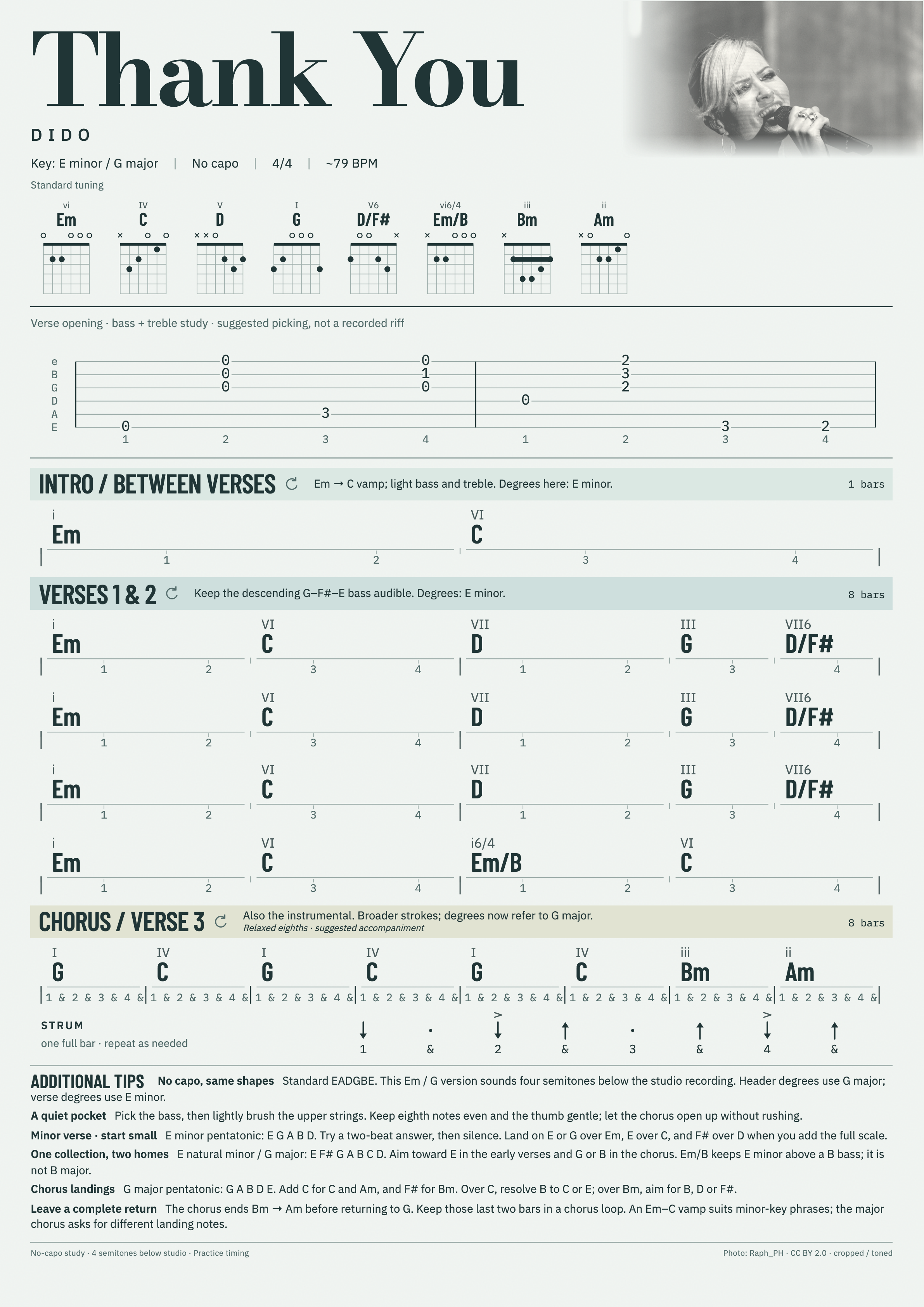
Thank You
Dido
No-capo study · 4 semitones below studio
No checkout. No sign-up.
On your music stand.
For the print view, choose A4 paper, portrait, 100% scale, no browser headers or footers, and enable background graphics.
Explore the sections freely. The sheet gives you the material; the arrangement is yours.
Sources & musical analysis
Dido — Thank You, No Angel studio song; transposed acoustic practice arrangement
Standard-tuning, no-capo Em/G acoustic study. Minor and relative-major material separated; rhythm suggestions explicitly adapted.
Research record Collected while preparing this sheet
Compared the inspected anonymous chord chart with independent Hooktheory key/meter statistics and indexed JustinGuitar capo guidance. Selected no-capo transposition following user preference. Normalized complete sections and inversions, derived chord tones and local Roman degrees, then authored clearly labelled accompaniment suggestions. Sought guitar lesson/tab material; no reliable complete lead phrase established, so no filler solo. Artwork inspected separately via Commons metadata and original image.
Recording independently checked: No.
Passage fidelity
Intro / between verses · Practice adaptation
Preserved: Section chord order, inversions and minor-to-relative-major contrast.
Changed: No capo, four semitones below studio; optional G/B fills omitted. Em 2 beats + C 2 beats. Even practice timing; chorus strum is a suggestion.
Checked: Inspected text-chart groupings and key/meter statistics; calculated chord tones and bar totals. Recording not auditioned.
Verses 1 & 2 · Practice adaptation
Preserved: Section chord order, inversions and minor-to-relative-major contrast.
Changed: No capo, four semitones below studio; optional G/B fills omitted. Em 2 beats + C 2 beats | D 2 beats + G 1 beats + D/F# 1 beats | Em 2 beats + C 2 beats | D 2 beats + G 1 beats + D/F# 1 beats | Em 2 beats + C 2 beats | D 2 beats + G 1 beats + D/F# 1 beats | Em 2 beats + C 2 beats | Em/B 2 beats + C 2 beats. Even practice timing; chorus strum is a suggestion.
Checked: Inspected text-chart groupings and key/meter statistics; calculated chord tones and bar totals. Recording not auditioned.
Chorus / verse 3 · Practice adaptation
Preserved: Section chord order, inversions and minor-to-relative-major contrast.
Changed: No capo, four semitones below studio; optional G/B fills omitted. G 4 beats | C 4 beats | G 4 beats | C 4 beats | G 4 beats | C 4 beats | Bm 4 beats | Am 4 beats. Even practice timing; chorus strum is a suggestion.
Checked: Inspected text-chart groupings and key/meter statistics; calculated chord tones and bar totals. Recording not auditioned.
verse-accompaniment · Practice adaptation
Preserved: Complete opening harmonic cell and G–F# bass lead back to E.
Changed: A bass/treble study replaces unverified guitar attacks; two full bars, no studio-riff claim.
Checked: Matched notes to diagrams and checked eight quarter units; no recording audition.
Claim-level evidence
Song · key adapted
Transpose the source G# minor / B major down four semitones to E minor / G major by using Em/G shapes without capo, as requested.
[2] Song Stats — Verse / All Sections
G# minor and B major; 79 BPM; 4/4.
[3] Indexed lesson introduction
Capo fret 4 specified to play in the original key. Full lesson and video not inspected.
[1] Verse and chorus chord chart
Em/C opening, D/G/D-F# continuation, Em/B close; later G/C cycle ends Bm/Am.
Song · tuning adapted
Choose standard EADGBE, no capo; fret pitches are sounding pitches in the transposed arrangement.
[1] Chart controls
Standard EADGBE shown; capo OFF is a chart UI setting, not proof of studio tuning.
[3] Indexed lesson introduction
Capo fret 4 specified to play in the original key. Full lesson and video not inspected.
Song · meter inferred
Use the 4/4 meter reported by the TheoryTab analysis.
[2] Song Stats — Verse / All Sections
G# minor and B major; 79 BPM; 4/4.
Song · tempo inferred
Approximate practice tempo 79 quarter-note BPM from TheoryTab; not independently measured.
[2] Song Stats — Verse / All Sections
G# minor and B major; 79 BPM; 4/4.
Em · harmony inferred
Em contains E G B; derived from the selected Em/G chart and local scale centers.
[1] Verse and chorus chord chart
Em/C opening, D/G/D-F# continuation, Em/B close; later G/C cycle ends Bm/Am.
Em · voicing adapted
Authored standard-tuning grip, low to high: [0, 2, 2, 0, 0, 0]. Calculated each sounding pitch against E G B. D/F# keeps the high string muted to avoid the source alternative adding E.
[1] Verse and chorus chord chart
Em/C opening, D/G/D-F# continuation, Em/B close; later G/C cycle ends Bm/Am.
C · harmony inferred
C contains C E G; derived from the selected Em/G chart and local scale centers.
[1] Verse and chorus chord chart
Em/C opening, D/G/D-F# continuation, Em/B close; later G/C cycle ends Bm/Am.
C · voicing adapted
Authored standard-tuning grip, low to high: [None, 3, 2, 0, 1, 0]. Calculated each sounding pitch against C E G. D/F# keeps the high string muted to avoid the source alternative adding E.
[1] Verse and chorus chord chart
Em/C opening, D/G/D-F# continuation, Em/B close; later G/C cycle ends Bm/Am.
D · harmony inferred
D contains D F# A; derived from the selected Em/G chart and local scale centers.
[1] Verse and chorus chord chart
Em/C opening, D/G/D-F# continuation, Em/B close; later G/C cycle ends Bm/Am.
D · voicing adapted
Authored standard-tuning grip, low to high: [None, None, 0, 2, 3, 2]. Calculated each sounding pitch against D F# A. D/F# keeps the high string muted to avoid the source alternative adding E.
[1] Verse and chorus chord chart
Em/C opening, D/G/D-F# continuation, Em/B close; later G/C cycle ends Bm/Am.
G · harmony inferred
G contains G B D; derived from the selected Em/G chart and local scale centers.
[1] Verse and chorus chord chart
Em/C opening, D/G/D-F# continuation, Em/B close; later G/C cycle ends Bm/Am.
G · voicing adapted
Authored standard-tuning grip, low to high: [3, 2, 0, 0, 0, 3]. Calculated each sounding pitch against G B D. D/F# keeps the high string muted to avoid the source alternative adding E.
[1] Verse and chorus chord chart
Em/C opening, D/G/D-F# continuation, Em/B close; later G/C cycle ends Bm/Am.
D/F# · harmony inferred
D/F# contains F# A D; first inversion of D; derived from the selected Em/G chart and local scale centers.
[1] Verse and chorus chord chart
Em/C opening, D/G/D-F# continuation, Em/B close; later G/C cycle ends Bm/Am.
D/F# · voicing adapted
Authored standard-tuning grip, low to high: [2, 0, 0, 2, 3, None]. Calculated each sounding pitch against F# A D; first inversion of D. D/F# keeps the high string muted to avoid the source alternative adding E.
[1] Verse and chorus chord chart
Em/C opening, D/G/D-F# continuation, Em/B close; later G/C cycle ends Bm/Am.
Em/B · harmony inferred
Em/B contains B E G; second inversion of Em; derived from the selected Em/G chart and local scale centers.
[1] Verse and chorus chord chart
Em/C opening, D/G/D-F# continuation, Em/B close; later G/C cycle ends Bm/Am.
Em/B · voicing adapted
Authored standard-tuning grip, low to high: [None, 2, 2, 0, 0, 0]. Calculated each sounding pitch against B E G; second inversion of Em. D/F# keeps the high string muted to avoid the source alternative adding E.
[1] Verse and chorus chord chart
Em/C opening, D/G/D-F# continuation, Em/B close; later G/C cycle ends Bm/Am.
Bm · harmony inferred
Bm contains B D F#; derived from the selected Em/G chart and local scale centers.
[1] Verse and chorus chord chart
Em/C opening, D/G/D-F# continuation, Em/B close; later G/C cycle ends Bm/Am.
Bm · voicing adapted
Authored standard-tuning grip, low to high: [None, 2, 4, 4, 3, 2]. Calculated each sounding pitch against B D F#. D/F# keeps the high string muted to avoid the source alternative adding E.
[1] Verse and chorus chord chart
Em/C opening, D/G/D-F# continuation, Em/B close; later G/C cycle ends Bm/Am.
Am · harmony inferred
Am contains A C E; derived from the selected Em/G chart and local scale centers.
[1] Verse and chorus chord chart
Em/C opening, D/G/D-F# continuation, Em/B close; later G/C cycle ends Bm/Am.
Am · voicing adapted
Authored standard-tuning grip, low to high: [None, 0, 2, 2, 1, 0]. Calculated each sounding pitch against A C E. D/F# keeps the high string muted to avoid the source alternative adding E.
[1] Verse and chorus chord chart
Em/C opening, D/G/D-F# continuation, Em/B close; later G/C cycle ends Bm/Am.
Intro / between verses · harmony adapted
Retain source chord sequence for this location; omit optional passing G/B embellishments. Third verse uses the major chorus cycle.
[1] Verse and chorus chord chart
Em/C opening, D/G/D-F# continuation, Em/B close; later G/C cycle ends Bm/Am.
Intro / between verses · timing adapted
Chosen practice timing: Em 2 beats + C 2 beats. Source bar grouping guides this study; split-bar subdivisions and strumming are authored, not recording-verified.
[1] Verse and chorus chord chart
Em/C opening, D/G/D-F# continuation, Em/B close; later G/C cycle ends Bm/Am.
Verses 1 & 2 · harmony adapted
Retain source chord sequence for this location; omit optional passing G/B embellishments. Third verse uses the major chorus cycle.
[1] Verse and chorus chord chart
Em/C opening, D/G/D-F# continuation, Em/B close; later G/C cycle ends Bm/Am.
Verses 1 & 2 · timing adapted
Chosen practice timing: Em 2 beats + C 2 beats | D 2 beats + G 1 beats + D/F# 1 beats | Em 2 beats + C 2 beats | D 2 beats + G 1 beats + D/F# 1 beats | Em 2 beats + C 2 beats | D 2 beats + G 1 beats + D/F# 1 beats | Em 2 beats + C 2 beats | Em/B 2 beats + C 2 beats. Source bar grouping guides this study; split-bar subdivisions and strumming are authored, not recording-verified.
[1] Verse and chorus chord chart
Em/C opening, D/G/D-F# continuation, Em/B close; later G/C cycle ends Bm/Am.
Chorus / verse 3 · harmony adapted
Retain source chord sequence for this location; omit optional passing G/B embellishments. Third verse uses the major chorus cycle.
[1] Verse and chorus chord chart
Em/C opening, D/G/D-F# continuation, Em/B close; later G/C cycle ends Bm/Am.
Chorus / verse 3 · timing adapted
Chosen practice timing: G 4 beats | C 4 beats | G 4 beats | C 4 beats | G 4 beats | C 4 beats | Bm 4 beats | Am 4 beats. Source bar grouping guides this study; split-bar subdivisions and strumming are authored, not recording-verified.
[1] Verse and chorus chord chart
Em/C opening, D/G/D-F# continuation, Em/B close; later G/C cycle ends Bm/Am.
verse-accompaniment · pitches adapted
A complete two-bar bass/treble accompaniment to Em C | D G D/F#. Notes calculated from header grips; intentionally an authored picking study, not a transcription.
[1] Verse and chorus chord chart
Em/C opening, D/G/D-F# continuation, Em/B close; later G/C cycle ends Bm/Am.
verse-accompaniment · timing adapted
Two 4/4 practice bars. Em and C take two beats each, D two, G and D/F# one each. Bass on each change, upper strings on the next beat of the two-beat chords; no invented claim of recorded attacks.
[1] Verse and chorus chord chart
Em/C opening, D/G/D-F# continuation, Em/B close; later G/C cycle ends Bm/Am.
Key & tuning Harmonic interpretation
Studio G# minor/B major becomes E minor/G major without the lesson capo 4. Standard tuning. Header degrees refer to G major; early verse degrees to E minor. [1] [2] [3]
Chord functions
Em: E G B. vi uses G major header/chorus center. Both centers share E F# G A B C D; inversions retain chord quality. [1] [2]
Harmonic interpretationEm: E G B. i uses E minor verse center. Both centers share E F# G A B C D; inversions retain chord quality. [1] [2]
Harmonic interpretationC: C E G. IV uses G major header/chorus center. Both centers share E F# G A B C D; inversions retain chord quality. [1] [2]
Harmonic interpretationC: C E G. VI uses E minor verse center. Both centers share E F# G A B C D; inversions retain chord quality. [1] [2]
Harmonic interpretationD: D F# A. V uses G major header/chorus center. Both centers share E F# G A B C D; inversions retain chord quality. [1] [2]
Harmonic interpretationD: D F# A. VII uses E minor verse center. Both centers share E F# G A B C D; inversions retain chord quality. [1] [2]
Harmonic interpretationG: G B D. I uses G major header/chorus center. Both centers share E F# G A B C D; inversions retain chord quality. [1] [2]
Harmonic interpretationG: G B D. III uses E minor verse center. Both centers share E F# G A B C D; inversions retain chord quality. [1] [2]
Harmonic interpretationD/F#: F# A D; first inversion of D. V6 uses G major header/chorus center. Both centers share E F# G A B C D; inversions retain chord quality. [1] [2]
Harmonic interpretationD/F#: F# A D; first inversion of D. VII6 uses E minor verse center. Both centers share E F# G A B C D; inversions retain chord quality. [1] [2]
Harmonic interpretationEm/B: B E G; second inversion of Em. vi6/4 uses G major header/chorus center. Both centers share E F# G A B C D; inversions retain chord quality. [1] [2]
Harmonic interpretationEm/B: B E G; second inversion of Em. i6/4 uses E minor verse center. Both centers share E F# G A B C D; inversions retain chord quality. [1] [2]
Harmonic interpretationMeter, duration & feel Harmonic interpretation
4/4 at about 79 quarter-note BPM; one-bar intro vamp, eight-bar early verses and eight-bar chorus cycle. Text grouping retained; internal durations and accompaniment attacks are explicit practice choices. [1] [2]
Choosing material for a looper Playing suggestion
Use the full minor verse or major chorus as separate harmonic cycles; retain Bm–Am at the chorus return. Em–C alone is a smaller vamp. No more than two concurrent layers are needed; no prescribed performance. [1] [2]
Improvisation choices Playing suggestion
E minor pentatonic E G A B D suits the verse as a starting point; G major pentatonic G A B D E shifts the tonal emphasis for chorus. Add F# and C from the shared diatonic collection to target D, Bm, C and Am. These are authored suggestions, not a recorded solo. [1] [2]
Cross-checks & arrangement decisions
Original pitch versus no-capo preference. G# minor/B major and capo 4 agree with Em/G shapes. Remove capo: E minor/G major, four semitones down. [2] [3] [1]
Verse closing bass and major third verse. Select Em/B at the verse close and the later G/C chorus harmony. Preserve the distinction from early verses; exact attacks remain adapted. [1] [2]
Limits of this edition
- Recording and lesson video were not auditioned. Chart timing is regularized for practice, not a studio transcription.
- JustinGuitar consultation was limited to indexed introductory text. Hooktheory statistics support key/meter, not exact guitar parts.
- No independent complete guitar riff/solo transcription was verified. Omit lead tabs for evidence/relevance, not page space; provide improvisation advice.
Image research & credit
Photo: Raph_PH · CC BY 2.0 · cropped / toned
https://commons.wikimedia.org/wiki/File:DidoHamm081219-31_(49217719046)_(cropped).jpg ↗

Raph_PH, CC BY 2.0 https://creativecommons.org/licenses/by/2.0/; Commons cropped derivative of https://www.flickr.com/photos/raph_ph/49217719046/. Desaturated and faded in this sheet.
Inspected licensed portrait of Dido. Hammersmith, 8 December 2019; identifies the artist, not an image from the original recording era.
Sources
- Thank You — community chord chart ↗
Em/G chord order, verse inversions, later major-harmony verse and bar groupings.
Songsterr · Lineage: anonymous-thank-you-em-chart · Anonymous chart; any mirrors of this arrangement count as the same origin. - Thank You — TheoryTab analysis ↗
G# minor verse, B major chorus, 79 quarter-note BPM and 4/4; no exact guitar voicing claim.
Hooktheory · Lineage: hooktheory-thank-you-analysis · Separate community harmonic analysis with key, tempo and meter statistics, not the anonymous text chart. - Thank You — Justin Sandercoe guitar lesson ↗
Capo fret 4 for original key; limited contextual corroboration, not passage timing.
JustinGuitar · Lineage: justin-sandercoe-thank-you-lesson · Independently authored guitar teaching. Only search-indexed lesson text consulted; video not auditioned.