GUITAR / LOOPER-READY SHEET
Take Me Out
Franz Ferdinand
2004 studio song · simplified guitar map · A440
No checkout. No sign-up.
On your music stand.
For the print view, choose A4 paper, portrait, 100% scale, no browser headers or footers, and enable background graphics.
Explore the sections freely. The sheet gives you the material; the arrangement is yours.
Sources & musical analysis
Franz Ferdinand — Take Me Out, 2004 studio release; selected practice arrangement
E-minor single-guitar practice map with an untimed full riff cycle; layered harmony simplified, recording not auditioned.
Research record Collected while preparing this sheet
Inspected independent publisher analysis and community tab with different authorship and arrangements. Visually inspected the source riff PNG and licensed live photo. Chose a bounded single-guitar map, retaining the full selected riff variant and documenting source disagreements before rendering.
Recording independently checked: No.
Passage fidelity
Opening verse · Practice adaptation
Preserved: Root-position Am–D–G–Bm–Em reduction of the bass-aware verse cell.
Changed: Four 4/4 bars: Am 4, D 4, G 2 + Bm 2, Em 4 quarter-note units. Root-position grips replace layered voicings.
Checked: Compared the cited chart passages; checked chord tones and measure sums by calculation. No recording audition.
Main riff / vocal groove · Practice adaptation
Preserved: Em–Em–Am–Bm triadic reduction; seventh extensions omitted.
Changed: Four 4/4 bars: Em 4, Em 4, Am 4, Bm 4. Suggested straight eighths are authored practice accompaniment. Root-position grips replace layered voicings.
Checked: Compared the cited chart passages; checked chord tones and measure sums by calculation. No recording audition.
Bridge · Practice adaptation
Preserved: Am–C–D simplified chord layer; no moving-bass reconstruction.
Changed: Two 4/4 bars: Am 4, C 2 + D 2. Chosen practice allocation, not verified recorded changes. Root-position grips replace layered voicings.
Checked: Compared the cited chart passages; checked chord tones and measure sums by calculation. No recording audition.
signature-riff · Practice adaptation
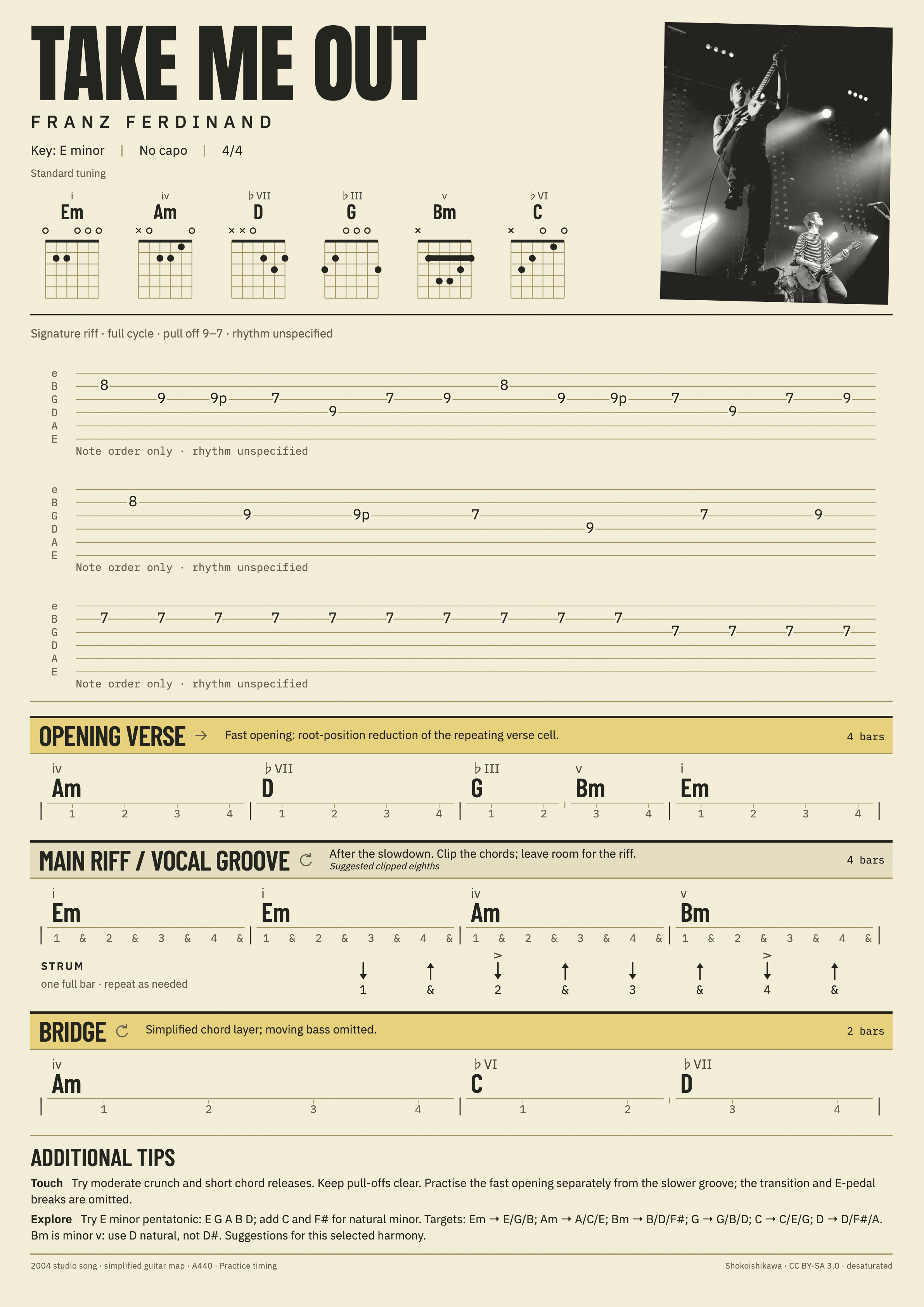
Preserved: All four pitch groups and complete fourteen-note ending of selected Spy Tunes variant; three 9-to-7 pull-offs.
Changed: Timing removed rather than invented; Cifra’s extra second-motif repeated notes are not combined into this variant.
Checked: Visually inspected the entire four-bar source PNG and compared Cifra Riff 1, including phrase endings. No audio check.
Claim-level evidence
Song · key inferred
E minor is the selected tonal center from recurring Em and minor-v Bm. Cifra’s G label is the relative-major signature, not evidence of a G tonic.
[1] Chord Progressions — Riff / Chorus
Four-bar cycle Em7, Em7, Am7, Bm.
[2] Segunda Parte / Terceira Parte
Vocal harmony uses Em, Am and Bm.
Song · tuning adapted
Standard EADGBE, no capo, A440. No transposition of named notes. The recording’s exact reference pitch was not checked.
[2] Tuning and capo controls
Standard; no capo.
[1] Backing Track — Chord Analysis
Publisher advises A443 for original-recording playback; own backing track is A440.
Song · meter inferred
Use 4/4 as implied by the beamed riff notation and four-bar harmonic grouping; not independently checked against audio.
[1] TAB — Riff image
Full bars contain rests and beamed eighth/sixteenth values consistent with four quarter notes.
Em · harmony inferred
Em: i relative to E natural minor. Chord tones derived from the named source harmony; seventh extensions and slash basses are omitted.
[1] Chord Progressions — Riff / Chorus
Four-bar cycle Em7, Em7, Am7, Bm.
[2] Segunda Parte / Terceira Parte
Vocal harmony uses Em, Am and Bm.
Em · voicing adapted
Chosen playable accompaniment grip, not a recorded-voicing claim. Standard-tuning pitches low to high: E–B–E–G–B–E. Unused strings muted; Bm uses a second-fret barre.
[1] Chord Progressions — Riff / Chorus
Four-bar cycle Em7, Em7, Am7, Bm.
[2] Segunda Parte / Terceira Parte
Vocal harmony uses Em, Am and Bm.
Am · harmony inferred
Am: iv relative to E natural minor. Chord tones derived from the named source harmony; seventh extensions and slash basses are omitted.
[1] Chord Progressions — Riff / Chorus
Four-bar cycle Em7, Em7, Am7, Bm.
[2] Segunda Parte / Terceira Parte
Vocal harmony uses Em, Am and Bm.
Am · voicing adapted
Chosen playable accompaniment grip, not a recorded-voicing claim. Standard-tuning pitches low to high: A–E–A–C–E. Unused strings muted; Bm uses a second-fret barre.
[1] Chord Progressions — Riff / Chorus
Four-bar cycle Em7, Em7, Am7, Bm.
[2] Segunda Parte / Terceira Parte
Vocal harmony uses Em, Am and Bm.
D · harmony inferred
D: ♭VII relative to E natural minor. Chord tones derived from the named source harmony; seventh extensions and slash basses are omitted.
[1] Intro + Verse
Four-bar verse cell Am7, D/F#, G then Bm/F#, Em.
[2] Introdução — Guitarra 1 / Guitarra 2
Interlocking single-note guitar lines rather than a complete chord chart.
D · voicing adapted
Chosen playable accompaniment grip, not a recorded-voicing claim. Standard-tuning pitches low to high: D–A–D–F#. Unused strings muted; Bm uses a second-fret barre.
[1] Intro + Verse
Four-bar verse cell Am7, D/F#, G then Bm/F#, Em.
[2] Introdução — Guitarra 1 / Guitarra 2
Interlocking single-note guitar lines rather than a complete chord chart.
G · harmony inferred
G: ♭III relative to E natural minor. Chord tones derived from the named source harmony; seventh extensions and slash basses are omitted.
[1] Intro + Verse
Four-bar verse cell Am7, D/F#, G then Bm/F#, Em.
[2] Introdução — Guitarra 1 / Guitarra 2
Interlocking single-note guitar lines rather than a complete chord chart.
G · voicing adapted
Chosen playable accompaniment grip, not a recorded-voicing claim. Standard-tuning pitches low to high: G–B–D–G–B–G. Unused strings muted; Bm uses a second-fret barre.
[1] Intro + Verse
Four-bar verse cell Am7, D/F#, G then Bm/F#, Em.
[2] Introdução — Guitarra 1 / Guitarra 2
Interlocking single-note guitar lines rather than a complete chord chart.
Bm · harmony inferred
Bm: v relative to E natural minor. Chord tones derived from the named source harmony; seventh extensions and slash basses are omitted.
[1] Chord Progressions — Riff / Chorus
Four-bar cycle Em7, Em7, Am7, Bm.
[2] Segunda Parte / Terceira Parte
Vocal harmony uses Em, Am and Bm.
Bm · voicing adapted
Chosen playable accompaniment grip, not a recorded-voicing claim. Standard-tuning pitches low to high: B–F#–B–D–F#. Unused strings muted; Bm uses a second-fret barre.
[1] Chord Progressions — Riff / Chorus
Four-bar cycle Em7, Em7, Am7, Bm.
[2] Segunda Parte / Terceira Parte
Vocal harmony uses Em, Am and Bm.
C · harmony inferred
C: ♭VI relative to E natural minor. Chord tones derived from the named source harmony; seventh extensions and slash basses are omitted.
[1] Middle 8
Descending then ascending bass with several slash-chord names.
[2] Ponte
Chord layer Am, C, D above moving bass tab.
C · voicing adapted
Chosen playable accompaniment grip, not a recorded-voicing claim. Standard-tuning pitches low to high: C–E–G–C–E. Unused strings muted; Bm uses a second-fret barre.
[1] Middle 8
Descending then ascending bass with several slash-chord names.
[2] Ponte
Chord layer Am, C, D above moving bass tab.
Opening verse · harmony adapted
Root-position Am–D–G–Bm–Em reduction of the bass-aware verse cell.
[1] Intro + Verse
Four-bar verse cell Am7, D/F#, G then Bm/F#, Em.
[2] Introdução — Guitarra 1 / Guitarra 2
Interlocking single-note guitar lines rather than a complete chord chart.
Opening verse · timing adapted
Four 4/4 bars: Am 4, D 4, G 2 + Bm 2, Em 4 quarter-note units.
[1] Intro + Verse
Four-bar verse cell Am7, D/F#, G then Bm/F#, Em.
[2] Introdução — Guitarra 1 / Guitarra 2
Interlocking single-note guitar lines rather than a complete chord chart.
Main riff / vocal groove · harmony adapted
Em–Em–Am–Bm triadic reduction; seventh extensions omitted.
[1] Chord Progressions — Riff / Chorus
Four-bar cycle Em7, Em7, Am7, Bm.
[2] Segunda Parte / Terceira Parte
Vocal harmony uses Em, Am and Bm.
Main riff / vocal groove · timing adapted
Four 4/4 bars: Em 4, Em 4, Am 4, Bm 4. Suggested straight eighths are authored practice accompaniment.
[1] Chord Progressions — Riff / Chorus
Four-bar cycle Em7, Em7, Am7, Bm.
[2] Segunda Parte / Terceira Parte
Vocal harmony uses Em, Am and Bm.
Bridge · harmony adapted
Am–C–D simplified chord layer; no moving-bass reconstruction.
[1] Middle 8
Descending then ascending bass with several slash-chord names.
[2] Ponte
Chord layer Am, C, D above moving bass tab.
Bridge · timing adapted
Two 4/4 bars: Am 4, C 2 + D 2. Chosen practice allocation, not verified recorded changes.
[1] Middle 8
Descending then ascending bass with several slash-chord names.
[2] Ponte
Chord layer Am, C, D above moving bass tab.
signature-riff · pitches adapted
Retain the complete four-part Spy Tunes phrase, including its pull-offs and fourteen-note ending. Use its repeated second motif, acknowledging extra 9s in Cifra’s variant. This is a selected published variant, not a consensus transcription.
[1] TAB — Riff image, all four bars
First three bars repeat B-string 8; G-string 9, 9 pull-off 7; D-string 9; G-string 7, 9. Last bar: ten B-string 7 notes then four G-string 7 notes.
[2] Guitarra 1 — Riff 1, two tab lines
Same core pitch contour and ten B-string 7 notes plus four G-string 7 ending notes; second motif has extra repeated 9s.
signature-riff · timing adapted
Untimed note-sequence presentation: slots only, no beat counts, barlines or final hold. Engraved rhythm exists in one source but independent timing corroboration is absent.
[1] TAB — Riff image, all four bars
First three bars repeat B-string 8; G-string 9, 9 pull-off 7; D-string 9; G-string 7, 9. Last bar: ten B-string 7 notes then four G-string 7 notes.
[2] Guitarra 1 — Riff 1, two tab lines
Same core pitch contour and ten B-string 7 notes plus four G-string 7 ending notes; second motif has extra repeated 9s.
Key & tuning Harmonic interpretation
E minor, standard EADGBE, capo 0, A440; shape key equals sounding key. Relative-major page label and reported A443 reference are documented. [1] [2]
Chord functions
Em = i in E natural minor. Selected grip sounds E–B–E–G–B–E; full triad quality retained. Slash basses and seventh extensions are deliberately reduced. [1] [2]
Harmonic interpretationAm = iv in E natural minor. Selected grip sounds A–E–A–C–E; full triad quality retained. Slash basses and seventh extensions are deliberately reduced. [1] [2]
Harmonic interpretationD = ♭VII in E natural minor. Selected grip sounds D–A–D–F#; full triad quality retained. Slash basses and seventh extensions are deliberately reduced. [1] [2]
Harmonic interpretationG = ♭III in E natural minor. Selected grip sounds G–B–D–G–B–G; full triad quality retained. Slash basses and seventh extensions are deliberately reduced. [1] [2]
Harmonic interpretationMeter, duration & feel Harmonic interpretation
4/4 practice grid. No global BPM because the fast opening slows into the main groove. Exact allocated section durations and suggested eighths are adaptations, while the riff is explicitly untimed. [1] [2]
Choosing material for a looper Playing suggestion
Main four-bar cycle returns Bm to Em; bridge is a separate two-bar practice loop. Opening cell is shown once as an arrangement region used only early in the song. Do not layer different harmonic cycles or the fast and slow regions together. [1] [2]
Improvisation choices Playing suggestion
Try E minor pentatonic E G A B D; E natural minor adds C and F#. Target chord thirds locally, especially C over Am and F# over Bm/D. Bm is minor v, so no D#. Omitted transition harmony is not covered by this advice. [1] [2]
Cross-checks & arrangement decisions
Relative-major label versus tonal center. Use E minor from the recurrent tonic and minor dominant; Cifra labels its chart G. [1] [2]
Extensions, inversions and bridge bass. Use explicitly simplified root-position triads. Bridge follows the Am–C–D chord layer; its timing is adapted. [1] [2]
Riff variants and timing. Select the complete Spy Tunes pitch variant. Extra second-motif 9s in Cifra are documented; rhythm remains unspecified. [1] [2]
Limits of this edition
- Recording not independently auditioned; tempo and exact change positions are not verified.
- Standard A440 chosen; Spy Tunes reports A443 for the recording.
- Fast opening turnaround, slowdown/build and E-pedal interludes are omitted; this is a selected practice map, not full-song performance directions.
- Secondary guitar counterline and later high-register fill were researched in Cifra but omitted to prioritize the complete signature riff and harmony.
- Riff uses the complete Spy Tunes variant, with three identical motifs; Cifra includes extra notes in its second motif. Rhythm is unspecified.
Image research & credit
Shokoishikawa · CC BY-SA 3.0 · desaturated
https://commons.wikimedia.org/wiki/File:Franz-ferdinand-live-2006-tag.jpg ↗

Shokoishikawa; CC BY-SA 3.0 https://creativecommons.org/licenses/by-sa/3.0/ . Desaturated display under the same license; source file unchanged.
Early-era live guitar photograph, visually inspected. No existing Franz Ferdinand song or photograph was found in the local library.
Sources
- Take Me Out — chords, analysis and riff TAB ↗
Opening bass-aware harmony, main cycle, riff notation and tuning-reference caveat.
Spy Tunes · Lineage: spytunes-take-me-out-arrangement · Publisher’s own annotated single-guitar arrangement, including explicitly invented chorus accompaniment; differs from the community chart. - Take Me Out — principal guitar version ↗
Standard tuning/no capo, main minor chords, bridge reduction and two-guitar riff pitch sequence.
Cifra Club · Lineage: cifraclub-principal-take-me-out · Community chart credited to Vinícius Dias, Gabriel Lorena, Marcos Perussolo and others; distinct tabs and bridge reduction, no Spy Tunes attribution.