GUITAR / LOOPER-READY SHEET
Spider
GIMS & DYSTINCT
2024 single · acoustic practice study
No checkout. No sign-up.
On your music stand.
For the print view, choose A4 paper, portrait, 100% scale, no browser headers or footers, and enable background graphics.
Explore the sections freely. The sheet gives you the material; the arrangement is yours.
Sources & musical analysis
GIMS & DYSTINCT — SPIDER, 2024 single; simplified acoustic reference
Three-chord acoustic study in standard tuning, no capo. One shared cycle; accompaniment options and tonal-center choice explicitly documented.
Research record Collected while preparing this sheet
Compared Sarah Harris’s UChords chart, Chordify recording-linked detection and Tency’s original-reference metadata. Matching Le Carnet chart was treated as derivative, not an independent confirmation. Resolved the minor-key labels by explicitly choosing A minor and discussing the D-Dorian alternative. Rejected the unrelated Note-Store public preview; did not purchase or reproduce its score. Selected one complete harmonic cycle, two authored accompaniment textures and practical scale targets. Inspected the licensed Gims photograph separately.
Recording independently checked: No.
Passage fidelity
Verse / chorus / bridge · Practice adaptation
Preserved: Recurring Am–Dm–G–Dm order and final Dm-to-Am return, shared by the named sections.
Changed: Normalize to two 4/4 bars with two quarter beats per chord; omit vocal pickups, stops and production details. Strumming options are authored.
Checked: Compared chord chart and detected cycle; derived chord tones and measured totals. Recording not auditioned.
offbeat-cycle · Practice adaptation
Preserved: Complete harmonic cycle and smooth final Dm-to-Am return.
Changed: Authored upper-triad brushes; printed timing is a practice choice, not copied or recording-verified guitar attacks.
Checked: Calculated pitches against standard tuning and matched both diagram rows; all onsets and bar totals validated. Recording not auditioned.
quiet-cycle · Practice adaptation
Preserved: Complete harmonic cycle and smooth final Dm-to-Am return.
Changed: Authored bass and upper-string picking; printed timing is a practice choice, not copied or recording-verified guitar attacks.
Checked: Calculated pitches against standard tuning and matched both diagram rows; all onsets and bar totals validated. Recording not auditioned.
Claim-level evidence
Song · key inferred
Use A minor as the numbering reference, following Tency and the Am-led chart. Chordify labels D minor; Dm emphasis admits a D-Dorian hearing because G major supplies B natural. Do not claim D natural minor or ear-verified tonic. No transposition is needed for the chosen pitches.
[3] Tempo / Tonalité, serial 82232
Explicitly labels 120 BPM and A minor as matching the original reference; this page represents a studio cover.
[1] Intro, chorus, verses, bridge and outro
Same Am–Dm–G–Dm chord order recurs in the labelled sections.
[2] Key metadata
Labels D minor despite the displayed G-major chord.
Song · tuning adapted
Choose standard EADGBE with no capo for this acoustic adaptation. Computed chord pitches match Am, Dm and G; no claim about original session guitar setup.
[1] Intro, chorus, verses, bridge and outro
Same Am–Dm–G–Dm chord order recurs in the labelled sections.
[2] Chord summary and repeating chord grid
Reports Am–Dm–G–Dm; repeated grid entries corroborate the cycle, not an independently verified guitar rhythm.
Song · meter adapted
Choose 4/4 practice bars consistent with the reported dance tempo and recurring grid. Four quarter beats per bar, two beats per chord; bar placement is adapted, not independently auditioned.
[1] Intro, chorus, verses, bridge and outro
Same Am–Dm–G–Dm chord order recurs in the labelled sections.
[2] Chord summary and repeating chord grid
Reports Am–Dm–G–Dm; repeated grid entries corroborate the cycle, not an independently verified guitar rhythm.
Song · tempo supported
Approximately 120 quarter-note BPM. Tency explicitly matches original tempo, independently agreeing with Chordify metadata.
[3] Tempo / Tonalité, serial 82232
Explicitly labels 120 BPM and A minor as matching the original reference; this page represents a studio cover.
[2] BPM metadata
120 BPM reported.
Am · harmony inferred
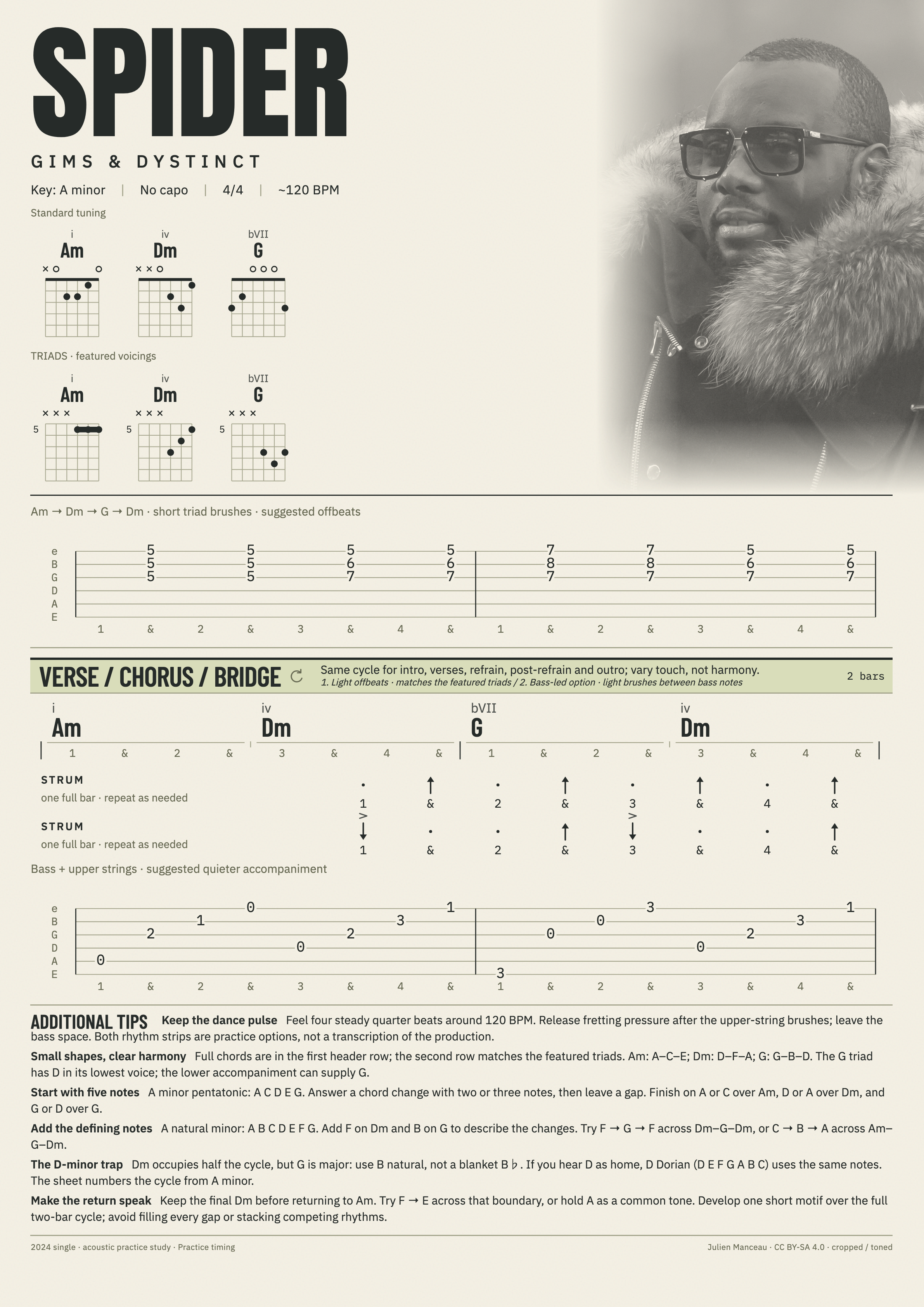
Am consists of A C E; i in the A-minor reference. The full grip and upper triad express the same harmony; inversion of a small voicing does not change the harmonic root.
[1] Intro, chorus, verses, bridge and outro
Same Am–Dm–G–Dm chord order recurs in the labelled sections.
[2] Chord summary and repeating chord grid
Reports Am–Dm–G–Dm; repeated grid entries corroborate the cycle, not an independently verified guitar rhythm.
Am · voicing adapted
Authored standard-tuning grips: full [None, 0, 2, 2, 1, 0], upper-string [None, None, None, 5, 5, 5], low to high. Calculated pitch classes A C E. Triads are practice reductions, not sourced session fingerings; G upper shape has D as lowest voice.
[1] Intro, chorus, verses, bridge and outro
Same Am–Dm–G–Dm chord order recurs in the labelled sections.
[2] Chord summary and repeating chord grid
Reports Am–Dm–G–Dm; repeated grid entries corroborate the cycle, not an independently verified guitar rhythm.
Dm · harmony inferred
Dm consists of D F A; iv in the A-minor reference. The full grip and upper triad express the same harmony; inversion of a small voicing does not change the harmonic root.
[1] Intro, chorus, verses, bridge and outro
Same Am–Dm–G–Dm chord order recurs in the labelled sections.
[2] Chord summary and repeating chord grid
Reports Am–Dm–G–Dm; repeated grid entries corroborate the cycle, not an independently verified guitar rhythm.
Dm · voicing adapted
Authored standard-tuning grips: full [None, None, 0, 2, 3, 1], upper-string [None, None, None, 7, 6, 5], low to high. Calculated pitch classes D F A. Triads are practice reductions, not sourced session fingerings; G upper shape has D as lowest voice.
[1] Intro, chorus, verses, bridge and outro
Same Am–Dm–G–Dm chord order recurs in the labelled sections.
[2] Chord summary and repeating chord grid
Reports Am–Dm–G–Dm; repeated grid entries corroborate the cycle, not an independently verified guitar rhythm.
G · harmony inferred
G consists of G B D; bVII in the A-minor reference. G is major, the subtonic, with B natural; not the harmonic-minor E dominant.
[1] Intro, chorus, verses, bridge and outro
Same Am–Dm–G–Dm chord order recurs in the labelled sections.
[2] Chord summary and repeating chord grid
Reports Am–Dm–G–Dm; repeated grid entries corroborate the cycle, not an independently verified guitar rhythm.
G · voicing adapted
Authored standard-tuning grips: full [3, 2, 0, 0, 0, 3], upper-string [None, None, None, 7, 8, 7], low to high. Calculated pitch classes G B D. Triads are practice reductions, not sourced session fingerings; G upper shape has D as lowest voice.
[1] Intro, chorus, verses, bridge and outro
Same Am–Dm–G–Dm chord order recurs in the labelled sections.
[2] Chord summary and repeating chord grid
Reports Am–Dm–G–Dm; repeated grid entries corroborate the cycle, not an independently verified guitar rhythm.
Verse / chorus / bridge · harmony supported
The Am–Dm–G–Dm cycle is independently present in the attributed chart and recording-linked detection. Same underlying harmony is consolidated rather than printing duplicate sections.
[1] Intro, chorus, verses, bridge and outro
Same Am–Dm–G–Dm chord order recurs in the labelled sections.
[2] Chord summary and repeating chord grid
Reports Am–Dm–G–Dm; repeated grid entries corroborate the cycle, not an independently verified guitar rhythm.
Verse / chorus / bridge · timing adapted
Explicit two-bar 4/4 practice cycle: Am2 Dm2 | G2 Dm2 quarter units. Two full-bar rhythm options are suggestions, repeated over each bar. Source charts establish order but do not independently verify these guitar attacks.
[1] Intro, chorus, verses, bridge and outro
Same Am–Dm–G–Dm chord order recurs in the labelled sections.
[2] Chord summary and repeating chord grid
Reports Am–Dm–G–Dm; repeated grid entries corroborate the cycle, not an independently verified guitar rhythm.
offbeat-cycle · pitches adapted
Complete Am–Dm–G–Dm cycle arranged as upper-triad brushes. Fret pitches calculated from the header grips. No claim of a transcribed signature riff.
[1] Intro, chorus, verses, bridge and outro
Same Am–Dm–G–Dm chord order recurs in the labelled sections.
[2] Chord summary and repeating chord grid
Reports Am–Dm–G–Dm; repeated grid entries corroborate the cycle, not an independently verified guitar rhythm.
offbeat-cycle · timing adapted
Two 4/4 practice bars, two beats per chord. Triad attacks on every offbeat at .5, 1.5, 2.5, 3.5 per bar; short releases.
[1] Intro, chorus, verses, bridge and outro
Same Am–Dm–G–Dm chord order recurs in the labelled sections.
[2] Chord summary and repeating chord grid
Reports Am–Dm–G–Dm; repeated grid entries corroborate the cycle, not an independently verified guitar rhythm.
quiet-cycle · pitches adapted
Complete Am–Dm–G–Dm cycle arranged as bass and upper-string picking. Fret pitches calculated from the header grips. No claim of a transcribed signature riff.
[1] Intro, chorus, verses, bridge and outro
Same Am–Dm–G–Dm chord order recurs in the labelled sections.
[2] Chord summary and repeating chord grid
Reports Am–Dm–G–Dm; repeated grid entries corroborate the cycle, not an independently verified guitar rhythm.
quiet-cycle · timing adapted
Two 4/4 practice bars, two beats per chord. Within each two-beat chord: bass, G string, B string, high E string at eighth-note spacing. Complete cycle retained.
[1] Intro, chorus, verses, bridge and outro
Same Am–Dm–G–Dm chord order recurs in the labelled sections.
[2] Chord summary and repeating chord grid
Reports Am–Dm–G–Dm; repeated grid entries corroborate the cycle, not an independently verified guitar rhythm.
Key & tuning Harmonic interpretation
Standard EADGBE, no capo; Am–Dm–G–Dm in the original-reference A-minor pitch collection. A minor is an editorial tonal reference supported by Tency, not an auditioned tonic verdict; D-Dorian is compatible with the G-major B natural. [1] [2] [3]
Chord functions
Am consists of A C E; i in the A-minor reference. The full grip and upper triad express the same harmony; inversion of a small voicing does not change the harmonic root. [1] [2]
Harmonic interpretationMeter, duration & feel Harmonic interpretation
Approximately 120 quarter-note BPM. Two 4/4 practice bars, each chord two beats. The offbeat brushes and alternative bass-led strum are not recorded attack transcriptions. [1] [2] [3]
Choosing material for a looper Playing suggestion
A single complete Am–Dm–G–Dm cycle covers the chart’s repeated material. Retain the last Dm before Am; choose either an upper-string or bass-led texture, leaving room for a short melodic response. At most two concurrent layers; no prescribed recording actions. [1] [2] [3]
Improvisation choices Playing suggestion
A minor pentatonic A C D E G gives a starting vocabulary. Add F over Dm and B over G from A natural minor. If D feels central, use D Dorian, not automatic D natural minor with Bb. Aim at chord tones and use F-to-E at the cycle return. These are authored suggestions. [1] [2] [3]
Cross-checks & arrangement decisions
Tonal center and major G. Use A minor for numbering; D-Dorian is an alternative hearing of the same white-note collection. Reject D natural minor as a blanket scale because G contains B natural. [3] [2] [1]
Tempo conflict. Both support 120 BPM. Other search results give inconsistent 101, 117 or 160 values; they are not adopted. [3] [2]
Cycle coverage. Consolidate the recurring Am–Dm–G–Dm cycle. Practice timing does not claim exact production breaks or vocal pickups. [1] [2]
Limits of this edition
- Recording not auditioned. Source chord order is corroborated; displayed picking, strumming, bar placement and voicings are explicit practice adaptations.
- No reliable complete signature riff/solo transcription was established. A Note-Store preview contained unrelated English lyrics and notation and was rejected; omission is due to evidence, not space.
- The Tency source is a studio re-recording, not the original audio. Its original-reference metadata informs the study; its longer cover duration is not used.
Image research & credit
Julien Manceau · CC BY-SA 4.0 · cropped / toned
https://commons.wikimedia.org/wiki/File:Maitre_Gims.jpg ↗

Julien Manceau, 2013, CC BY-SA 4.0 https://creativecommons.org/licenses/by-sa/4.0/. Cropped, desaturated and faded; adapted image remains under the same license.
Inspected portrait identifies Gims through his characteristic sunglasses. This 2013 photograph predates the 2024 single; no claim that it depicts its recording session. No prior Gims image exists in the library.
Sources
- SPIDER (ft DYSTINCT) — chord selection by Sarah Harris ↗
Am–Dm–G–Dm throughout named song sections; no measured attack notation.
UChords · Lineage: spider-sarah-harris-chart · Attributed community chart published 10 June 2024. Le Carnet has matching placements and is conservatively treated as the same origin. - SPIDER — recording-linked chord detection ↗
Repeated Am–Dm–G–Dm and 120 BPM; D-minor key label conflicts with Tency.
Chordify · Lineage: chordify-spider-detection · Separate automated transcription; useful corroboration of chord cycle, not a human-verified tab. - Spider — studio cover catalogue, serial 82232 ↗
Explicit original-reference A-minor key and 120 BPM; cover duration differs from single.
Tency Music · Lineage: tency-spider-82232 · Independent studio re-recording publisher; Version Karaoké pages share this origin and are not additional corroboration.