GUITAR / LOOPER-READY SHEET
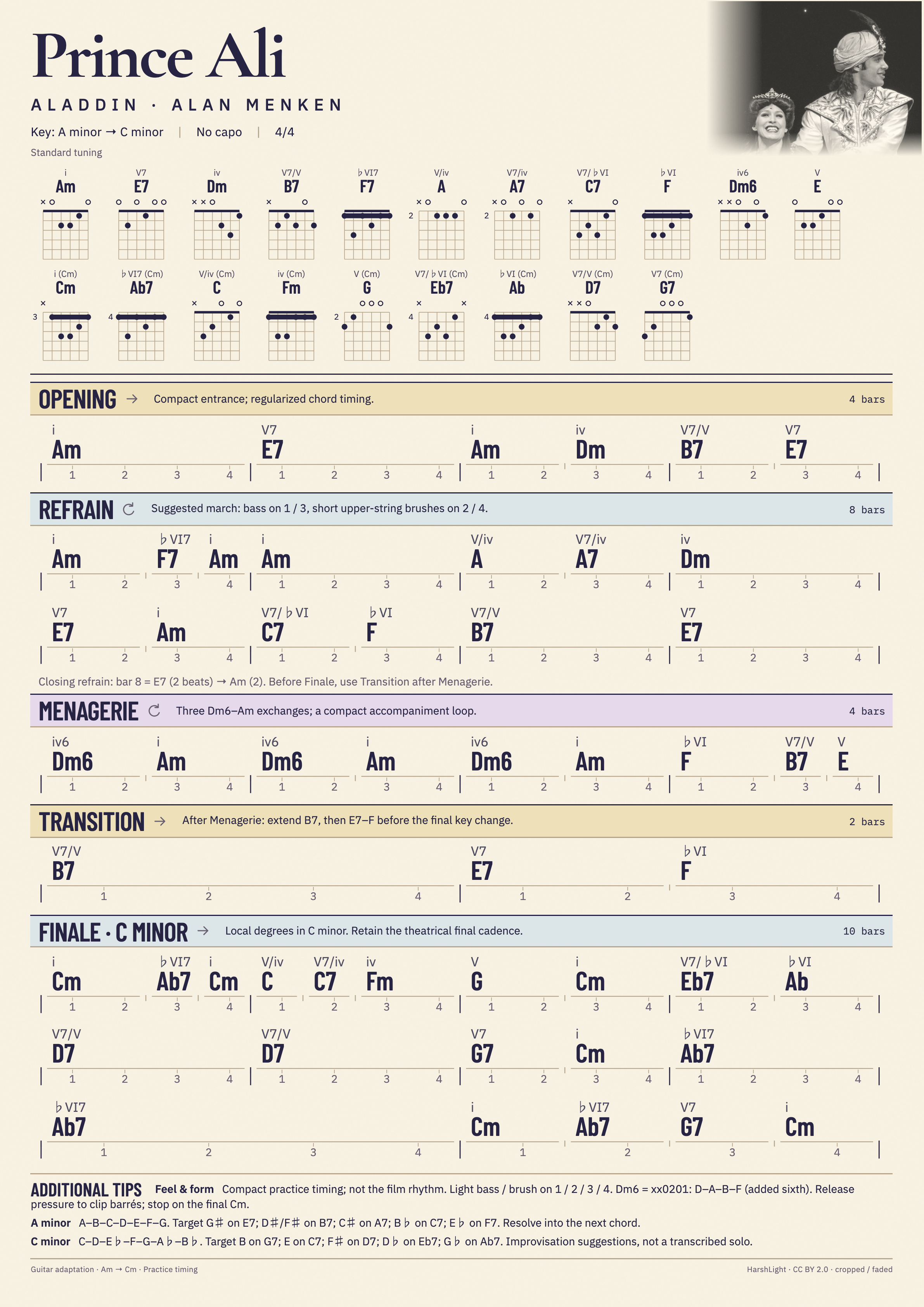
Prince Ali
Aladdin · Alan Menken
Guitar adaptation · Am → Cm
No checkout. No sign-up.
On your music stand.
For the print view, choose A4 paper, portrait, 100% scale, no browser headers or footers, and enable background graphics.
Explore the sections freely. The sheet gives you the material; the arrangement is yours.
Sources & musical analysis
Aladdin (1992) song · community-chart guitar adaptation; not a soundtrack transcription
User-selected Am → Cm guitar arrangement with explicitly regularized practice timing, contextual degrees and selected stage photograph.
Research record Collected while preparing this sheet
Read both user-supplied Ultimate Guitar charts in the browser; compared the separately engraved MusiGrilles text preview and Le Chansonnier variants. User approved simplified Am-to-Cm practice timing and image candidate B. Chord pitches/degrees derived explicitly; no ear-verification claimed.
Recording independently checked: No.
Passage fidelity
Opening · Practice adaptation
Preserved: Selected chord order and characteristic applied-dominant / minor-subdominant / chromatic-colour relationships from the requested chart.
Changed: Explicitly compacted to 4 regular 4/4 bars; ornamental intro A5, A7/E turnaround and initial B major replaced by the approved simpler opening. Tonic minor-sixth colours from MusiGrilles reduced to minor triads.
Checked: Compared section harmony across the requested chart and the separate MusiGrilles arrangement. Summed durations per bar; checked onset order, selected final chord and loop boundary. Recording not auditioned. One-time passage; not presented as a cyclic loop.
Refrain · Practice adaptation
Preserved: Selected chord order and characteristic applied-dominant / minor-subdominant / chromatic-colour relationships from the requested chart.
Changed: Explicitly compacted to 8 regular 4/4 bars; ornamental intro A5, A7/E turnaround and initial B major replaced by the approved simpler opening. Tonic minor-sixth colours from MusiGrilles reduced to minor triads.
Checked: Compared section harmony across the requested chart and the separate MusiGrilles arrangement. Summed durations per bar; checked onset order, selected final chord and loop boundary. Recording not auditioned. E7→Am closes the cycle; alternate tonic ending described below.
Menagerie · Practice adaptation
Preserved: Selected chord order and characteristic applied-dominant / minor-subdominant / chromatic-colour relationships from the requested chart.
Changed: Explicitly compacted to 4 regular 4/4 bars; ornamental intro A5, A7/E turnaround and initial B major replaced by the approved simpler opening. Tonic minor-sixth colours from MusiGrilles reduced to minor triads.
Checked: Compared section harmony across the requested chart and the separate MusiGrilles arrangement. Summed durations per bar; checked onset order, selected final chord and loop boundary. Recording not auditioned. E→Dm6 returns into the selected loop.
Transition · Practice adaptation
Preserved: Selected chord order and characteristic applied-dominant / minor-subdominant / chromatic-colour relationships from the requested chart.
Changed: Explicitly compacted to 2 regular 4/4 bars; ornamental intro A5, A7/E turnaround and initial B major replaced by the approved simpler opening. Tonic minor-sixth colours from MusiGrilles reduced to minor triads.
Checked: Compared section harmony across the requested chart and the separate MusiGrilles arrangement. Summed durations per bar; checked onset order, selected final chord and loop boundary. Recording not auditioned. One-time passage; not presented as a cyclic loop.
Finale · C minor · Practice adaptation
Preserved: Selected chord order and characteristic applied-dominant / minor-subdominant / chromatic-colour relationships from the requested chart.
Changed: Explicitly compacted to 10 regular 4/4 bars; ornamental intro A5, A7/E turnaround and initial B major replaced by the approved simpler opening. Tonic minor-sixth colours from MusiGrilles reduced to minor triads.
Checked: Compared section harmony across the requested chart and the separate MusiGrilles arrangement. Summed durations per bar; checked onset order, selected final chord and loop boundary. Recording not auditioned. One-time passage; not presented as a cyclic loop.
Claim-level evidence
Song · key adapted
Requested community-chart arrangement in Am then Cm, not a claim about the soundtrack concert keys. Minor-sixth tonic colours in MusiGrilles reduced to minor triads.
[1] Tuning / Capo metadata; Chorus; final Chorus
Standard EADGBE and no capo. Main refrains in Am; last refrain in Cm. No measured strumming pattern supplied.
[2] Page 1, Chorus / Couplet; page 2, Chorus final
Opening and main material use Am6; Dm6 exchanges; final material uses Cm6, Fm6, G7, D7, Eb7 and Ab7/Ab. Marked 4/4.
Song · tuning adapted
Standard E2 A2 D3 G3 B3 E4, no capo, adopted from the requested chart.
[1] Tuning / Capo metadata; Chorus; final Chorus
Standard EADGBE and no capo. Main refrains in Am; last refrain in Cm. No measured strumming pattern supplied.
Song · meter adapted
Use 4/4 for an explicitly regularized accompaniment. No original tempo claimed. Nashgrid default 100 quarter notes/min is an editorial playback setting.
[2] Page 1, Chorus / Couplet; page 2, Chorus final
Opening and main material use Am6; Dm6 exchanges; final material uses Cm6, Fm6, G7, D7, Eb7 and Ab7/Ab. Marked 4/4.
[1] Tuning / Capo metadata; Chorus; final Chorus
Standard EADGBE and no capo. Main refrains in Am; last refrain in Cm. No measured strumming pattern supplied.
Am · harmony inferred
A–C–E; tonic in A minor.
[1] Verse 1 / Chorus / Verse 2 / Bridge
Am occurs in the Verse 1 / Chorus / Verse 2 / Bridge chord vocabulary. Timing is not specified.
[2] Page 1, Chorus / Couplet; page 2, Chorus final
MusiGrilles uses the corresponding added-sixth minor chord; this edition deliberately omits that added note, except in Dm6.
Am · voicing adapted
Editorial low-to-high grip [None, 0, 2, 2, 1, 0]; pitch classes [9, 4, 9, 0, 4] (C=0). Open-position grip for accessible changes.
[1] Chord symbols in Verse 1 / Chorus / Verse 2 / Bridge
Symbols establish the intended harmony, not these exact fingerings. These grips were selected and pitch-checked editorially.
E7 · harmony inferred
E–G♯–B–D; dominant of Am, G♯ leads to A.
[1] Verse 1 / Chorus / Verse 2 / Bridge
E7 occurs in the Verse 1 / Chorus / Verse 2 / Bridge chord vocabulary. Timing is not specified.
[2] Page 1, Chorus / Couplet; page 2, Chorus final
MusiGrilles chord inventory and sections provide the related dominant/colour harmony; exact grips are editorial, not copied.
E7 · voicing adapted
Editorial low-to-high grip [0, 2, 0, 1, 0, 0]; pitch classes [4, 11, 2, 8, 11, 4] (C=0). Open-position grip for accessible changes.
[1] Chord symbols in Verse 1 / Chorus / Verse 2 / Bridge
Symbols establish the intended harmony, not these exact fingerings. These grips were selected and pitch-checked editorially.
Dm · harmony inferred
D–F–A; minor subdominant.
[1] Verse 1 / Chorus / Verse 2 / Bridge
Dm occurs in the Verse 1 / Chorus / Verse 2 / Bridge chord vocabulary. Timing is not specified.
[2] Page 1, Chorus / Couplet; page 2, Chorus final
MusiGrilles uses the corresponding added-sixth minor chord; this edition deliberately omits that added note, except in Dm6.
Dm · voicing adapted
Editorial low-to-high grip [None, None, 0, 2, 3, 1]; pitch classes [2, 9, 2, 5] (C=0). Open-position grip for accessible changes.
[1] Chord symbols in Verse 1 / Chorus / Verse 2 / Bridge
Symbols establish the intended harmony, not these exact fingerings. These grips were selected and pitch-checked editorially.
B7 · harmony inferred
B–D♯–F♯–A; applied dominant of E/E7.
[1] Verse 1 / Chorus / Verse 2 / Bridge
B7 occurs in the Verse 1 / Chorus / Verse 2 / Bridge chord vocabulary. Timing is not specified.
[2] Page 1, Chorus / Couplet; page 2, Chorus final
MusiGrilles chord inventory and sections provide the related dominant/colour harmony; exact grips are editorial, not copied.
B7 · voicing adapted
Editorial low-to-high grip [None, 2, 1, 2, 0, 2]; pitch classes [11, 3, 9, 11, 6] (C=0). Open-position grip for accessible changes.
[1] Chord symbols in Verse 1 / Chorus / Verse 2 / Bridge
Symbols establish the intended harmony, not these exact fingerings. These grips were selected and pitch-checked editorially.
F7 · harmony inferred
F–A–C–E♭; chromatic colour. Its E♭ is outside A natural minor; this edition retains the supplied chart, not a diminished substitute.
[1] Verse 1 / Chorus / Verse 2 / Bridge
F7 occurs in the Verse 1 / Chorus / Verse 2 / Bridge chord vocabulary. Timing is not specified.
[2] Page 1, Chorus / Couplet; page 2, Chorus final
MusiGrilles chord inventory and sections provide the related dominant/colour harmony; exact grips are editorial, not copied.
F7 · voicing adapted
Editorial low-to-high grip [1, 3, 1, 2, 1, 1]; pitch classes [5, 0, 3, 9, 0, 5] (C=0). Root-position closed barre for controlled release.
[1] Chord symbols in Verse 1 / Chorus / Verse 2 / Bridge
Symbols establish the intended harmony, not these exact fingerings. These grips were selected and pitch-checked editorially.
A · harmony inferred
A–C♯–E; major tonic root used as an applied dominant of Dm.
[1] Verse 1 / Chorus / Verse 2 / Bridge
A occurs in the Verse 1 / Chorus / Verse 2 / Bridge chord vocabulary. Timing is not specified.
A · voicing adapted
Editorial low-to-high grip [None, 0, 2, 2, 2, 0]; pitch classes [9, 4, 9, 1, 4] (C=0). Open-position grip for accessible changes.
[1] Chord symbols in Verse 1 / Chorus / Verse 2 / Bridge
Symbols establish the intended harmony, not these exact fingerings. These grips were selected and pitch-checked editorially.
A7 · harmony inferred
A–C♯–E–G; dominant of Dm, C♯ resolves to D.
[1] Verse 1 / Chorus / Verse 2 / Bridge
A7 occurs in the Verse 1 / Chorus / Verse 2 / Bridge chord vocabulary. Timing is not specified.
[2] Page 1, Chorus / Couplet; page 2, Chorus final
MusiGrilles chord inventory and sections provide the related dominant/colour harmony; exact grips are editorial, not copied.
A7 · voicing adapted
Editorial low-to-high grip [None, 0, 2, 0, 2, 0]; pitch classes [9, 4, 7, 1, 4] (C=0). Open-position grip for accessible changes.
[1] Chord symbols in Verse 1 / Chorus / Verse 2 / Bridge
Symbols establish the intended harmony, not these exact fingerings. These grips were selected and pitch-checked editorially.
C7 · harmony inferred
C–E–G–B♭; dominant of F in A minor. In the finale its local role is V7/iv, leading to Fm.
[1] Verse 1 / Chorus / Verse 2 / Bridge
C7 occurs in the Verse 1 / Chorus / Verse 2 / Bridge chord vocabulary. Timing is not specified.
[2] Page 1, Chorus / Couplet; page 2, Chorus final
MusiGrilles chord inventory and sections provide the related dominant/colour harmony; exact grips are editorial, not copied.
C7 · voicing adapted
Editorial low-to-high grip [None, 3, 2, 3, 1, 0]; pitch classes [0, 4, 10, 0, 4] (C=0). Open-position grip for accessible changes. The fifth G is omitted; C, E and B♭ retain the root, major third and minor seventh.
[1] Chord symbols in Verse 1 / Chorus / Verse 2 / Bridge
Symbols establish the intended harmony, not these exact fingerings. These grips were selected and pitch-checked editorially.
F · harmony inferred
F–A–C; diatonic sixth-degree major triad in A minor.
[1] Verse 1 / Chorus / Verse 2 / Bridge
F occurs in the Verse 1 / Chorus / Verse 2 / Bridge chord vocabulary. Timing is not specified.
[2] Page 1, Chorus / Couplet; page 2, Chorus final
MusiGrilles chord inventory and sections provide the related dominant/colour harmony; exact grips are editorial, not copied.
F · voicing adapted
Editorial low-to-high grip [1, 3, 3, 2, 1, 1]; pitch classes [5, 0, 5, 9, 0, 5] (C=0). Root-position closed barre for controlled release.
[1] Chord symbols in Verse 1 / Chorus / Verse 2 / Bridge
Symbols establish the intended harmony, not these exact fingerings. These grips were selected and pitch-checked editorially.
Dm6 · harmony inferred
D–F–A–B; minor subdominant with added major sixth. iv6 here denotes added-sixth colour, not first inversion.
[1] Verse 1 / Chorus / Verse 2 / Bridge
Dm6 occurs in the Verse 1 / Chorus / Verse 2 / Bridge chord vocabulary. Timing is not specified.
[2] Page 1, Chorus / Couplet; page 2, Chorus final
MusiGrilles chord inventory and sections provide the related dominant/colour harmony; exact grips are editorial, not copied.
Dm6 · voicing adapted
Editorial low-to-high grip [None, None, 0, 2, 0, 1]; pitch classes [2, 9, 11, 5] (C=0). Open-position grip for accessible changes.
[1] Chord symbols in Verse 1 / Chorus / Verse 2 / Bridge
Symbols establish the intended harmony, not these exact fingerings. These grips were selected and pitch-checked editorially.
E · harmony inferred
E–G♯–B; major dominant of Am.
[1] Verse 1 / Chorus / Verse 2 / Bridge
E occurs in the Verse 1 / Chorus / Verse 2 / Bridge chord vocabulary. Timing is not specified.
E · voicing adapted
Editorial low-to-high grip [0, 2, 2, 1, 0, 0]; pitch classes [4, 11, 4, 8, 11, 4] (C=0). Open-position grip for accessible changes.
[1] Chord symbols in Verse 1 / Chorus / Verse 2 / Bridge
Symbols establish the intended harmony, not these exact fingerings. These grips were selected and pitch-checked editorially.
Cm · harmony inferred
C–E♭–G; tonic after the direct move from Am to Cm. Finale degrees are relative to C.
[1] final Chorus
Cm occurs in the final Chorus chord vocabulary. Timing is not specified.
[2] Page 1, Chorus / Couplet; page 2, Chorus final
MusiGrilles uses the corresponding added-sixth minor chord; this edition deliberately omits that added note, except in Dm6.
Cm · voicing adapted
Editorial low-to-high grip [None, 3, 5, 5, 4, 3]; pitch classes [0, 7, 0, 3, 7] (C=0). Root-position closed barre for controlled release.
[1] Chord symbols in final Chorus
Symbols establish the intended harmony, not these exact fingerings. These grips were selected and pitch-checked editorially.
Ab7 · harmony inferred
A♭–C–E♭–G♭; chromatic sixth-degree dominant-seventh colour in C minor, analogous to F7 in A minor.
[1] final Chorus
Ab7 occurs in the final Chorus chord vocabulary. Timing is not specified.
[2] Page 1, Chorus / Couplet; page 2, Chorus final
MusiGrilles chord inventory and sections provide the related dominant/colour harmony; exact grips are editorial, not copied.
Ab7 · voicing adapted
Editorial low-to-high grip [4, 6, 4, 5, 4, 4]; pitch classes [8, 3, 6, 0, 3, 8] (C=0). Root-position closed barre for controlled release.
[1] Chord symbols in final Chorus
Symbols establish the intended harmony, not these exact fingerings. These grips were selected and pitch-checked editorially.
C · harmony inferred
C–E–G; major tonic root as dominant of Fm.
[1] final Chorus
C occurs in the final Chorus chord vocabulary. Timing is not specified.
C · voicing adapted
Editorial low-to-high grip [None, 3, 2, 0, 1, 0]; pitch classes [0, 4, 7, 0, 4] (C=0). Open-position grip for accessible changes.
[1] Chord symbols in final Chorus
Symbols establish the intended harmony, not these exact fingerings. These grips were selected and pitch-checked editorially.
Fm · harmony inferred
F–A♭–C; minor subdominant in C minor.
[1] final Chorus
Fm occurs in the final Chorus chord vocabulary. Timing is not specified.
[2] Page 1, Chorus / Couplet; page 2, Chorus final
MusiGrilles uses the corresponding added-sixth minor chord; this edition deliberately omits that added note, except in Dm6.
Fm · voicing adapted
Editorial low-to-high grip [1, 3, 3, 1, 1, 1]; pitch classes [5, 0, 5, 8, 0, 5] (C=0). Root-position closed barre for controlled release.
[1] Chord symbols in final Chorus
Symbols establish the intended harmony, not these exact fingerings. These grips were selected and pitch-checked editorially.
G · harmony inferred
G–B–D; dominant in C minor, with leading tone B.
[1] final Chorus
G occurs in the final Chorus chord vocabulary. Timing is not specified.
G · voicing adapted
Editorial low-to-high grip [3, 2, 0, 0, 0, 3]; pitch classes [7, 11, 2, 7, 11, 7] (C=0). Open-position grip for accessible changes.
[1] Chord symbols in final Chorus
Symbols establish the intended harmony, not these exact fingerings. These grips were selected and pitch-checked editorially.
Eb7 · harmony inferred
E♭–G–B♭–D♭; dominant of A♭. Chosen grip sounds E♭–G–D♭–E♭ and omits the fifth B♭.
[1] final Chorus
Eb7 occurs in the final Chorus chord vocabulary. Timing is not specified.
[2] Page 1, Chorus / Couplet; page 2, Chorus final
MusiGrilles chord inventory and sections provide the related dominant/colour harmony; exact grips are editorial, not copied.
Eb7 · voicing adapted
Editorial low-to-high grip [None, 6, 5, 6, 4, None]; pitch classes [3, 7, 1, 3] (C=0). Four-string E-flat seventh grip, fifth omitted, root in bass.
[1] Chord symbols in final Chorus
Symbols establish the intended harmony, not these exact fingerings. These grips were selected and pitch-checked editorially.
Ab · harmony inferred
A♭–C–E♭; diatonic sixth-degree major triad in C minor.
[1] final Chorus
Ab occurs in the final Chorus chord vocabulary. Timing is not specified.
[2] Page 1, Chorus / Couplet; page 2, Chorus final
MusiGrilles chord inventory and sections provide the related dominant/colour harmony; exact grips are editorial, not copied.
Ab · voicing adapted
Editorial low-to-high grip [4, 6, 6, 5, 4, 4]; pitch classes [8, 3, 8, 0, 3, 8] (C=0). Root-position closed barre for controlled release.
[1] Chord symbols in final Chorus
Symbols establish the intended harmony, not these exact fingerings. These grips were selected and pitch-checked editorially.
D7 · harmony inferred
D–F♯–A–C; applied dominant of G/G7.
[1] final Chorus
D7 occurs in the final Chorus chord vocabulary. Timing is not specified.
[2] Page 1, Chorus / Couplet; page 2, Chorus final
MusiGrilles chord inventory and sections provide the related dominant/colour harmony; exact grips are editorial, not copied.
D7 · voicing adapted
Editorial low-to-high grip [None, None, 0, 2, 1, 2]; pitch classes [2, 9, 0, 6] (C=0). Open-position grip for accessible changes.
[1] Chord symbols in final Chorus
Symbols establish the intended harmony, not these exact fingerings. These grips were selected and pitch-checked editorially.
G7 · harmony inferred
G–B–D–F; dominant seventh resolving to Cm.
[1] final Chorus
G7 occurs in the final Chorus chord vocabulary. Timing is not specified.
[2] Page 1, Chorus / Couplet; page 2, Chorus final
MusiGrilles chord inventory and sections provide the related dominant/colour harmony; exact grips are editorial, not copied.
G7 · voicing adapted
Editorial low-to-high grip [3, 2, 0, 0, 0, 1]; pitch classes [7, 11, 2, 7, 11, 5] (C=0). Open-position grip for accessible changes.
[1] Chord symbols in final Chorus
Symbols establish the intended harmony, not these exact fingerings. These grips were selected and pitch-checked editorially.
Opening · harmony adapted
Compact accompaniment preserving the selected harmonic route. Am:4 | E7:4 | Am:2 + Dm:2 | B7:2 + E7:2
[1] Verse 1
Compared the ordered chord symbols in this passage. The supplied chart has no barline or beat-duration specification.
[2] Page 1, Chorus / Couplet; page 2, Chorus final
Opening and main material use Am6; Dm6 exchanges; final material uses Cm6, Fm6, G7, D7, Eb7 and Ab7/Ab. Marked 4/4.
Opening · timing adapted
Editorial 4/4 map, numbers are quarter-note beats: Am:4 | E7:4 | Am:2 + Dm:2 | B7:2 + E7:2. One attack at each chord onset; optionally use the suggested full-bar bass/brush pattern. Not soundtrack timing.
[1] Verse 1
Compared the ordered chord symbols in this passage. The supplied chart has no barline or beat-duration specification.
[2] Page 1, Chorus / Couplet; page 2, Chorus final
Opening and main material use Am6; Dm6 exchanges; final material uses Cm6, Fm6, G7, D7, Eb7 and Ab7/Ab. Marked 4/4.
Refrain · harmony adapted
Compact accompaniment preserving the selected harmonic route. Am:2 + F7:1 + Am:1 | Am:4 | A:2 + A7:2 | Dm:4 | E7:2 + Am:2 | C7:2 + F:2 | B7:4 | E7:4
[1] Chorus
Compared the ordered chord symbols in this passage. The supplied chart has no barline or beat-duration specification.
[2] Page 1, Chorus / Couplet; page 2, Chorus final
Opening and main material use Am6; Dm6 exchanges; final material uses Cm6, Fm6, G7, D7, Eb7 and Ab7/Ab. Marked 4/4.
Refrain · timing adapted
Editorial 4/4 map, numbers are quarter-note beats: Am:2 + F7:1 + Am:1 | Am:4 | A:2 + A7:2 | Dm:4 | E7:2 + Am:2 | C7:2 + F:2 | B7:4 | E7:4. One attack at each chord onset; optionally use the suggested full-bar bass/brush pattern. Not soundtrack timing.
[1] Chorus
Compared the ordered chord symbols in this passage. The supplied chart has no barline or beat-duration specification.
[2] Page 1, Chorus / Couplet; page 2, Chorus final
Opening and main material use Am6; Dm6 exchanges; final material uses Cm6, Fm6, G7, D7, Eb7 and Ab7/Ab. Marked 4/4.
Menagerie · harmony adapted
Compact accompaniment preserving the selected harmonic route. Dm6:2 + Am:2 | Dm6:2 + Am:2 | Dm6:2 + Am:2 | F:2 + B7:1 + E:1
[1] Verse 2 / Bridge
Compared the ordered chord symbols in this passage. The supplied chart has no barline or beat-duration specification.
[2] Page 1, Chorus / Couplet; page 2, Chorus final
Opening and main material use Am6; Dm6 exchanges; final material uses Cm6, Fm6, G7, D7, Eb7 and Ab7/Ab. Marked 4/4.
Menagerie · timing adapted
Editorial 4/4 map, numbers are quarter-note beats: Dm6:2 + Am:2 | Dm6:2 + Am:2 | Dm6:2 + Am:2 | F:2 + B7:1 + E:1. One attack at each chord onset; optionally use the suggested full-bar bass/brush pattern. Not soundtrack timing.
[1] Verse 2 / Bridge
Compared the ordered chord symbols in this passage. The supplied chart has no barline or beat-duration specification.
[2] Page 1, Chorus / Couplet; page 2, Chorus final
Opening and main material use Am6; Dm6 exchanges; final material uses Cm6, Fm6, G7, D7, Eb7 and Ab7/Ab. Marked 4/4.
Transition · harmony adapted
Compact accompaniment preserving the selected harmonic route. B7:4 | E7:2 + F:2
[1] Bridge ending
Compared the ordered chord symbols in this passage. The supplied chart has no barline or beat-duration specification.
[2] Page 1, Chorus / Couplet; page 2, Chorus final
Opening and main material use Am6; Dm6 exchanges; final material uses Cm6, Fm6, G7, D7, Eb7 and Ab7/Ab. Marked 4/4.
Transition · timing adapted
Editorial 4/4 map, numbers are quarter-note beats: B7:4 | E7:2 + F:2. One attack at each chord onset; optionally use the suggested full-bar bass/brush pattern. Not soundtrack timing.
[1] Bridge ending
Compared the ordered chord symbols in this passage. The supplied chart has no barline or beat-duration specification.
[2] Page 1, Chorus / Couplet; page 2, Chorus final
Opening and main material use Am6; Dm6 exchanges; final material uses Cm6, Fm6, G7, D7, Eb7 and Ab7/Ab. Marked 4/4.
Finale · C minor · harmony adapted
Compact accompaniment preserving the selected harmonic route. Cm:2 + Ab7:1 + Cm:1 | C:1 + C7:1 + Fm:2 | G:2 + Cm:2 | Eb7:2 + Ab:2 | D7:4 | D7:4 | G7:2 + Cm:2 | Ab7:4 | Ab7:4 | Cm:1 + Ab7:1 + G7:1 + Cm:1
[1] final Chorus
Compared the ordered chord symbols in this passage. The supplied chart has no barline or beat-duration specification.
[2] Page 1, Chorus / Couplet; page 2, Chorus final
Opening and main material use Am6; Dm6 exchanges; final material uses Cm6, Fm6, G7, D7, Eb7 and Ab7/Ab. Marked 4/4.
Finale · C minor · timing adapted
Editorial 4/4 map, numbers are quarter-note beats: Cm:2 + Ab7:1 + Cm:1 | C:1 + C7:1 + Fm:2 | G:2 + Cm:2 | Eb7:2 + Ab:2 | D7:4 | D7:4 | G7:2 + Cm:2 | Ab7:4 | Ab7:4 | Cm:1 + Ab7:1 + G7:1 + Cm:1. One attack at each chord onset; optionally use the suggested full-bar bass/brush pattern. Not soundtrack timing.
[1] final Chorus
Compared the ordered chord symbols in this passage. The supplied chart has no barline or beat-duration specification.
[2] Page 1, Chorus / Couplet; page 2, Chorus final
Opening and main material use Am6; Dm6 exchanges; final material uses Cm6, Fm6, G7, D7, Eb7 and Ab7/Ab. Marked 4/4.
Key & tuning Harmonic interpretation
Am main sections and Cm finale retained from the selected chart, corroborated as an arrangement by MusiGrilles Am6/Cm6. Standard tuning, no capo; no assertion of recording concert keys. [1] [2]
Chord functions
F–A–C–E♭; chromatic colour. Its E♭ is outside A natural minor; this edition retains the supplied chart, not a diminished substitute. [1] [2]
Harmonic interpretationC–E–G–B♭; dominant of F in A minor. In the finale its local role is V7/iv, leading to Fm. The x32310 guitar grip omits G and doubles C/E. [1] [2]
Harmonic interpretationIn the C-minor finale C–E–G–B♭ is the applied dominant of Fm; E resolves up to F. The x32310 guitar grip omits G and doubles C/E. [1] [2]
Harmonic interpretationD–F–A–B; minor subdominant with added major sixth. iv6 here denotes added-sixth colour, not first inversion. [1] [2]
Harmonic interpretationC–E♭–G; tonic after the direct move from Am to Cm. Finale degrees are relative to C. [1] [2]
Harmonic interpretationC–E♭–G; tonic after the direct move from Am to Cm. Finale degrees are relative to C. [1] [2]
Harmonic interpretationA♭–C–E♭–G♭; chromatic sixth-degree dominant-seventh colour in C minor, analogous to F7 in A minor. [1] [2]
Harmonic interpretationA♭–C–E♭–G♭; chromatic sixth-degree dominant-seventh colour in C minor, analogous to F7 in A minor. [1] [2]
Harmonic interpretationE♭–G–B♭–D♭; dominant of A♭. Chosen grip sounds E♭–G–D♭–E♭ and omits the fifth B♭. [1] [2]
Harmonic interpretationMeter, duration & feel Playing suggestion
Explicit regularized 4/4 accompaniment: Opening 4, Refrain 8, Menagerie 4, Transition 2 and Finale 10 bars. Printed timing is adapted; 100 quarter-note BPM is only the Nashgrid playback default. [1] [2]
Choosing material for a looper Playing suggestion
Refrain ends on E7 and returns to Am; Menagerie ends on E and returns to Dm6. Different lengths and keys need deliberate musical alignment; finale and transition are one-time references. At most two simultaneous loops. [1] [2]
Improvisation choices Playing suggestion
Use A natural minor then C natural minor as starting material; follow each applied dominant and the chromatic sixth-degree sevenths with their actual chord tones. Suggestions, not recorded lead parts. [1] [2]
Cross-checks & arrangement decisions
Reference corrected by user. English version 2 supersedes the initial French chart. Broad harmony matches; A5 intro and Dm–A7/E–Dm embellishment omitted in the approved simplified opening. [1]
Colour chords and modulation. Keep supplied F7/Ab7 and direct Am→Cm move. MusiGrilles broadly agrees but uses minor-sixth colours. Le Chansonnier differs in intermediate keys and an ambiguous diminished label; not adopted. [1] [2] [3]
Timing and guitar figure. No soundtrack rhythm or lead phrase verified. User approved regularized 4/4 accompaniment. No featured riff or page 2; text-only pitch sources did not establish a corroborated guitar phrase. [1] [2]
Limits of this edition
- Not checked against the recording; no original tempo or exact phrase timing claimed. Compact practice timing is printed on the sheet.
- A5 entrance, A7/E ornament and first B major replaced by the approved simpler opening. Source tacets and theatrical pauses are not transcribed.
- Finale degrees refer to C minor; header labels identify that context. Nashgrid uses fixed A-minor coordinates for all clips to preserve absolute pitches across shared chords such as C7.
- Artwork is a 2013 stage photograph, not a 1992 film still. CC BY 2.0 applies to the photograph; separate character rights are not independently cleared.
Image research & credit
HarshLight · CC BY 2.0 · cropped / faded
https://commons.wikimedia.org/wiki/File:Aladdin_-_11883895455_(cropped).jpg ↗

HarshLight, CC BY 2.0 (creativecommons.org/licenses/by/2.0/). Existing crop by Shark1989z; desaturated and faded here. Photo licence does not clear separate character rights.
Selected candidate B after comparison with Genie/Aladdin and discussion of film-still rights. Royal costume suits Prince Ali; stage photograph, not a 1992 film still.
Sources
- Aladdin – Prince Ali, chords version 2 · jasmineblakey1975 ↗
Chord sequence, Am-to-Cm arrangement, standard tuning and no capo; no quantified strumming or bar timing.
Ultimate Guitar · Lineage: ug-prince-ali-community-family · User-selected English chart. Near-identical French version and E-Chords mirror grouped with this family; not independent corroboration. - Prince Ali · MusiGrilles · dated 06/04/2019 ↗
Main minor-key harmony, Dm6/Am6 exchanges, applied dominants, F7/Ab7 colour, final Cm6 section; 4/4 marking.
MusiGrilles via Scribd · Lineage: musigrilles-prince-ali-2019 · Separately engraved two-page MusiGrilles chart, with Am6/Cm6, minor-sixth voicings and different transitions; distinct arrangement from the supplied lyric chart. Upstream transcription not established. - Prince Ali · Aladdin · Le Chansonnier ↗
Comparison only: rising intermediate keys and ambiguous F7(dim) label. Not used to certify the original recording key.
Le Chansonnier · Lineage: ug-prince-ali-community-family · French lyric-chart lineage uncertain; conservatively grouped with the supplied community chart, despite different modulations and chord colours.