GUITAR / LOOPER-READY SHEET
Music When the Lights Go Out
The Libertines
Community-chart study · adapted harmony & rhythm
No checkout. No sign-up.
On your music stand.
The PDF is already set to A4. For the print view, choose portrait, 100% scale, no browser headers or footers, and enable background graphics.
Explore the sections freely. The sheet gives you the material; the arrangement is yours.
Sources & musical analysis
Guitar study of the song released on the 2004 self-titled album; source-chart synthesis, not a verified album transcription.
Complete harmonic families and sourced lead phrase, normalized as an explicitly timed practice study; no recording audition.
Research record Collected while preparing this sheet
Read the signed Hawkins tab and independently credited Bernardt chart during authoring; compared actual verse shapes and chorus sequences. Read ChordU metadata as supplemental only. Collected atomic evidence before rendering; no audio was auditioned.
Recording independently checked: No.
Passage fidelity
Intro / verse · Practice adaptation
Preserved: Ordered harmony of the cited verse cycle.
Changed: Explicit 4/4 practice durations and guitar shapes. Solo looping option sustains G instead of final F#; final C is described in technique rather than adding another cycle.
Checked: Compared chart chord order and computed every bar total as four quarters. Checked last-to-first connection: G→C.
Chromatic link · Practice adaptation
Preserved: Ordered harmony of the cited chromatic link.
Changed: Explicit 4/4 practice durations and guitar shapes. Solo looping option sustains G instead of final F#; final C is described in technique rather than adding another cycle.
Checked: Compared chart chord order and computed every bar total as four quarters. Checked last-to-first connection: F#→F.
Chorus A / solo bed · Practice adaptation
Preserved: Ordered harmony of the cited chorus half; solo bed has the same F C F C F D G sequence.
Changed: Explicit 4/4 practice durations and guitar shapes. Solo looping option sustains G instead of final F#; final C is described in technique rather than adding another cycle.
Checked: Compared chart chord order and computed every bar total as four quarters. Checked last-to-first connection: F#→F.
Chorus B / return · Practice adaptation
Preserved: Ordered harmony of the cited second chorus half and G7 return.
Changed: Explicit 4/4 practice durations and guitar shapes. Solo looping option sustains G instead of final F#; final C is described in technique rather than adding another cycle.
Checked: Compared chart chord order and computed every bar total as four quarters. Checked last-to-first connection: G7→C. No recording audition.
chromatic-response · Practice adaptation
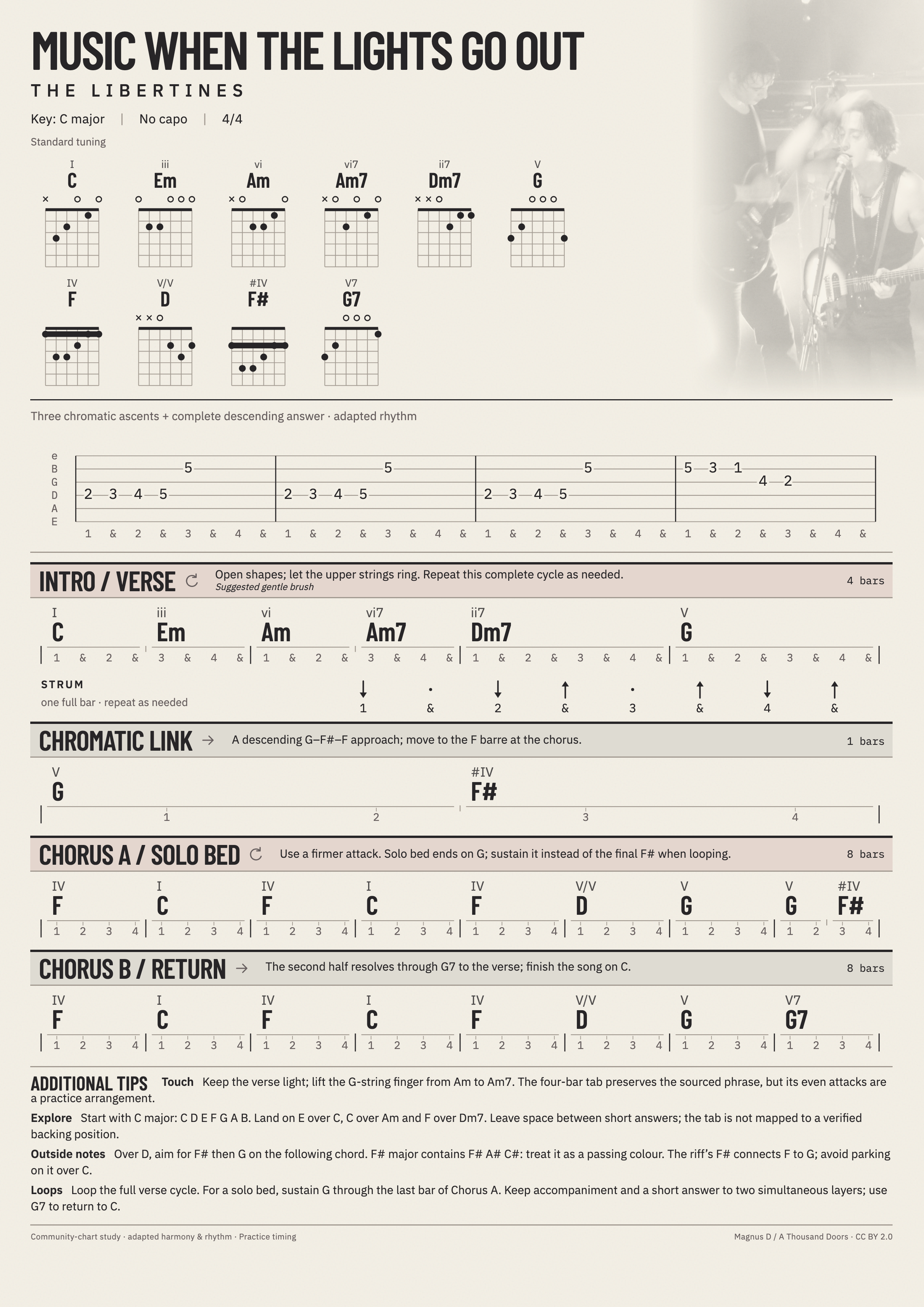
Preserved: All three five-note ascents and all five notes of the descending answer in source order and register.
Changed: Four-bar even eighth-note practice grid with final two-beat holds; slide articulation omitted. No backing chord alignment asserted.
Checked: Read both tab segments including x3 and final G-string 2; computed standard-tuning pitches and note boundaries. End A3 to next E3 is a deliberate study repeat, not verified performance timing.
Claim-level evidence
Song · key inferred
C is the tonal centre inferred from verse returns and G7–C resolution; ChordU explicitly labels C major. Same sounding and shape key in the chosen no-capo setup.
[2] Intro and Verso headings
Intro lists C Em Am Am7 Dm7 G twice; the verse follows those chords. No metrical durations supplied.
[2] Refrão heading and “solo guitarra-base” line
Chorus has G–F# approach, F C F C F D G, another G–F# approach, then F C F C F D G G7. Solo backing lists F C F C F D G.
[3] Top tuning/capo metadata and “Jam Along & Learn” paragraph
Displays standard EADGBE, capo +0, and key C Major. Algorithmic chart contains inconsistent chord/lyric detections.
Song · tuning supported
Standard EADGBE is explicitly stated by Hawkins and ChordU. Capo 0 is the selected arrangement, also shown by ChordU.
[1] Tuning line above main chord tab
Explicitly says Tuning: Standard.
[3] Top tuning/capo metadata and “Jam Along & Learn” paragraph
Displays standard EADGBE, capo +0, and key C Major. Algorithmic chart contains inconsistent chord/lyric detections.
Song · meter adapted
Choose a regular 4/4 practice grid. Neither manual chart supplies counted meter; no claim of verified recording meter is made.
[1] “The main chord part” six-string tab, immediately after Tuning: Standard
Printed shapes are x32010, x32000, x02210, xx0231 and 320003; second chord is labelled C(?). No metric bar divisions between its chords.
[2] Intro and Verso headings
Intro lists C Em Am Am7 Dm7 G twice; the verse follows those chords. No metrical durations supplied.
C · harmony inferred
C contains C E G; Roman I derives from C major. Quality follows the selected Bernardt accompaniment.
[2] Intro and Verso headings
Intro lists C Em Am Am7 Dm7 G twice; the verse follows those chords. No metrical durations supplied.
C · voicing adapted
Chosen low-to-high frets [None, 3, 2, 0, 1, 0] produce C E G in EADGBE. Authored playable voicing, not a claim of the recording’s exact fingering.
[2] Intro and Verso headings
Intro lists C Em Am Am7 Dm7 G twice; the verse follows those chords. No metrical durations supplied.
[1] “The main chord part” six-string tab, immediately after Tuning: Standard
Printed shapes are x32010, x32000, x02210, xx0231 and 320003; second chord is labelled C(?). No metric bar divisions between its chords.
Em · harmony inferred
Em contains E G B; Roman iii derives from C major. Quality follows the selected Bernardt accompaniment.
[2] Intro and Verso headings
Intro lists C Em Am Am7 Dm7 G twice; the verse follows those chords. No metrical durations supplied.
Em · voicing adapted
Chosen low-to-high frets [0, 2, 2, 0, 0, 0] produce E G B in EADGBE. Authored playable voicing, not a claim of the recording’s exact fingering.
[2] Intro and Verso headings
Intro lists C Em Am Am7 Dm7 G twice; the verse follows those chords. No metrical durations supplied.
[1] “The main chord part” six-string tab, immediately after Tuning: Standard
Printed shapes are x32010, x32000, x02210, xx0231 and 320003; second chord is labelled C(?). No metric bar divisions between its chords.
Am · harmony inferred
Am contains A C E; Roman vi derives from C major. Quality follows the selected Bernardt accompaniment.
[2] Intro and Verso headings
Intro lists C Em Am Am7 Dm7 G twice; the verse follows those chords. No metrical durations supplied.
Am · voicing adapted
Chosen low-to-high frets [None, 0, 2, 2, 1, 0] produce A C E in EADGBE. Authored playable voicing, not a claim of the recording’s exact fingering.
[2] Intro and Verso headings
Intro lists C Em Am Am7 Dm7 G twice; the verse follows those chords. No metrical durations supplied.
[1] “The main chord part” six-string tab, immediately after Tuning: Standard
Printed shapes are x32010, x32000, x02210, xx0231 and 320003; second chord is labelled C(?). No metric bar divisions between its chords.
Am7 · harmony inferred
Am7 contains A C E G; Roman vi7 derives from C major. Quality follows the selected Bernardt accompaniment.
[2] Intro and Verso headings
Intro lists C Em Am Am7 Dm7 G twice; the verse follows those chords. No metrical durations supplied.
Am7 · voicing adapted
Chosen low-to-high frets [None, 0, 2, 0, 1, 0] produce A C E G in EADGBE. Authored playable voicing, not a claim of the recording’s exact fingering.
[2] Intro and Verso headings
Intro lists C Em Am Am7 Dm7 G twice; the verse follows those chords. No metrical durations supplied.
[1] “The main chord part” six-string tab, immediately after Tuning: Standard
Printed shapes are x32010, x32000, x02210, xx0231 and 320003; second chord is labelled C(?). No metric bar divisions between its chords.
Dm7 · harmony inferred
Dm7 contains D F A C; Roman ii7 derives from C major. Quality follows the selected Bernardt accompaniment.
[2] Intro and Verso headings
Intro lists C Em Am Am7 Dm7 G twice; the verse follows those chords. No metrical durations supplied.
Dm7 · voicing adapted
Chosen low-to-high frets [None, None, 0, 2, 1, 1] produce D F A C in EADGBE. Authored playable voicing, not a claim of the recording’s exact fingering.
[2] Intro and Verso headings
Intro lists C Em Am Am7 Dm7 G twice; the verse follows those chords. No metrical durations supplied.
[1] “The main chord part” six-string tab, immediately after Tuning: Standard
Printed shapes are x32010, x32000, x02210, xx0231 and 320003; second chord is labelled C(?). No metric bar divisions between its chords.
G · harmony inferred
G contains G B D; Roman V derives from C major. Quality follows the selected Bernardt accompaniment.
[2] Intro and Verso headings
Intro lists C Em Am Am7 Dm7 G twice; the verse follows those chords. No metrical durations supplied.
G · voicing adapted
Chosen low-to-high frets [3, 2, 0, 0, 0, 3] produce G B D in EADGBE. Authored playable voicing, not a claim of the recording’s exact fingering.
[2] Intro and Verso headings
Intro lists C Em Am Am7 Dm7 G twice; the verse follows those chords. No metrical durations supplied.
[1] “The main chord part” six-string tab, immediately after Tuning: Standard
Printed shapes are x32010, x32000, x02210, xx0231 and 320003; second chord is labelled C(?). No metric bar divisions between its chords.
F · harmony inferred
F contains F A C; Roman IV derives from C major. Quality follows the selected Bernardt accompaniment.
[2] Refrão heading and “solo guitarra-base” line
Chorus has G–F# approach, F C F C F D G, another G–F# approach, then F C F C F D G G7. Solo backing lists F C F C F D G.
F · voicing adapted
Chosen low-to-high frets [1, 3, 3, 2, 1, 1] produce F A C in EADGBE. Authored playable voicing, not a claim of the recording’s exact fingering.
[2] Refrão heading and “solo guitarra-base” line
Chorus has G–F# approach, F C F C F D G, another G–F# approach, then F C F C F D G G7. Solo backing lists F C F C F D G.
[1] “The main chord part” six-string tab, immediately after Tuning: Standard
Printed shapes are x32010, x32000, x02210, xx0231 and 320003; second chord is labelled C(?). No metric bar divisions between its chords.
D · harmony inferred
D contains D F# A; Roman V/V derives from C major. D is the secondary dominant of G.
[2] Refrão heading and “solo guitarra-base” line
Chorus has G–F# approach, F C F C F D G, another G–F# approach, then F C F C F D G G7. Solo backing lists F C F C F D G.
D · voicing adapted
Chosen low-to-high frets [None, None, 0, 2, 3, 2] produce D F# A in EADGBE. Authored playable voicing, not a claim of the recording’s exact fingering.
[2] Refrão heading and “solo guitarra-base” line
Chorus has G–F# approach, F C F C F D G, another G–F# approach, then F C F C F D G G7. Solo backing lists F C F C F D G.
[1] “The main chord part” six-string tab, immediately after Tuning: Standard
Printed shapes are x32010, x32000, x02210, xx0231 and 320003; second chord is labelled C(?). No metric bar divisions between its chords.
F# · harmony inferred
F# contains F# A# C#; Roman #IV derives from C major. F# is a chromatic passing major chord, not diatonic IV.
[2] Refrão heading and “solo guitarra-base” line
Chorus has G–F# approach, F C F C F D G, another G–F# approach, then F C F C F D G G7. Solo backing lists F C F C F D G.
F# · voicing adapted
Chosen low-to-high frets [2, 4, 4, 3, 2, 2] produce F# A# C# in EADGBE. Authored playable voicing, not a claim of the recording’s exact fingering.
[2] Refrão heading and “solo guitarra-base” line
Chorus has G–F# approach, F C F C F D G, another G–F# approach, then F C F C F D G G7. Solo backing lists F C F C F D G.
[1] “The main chord part” six-string tab, immediately after Tuning: Standard
Printed shapes are x32010, x32000, x02210, xx0231 and 320003; second chord is labelled C(?). No metric bar divisions between its chords.
G7 · harmony inferred
G7 contains G B D F; Roman V7 derives from C major. Quality follows the selected Bernardt accompaniment.
[2] Refrão heading and “solo guitarra-base” line
Chorus has G–F# approach, F C F C F D G, another G–F# approach, then F C F C F D G G7. Solo backing lists F C F C F D G.
G7 · voicing adapted
Chosen low-to-high frets [3, 2, 0, 0, 0, 1] produce G B D F in EADGBE. Authored playable voicing, not a claim of the recording’s exact fingering.
[2] Refrão heading and “solo guitarra-base” line
Chorus has G–F# approach, F C F C F D G, another G–F# approach, then F C F C F D G G7. Solo backing lists F C F C F D G.
[1] “The main chord part” six-string tab, immediately after Tuning: Standard
Printed shapes are x32010, x32000, x02210, xx0231 and 320003; second chord is labelled C(?). No metric bar divisions between its chords.
Intro / verse · harmony adapted
Retain the Bernardt chord sequence shown in this section; choose its Em and Dm7 reading where Hawkins instead uses Cmaj7 and Dm. This is a declared arrangement, not a resolution of the recording discrepancy.
[2] Intro and Verso headings
Intro lists C Em Am Am7 Dm7 G twice; the verse follows those chords. No metrical durations supplied.
[1] “The main chord part” six-string tab, immediately after Tuning: Standard
Printed shapes are x32010, x32000, x02210, xx0231 and 320003; second chord is labelled C(?). No metric bar divisions between its chords.
Intro / verse · timing adapted
Chosen practice timing in quarter-note units, bars separated by semicolons: C 2 + Em 2; Am 2 + Am7 2; Dm7 4; G 4. These durations are editorial; source chord placements lack a beat grid.
[2] Intro and Verso headings
Intro lists C Em Am Am7 Dm7 G twice; the verse follows those chords. No metrical durations supplied.
Chromatic link · harmony adapted
Retain the Bernardt chord sequence shown in this section; choose its Em and Dm7 reading where Hawkins instead uses Cmaj7 and Dm. This is a declared arrangement, not a resolution of the recording discrepancy.
[2] Refrão heading and “solo guitarra-base” line
Chorus has G–F# approach, F C F C F D G, another G–F# approach, then F C F C F D G G7. Solo backing lists F C F C F D G.
Chromatic link · timing adapted
Chosen practice timing in quarter-note units, bars separated by semicolons: G 2 + F# 2. These durations are editorial; source chord placements lack a beat grid.
[2] Refrão heading and “solo guitarra-base” line
Chorus has G–F# approach, F C F C F D G, another G–F# approach, then F C F C F D G G7. Solo backing lists F C F C F D G.
Chorus A / solo bed · harmony adapted
Retain the Bernardt chord sequence shown in this section; choose its Em and Dm7 reading where Hawkins instead uses Cmaj7 and Dm. This is a declared arrangement, not a resolution of the recording discrepancy.
[2] Refrão heading and “solo guitarra-base” line
Chorus has G–F# approach, F C F C F D G, another G–F# approach, then F C F C F D G G7. Solo backing lists F C F C F D G.
Chorus A / solo bed · timing adapted
Chosen practice timing in quarter-note units, bars separated by semicolons: F 4; C 4; F 4; C 4; F 4; D 4; G 4; G 2 + F# 2. These durations are editorial; source chord placements lack a beat grid.
[2] Refrão heading and “solo guitarra-base” line
Chorus has G–F# approach, F C F C F D G, another G–F# approach, then F C F C F D G G7. Solo backing lists F C F C F D G.
Chorus B / return · harmony adapted
Retain the Bernardt chord sequence shown in this section; choose its Em and Dm7 reading where Hawkins instead uses Cmaj7 and Dm. This is a declared arrangement, not a resolution of the recording discrepancy.
[2] Refrão heading and “solo guitarra-base” line
Chorus has G–F# approach, F C F C F D G, another G–F# approach, then F C F C F D G G7. Solo backing lists F C F C F D G.
Chorus B / return · timing adapted
Chosen practice timing in quarter-note units, bars separated by semicolons: F 4; C 4; F 4; C 4; F 4; D 4; G 4; G7 4. These durations are editorial; source chord placements lack a beat grid.
[2] Refrão heading and “solo guitarra-base” line
Chorus has G–F# approach, F C F C F D G, another G–F# approach, then F C F C F D G G7. Solo backing lists F C F C F D G.
chromatic-response · pitches inferred
Preserve the complete Hawkins pitch order: E3 F3 F#3 G3 E4 three times, then E4 D4 C4 B3 A3. String/fret pitches derived in standard tuning; only one consulted source supplies this complete phrase.
[1] “A second guitar does something like this”, both tab segments
D-string 2 3 4 /5 then B-string 5 repeated x3; tail B-string 5 3 1 then G-string 4 2. No beat counts; source is tentative.
chromatic-response · timing adapted
Four 4/4 practice bars: each ascent has onsets 0, 0.5, 1, 1.5, 2; its final E rings for two beats. Repeat ascent three times, then the five-note descending answer uses the same onsets. Remove unspecified slide nuance.
[1] “A second guitar does something like this”, both tab segments
D-string 2 3 4 /5 then B-string 5 repeated x3; tail B-string 5 3 1 then G-string 4 2. No beat counts; source is tentative.
Key & tuning Harmonic interpretation
C centre and G7–C cadence inferred from both charts; standard tuning explicitly given by Hawkins, corroborated by ChordU. Select capo 0, so C shapes sound in C. [1] [2]
Chord functions
C: C E G. I in C; voicing checked by standard-tuning fret arithmetic. [1] [2]
Harmonic interpretationEm: E G B. iii in C; voicing checked by standard-tuning fret arithmetic. [1] [2]
Harmonic interpretationAm: A C E. vi in C; voicing checked by standard-tuning fret arithmetic. [1] [2]
Harmonic interpretationAm7: A C E G. vi7 in C; voicing checked by standard-tuning fret arithmetic. [1] [2]
Harmonic interpretationDm7: D F A C. ii7 in C; voicing checked by standard-tuning fret arithmetic. [1] [2]
Harmonic interpretationG: G B D. V in C; voicing checked by standard-tuning fret arithmetic. [1] [2]
Harmonic interpretationF: F A C. IV in C; voicing checked by standard-tuning fret arithmetic. [1] [2]
Harmonic interpretationMeter, duration & feel Playing suggestion
No BPM printed. Chosen 4/4, four-bar verse, one-bar chromatic link, two eight-bar chorus halves and four-bar featured practice figure; all source durations are unverified. Strum is an authored full-bar alternative. [1] [2]
Choosing material for a looper Playing suggestion
Verse G→C closes a useful cycle. Chorus A is a returning F#→F cycle; sustain G for the solo-bed variant. Chorus B points through G7 back to C. Accompaniment plus a short answer respects two simultaneous layers. [1] [2]
Improvisation choices Playing suggestion
C major C D E F G A B is a starting palette; target E over C, C over Am, F over Dm7. D requires F#, while F# major requires F# A# C#. Treat chromatic notes as passing tones and leave space. These are suggestions, not recorded solo claims. [1] [2]
Cross-checks & arrangement decisions
Verse second chord and minor-colour differences. Hawkins x32000 is Cmaj7 with C bass; Bernardt names Em (E bass). Dm versus Dm7 also differs. Choose Bernardt’s chord reading as an explicit practice arrangement; exact recorded voicings remain unverified. [1] [2]
Precise rhythm and tempo. Manual charts lack beat grids; ChordU’s uncertain detection is not timing proof. Omit BPM; explicitly assign practice durations to every section and the complete featured phrase. [1] [2] [3]
Limits of this edition
- Recording not auditioned. All printed timings are an editorial practice arrangement, not a verified transcription.
- The complete featured phrase has one manual source; its pitches are inferred from tablature, and its slide/expressive timing is simplified.
- Em/Cmaj7 and Dm/Dm7 remain differences between source arrangements. This sheet deliberately selects Bernardt’s harmony.
- Solo improvisation is not transcribed; its chord bed is preserved. Global performance repeat counts and rubato are not mapped.
- Hawkins identifies the self-titled album but does not establish exact recording fidelity; no demo/live/studio equivalence is assumed.
Image research & credit
Magnus D / A Thousand Doors · CC BY 2.0
https://commons.wikimedia.org/wiki/File:The_Libertines_at_HMV_Forum_(11)-cropped.jpg ↗
-cropped.jpg)
Magnus D; crop by A Thousand Doors. CC BY 2.0 https://creativecommons.org/licenses/by/2.0/ . Rendered in grayscale and faded; existing portrait crop retained.
Artist-related live portrait showing both guitarists; a later reunion image, not a photograph of the 2004 recording.
Sources
- Music When The Lights Go Out — matthawkins tab ↗
Standard tuning; C–Cmaj7–Am–Dm–G voicings; complete second-guitar pitch phrase; album identification.
Guitartabs.cc · Lineage: matthawkins-tab · Signed matthawkins. Distinct tablature, uncertain C(?) label and lead phrase; differs substantially from Bernardt’s lyric chart. No shared origin evident. - Music When The Lights Go Out — Luc Bernardt chord chart ↗
Intro/verse C Em Am Am7 Dm7 G; chorus and solo-bed harmony; G–F# chromatic link and G7 return.
E-Chords · Lineage: luc-bernardt-chart · Contribution credited to Luc Bernardt; Portuguese barre note and Em/Am7/Dm7 plus full chorus chart differ from Hawkins. No copied text or shared authorship evident. - Music When The Lights Go Out — ChordU detection ↗
Supplemental C-major label, standard tuning and capo 0 metadata. Tempo and detected chart not relied on.
ChordU · Lineage: chordu-detection-wX6EOxVLU6Q · Algorithmic video chord page, with obvious transcription errors. Independent supplemental detection; not used to certify phrase timings or resolve chord detail.