GUITAR / LOOPER-READY SHEET
Just the Two of Us
Grover Washington Jr. feat. Bill Withers
Winelight · guitar adaptation · Fm7 ending variant
No checkout. No sign-up.
On your music stand.
For the print view, choose A4 paper, portrait, 100% scale, no browser headers or footers, and enable background graphics.
Explore the sections freely. The sheet gives you the material; the arrangement is yours.
Sources & musical analysis
Grover Washington Jr. feat. Bill Withers · Winelight; guitar reference in F minor
Compared chord charts; standard-tuning guitar adaptation with an Fm7 ending variant. Melodic figures removed after playing feedback; recording not independently auditioned.
Research record Collected while preparing this sheet
Serna and Spy Tunes articles, Spy Tunes TAB, the Lifebend chart and Bruce Mock’s arrangement were consulted during preparation. Charts were visually compared; no listening verification is claimed. Only the chord page remains after playing feedback: melodic adaptations without rhythm or ornaments were removed because their musical fidelity was insufficient. Requested variant: final G♭6 replaced by Fm7* with high E♭ at fret 11.
Recording independently checked: No.
Passage fidelity
Intro / Verse / Solo · Corroborated passage
Preserved: Four bars: 2+2; 2+1+1; 2+2; four quarter-note beats. Final Fm7 returns to D♭maj7 at the loop boundary.
Changed: Cycles grouped by harmony; durations unchanged. Guitar attacks are not transcribed.
Checked: Compared barlines and chord-change positions in Lifebend and Spy Tunes charts/TAB; final transition retained.
Chorus · Corroborated passage
Preserved: Four bars: 2+2; 1+1+1+1; 2+2; four quarter-note beats.
Changed: Cycles grouped by harmony; durations unchanged. Guitar attacks are not transcribed.
Checked: Compared barlines and chord-change positions in Lifebend and Spy Tunes charts/TAB; final transition retained.
Interlude · Practice adaptation
Preserved: Four bars, two chords of two quarter-note beats per bar; two passes before the ending.
Changed: Requested variant: Fm7* x–8–10–8–9–11 replaces G♭6 at the interlude ending and its extension. A♭7sus4 retained.
Checked: Compared barlines and chord-change positions in Lifebend and Spy Tunes charts/TAB; final transition retained. Revision: F–C–E♭–A♭–E♭ pitches and unchanged durations checked; substitution distinguished from source claims.
Interlude ending · Practice adaptation
Preserved: One two-beat bar on Fm7* after the second pass; not a standalone loop.
Changed: Requested variant: Fm7* x–8–10–8–9–11 replaces G♭6 at the interlude ending and its extension. A♭7sus4 retained.
Checked: Compared barlines and chord-change positions in Lifebend and Spy Tunes charts/TAB; final transition retained. Revision: F–C–E♭–A♭–E♭ pitches and unchanged durations checked; substitution distinguished from source claims.
Claim-level evidence
Song · key supported
F minor retained; no capo or transposition of the progression.
[1] Just the Two of Us Chords, Option 1
The key is explicitly identified as F minor.
[3] Page 1, key signature and Intro/A/B charts
Four flats; C7 resolves to Fm7.
Song · tuning adapted
Explicit choice: E2–A2–D3–G3–B3–E4, no capo, working reference A=440. No listening check of the recording.
[1] Using a capo
The author distinguishes capo shapes from sounding key; this edition keeps F minor without a capo.
[4] Page 1, six-string TAB and key signature
The E-minor version uses standard open-position fingerings; it is a different adaptation.
Song · meter supported
4/4; the bridge ending is a partial bar of two quarter-note beats.
[3] Page 1, opening and bridge ending
The opening symbol is C (common time); 2/4 appears at the final transition.
[2] Instrumental 1 and Instrumental 2
Each pass has four bars; a 2/4 G♭6 bar ends the second pass.
D♭maj7 · harmony supported
D♭–F–A♭–C. Colourful predominant leading through C7 to Fm7. Degrees use F as tonic against the chromatic major reference; Nashgrid explicitly uses the minor scale.
[2] Chords + Lyrics, Intro / Chorus / Instrumental
The chord symbol appears in the corresponding chart.
[3] Page 1, Intro/A/B/Bridge
Same root and chord family; unsuspended A♭7 and G♭13 differ from the chosen variant.
D♭maj7 · voicing adapted
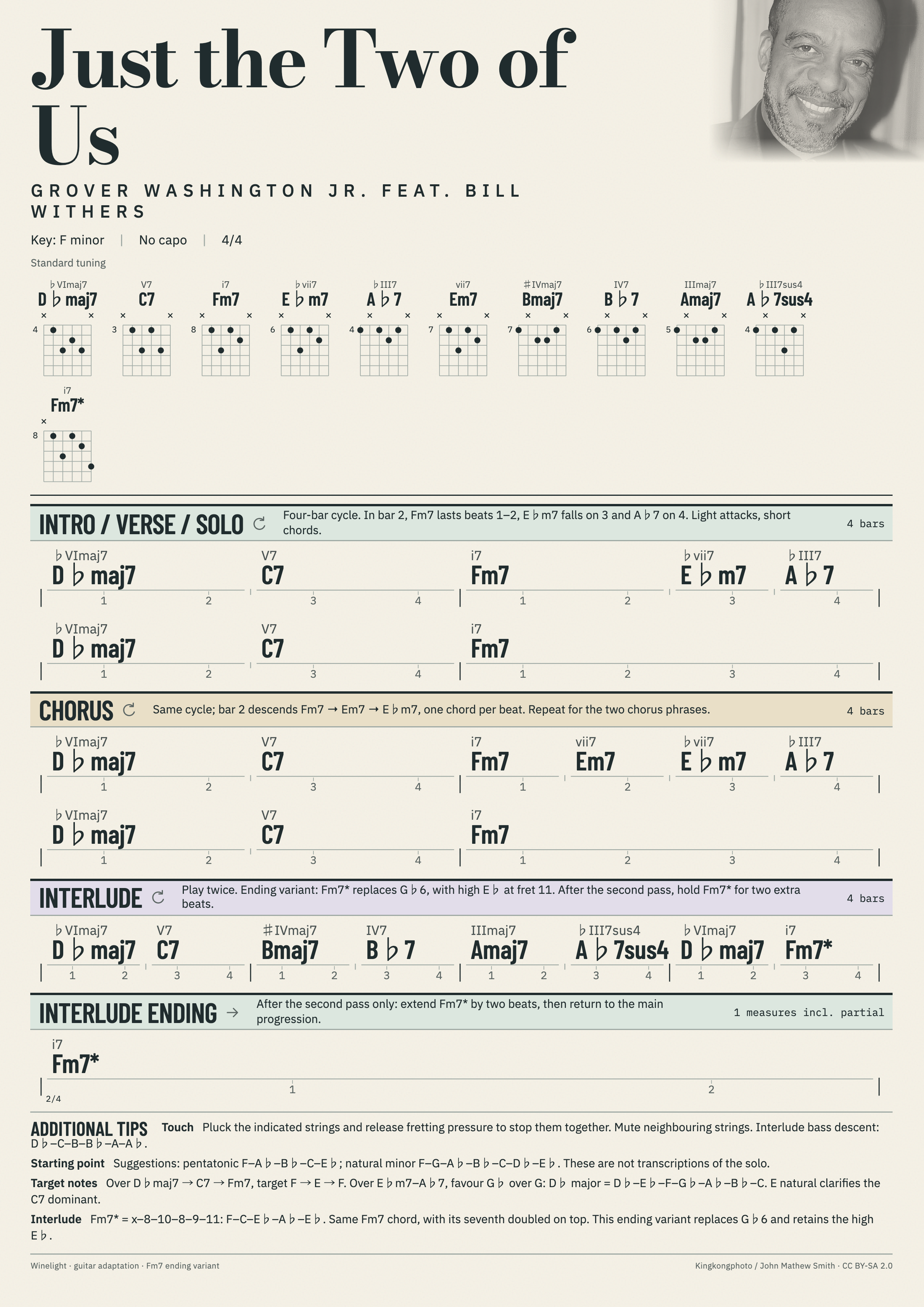
Editorial grip [None, 4, 6, 5, 6, None], low to high. Four notes, root in the bass, no open strings; complete chord. Closed grips allow the notes to stop together.
[2] TAB, Chorus idea 1
Dbmaj7 x46564 and C7 x35353 provide the same four inner voices; this edition mutes the first string. Fm7 and Em7 are shown as barre shapes.
[1] Chords, Options 1–3
Compares voicing families and the chromatic descent. Closed grips are editorial selections, not claimed to be Eric Gale’s fingerings.
C7 · harmony supported
C–E–G–B♭. Dominant of F; E natural is the leading tone. Degrees use F as tonic against the chromatic major reference; Nashgrid explicitly uses the minor scale.
[2] Chords + Lyrics, Intro / Chorus / Instrumental
The chord symbol appears in the corresponding chart.
[3] Page 1, Intro/A/B/Bridge
Same root and chord family; unsuspended A♭7 and G♭13 differ from the chosen variant.
C7 · voicing adapted
Editorial grip [None, 3, 5, 3, 5, None], low to high. Four notes, root in the bass, no open strings; complete chord. Closed grips allow the notes to stop together.
[2] TAB, Chorus idea 1
Dbmaj7 x46564 and C7 x35353 provide the same four inner voices; this edition mutes the first string. Fm7 and Em7 are shown as barre shapes.
[1] Chords, Options 1–3
Compares voicing families and the chromatic descent. Closed grips are editorial selections, not claimed to be Eric Gale’s fingerings.
Fm7 · harmony supported
F–A♭–C–E♭. Minor tonic; the cycle settles here. Degrees use F as tonic against the chromatic major reference; Nashgrid explicitly uses the minor scale.
[2] Chords + Lyrics, Intro / Chorus / Instrumental
The chord symbol appears in the corresponding chart.
[3] Page 1, Intro/A/B/Bridge
Same root and chord family; unsuspended A♭7 and G♭13 differ from the chosen variant.
Fm7 · voicing adapted
Editorial grip [None, 8, 10, 8, 9, None], low to high. Four notes, root in the bass, no open strings; complete chord. Closed grips allow the notes to stop together.
[2] TAB, Chorus idea 1
Dbmaj7 x46564 and C7 x35353 provide the same four inner voices; this edition mutes the first string. Fm7 and Em7 are shown as barre shapes.
[1] Chords, Options 1–3
Compares voicing families and the chromatic descent. Closed grips are editorial selections, not claimed to be Eric Gale’s fingerings.
E♭m7 · harmony supported
E♭–G♭–B♭–D♭. ii of D♭, outside F natural minor. Degrees use F as tonic against the chromatic major reference; Nashgrid explicitly uses the minor scale.
[2] Chords + Lyrics, Intro / Chorus / Instrumental
The chord symbol appears in the corresponding chart.
[3] Page 1, Intro/A/B/Bridge
Same root and chord family; unsuspended A♭7 and G♭13 differ from the chosen variant.
E♭m7 · voicing adapted
Editorial grip [None, 6, 8, 6, 7, None], low to high. Four notes, root in the bass, no open strings; complete chord. Closed grips allow the notes to stop together.
[2] TAB, Chorus idea 1
Dbmaj7 x46564 and C7 x35353 provide the same four inner voices; this edition mutes the first string. Fm7 and Em7 are shown as barre shapes.
[1] Chords, Options 1–3
Compares voicing families and the chromatic descent. Closed grips are editorial selections, not claimed to be Eric Gale’s fingerings.
A♭7 · harmony supported
A♭–C–E♭–G♭. V of D♭; forms ii–V with E♭m7. Degrees use F as tonic against the chromatic major reference; Nashgrid explicitly uses the minor scale.
[2] Chords + Lyrics, Intro / Chorus / Instrumental
The chord symbol appears in the corresponding chart.
[3] Page 1, Intro/A/B/Bridge
Same root and chord family; unsuspended A♭7 and G♭13 differ from the chosen variant.
A♭7 · voicing adapted
Editorial grip [4, None, 4, 5, 4, None], low to high. Four notes, root in the bass, no open strings; complete chord. Closed grips allow the notes to stop together.
[2] TAB, Chorus idea 1
Dbmaj7 x46564 and C7 x35353 provide the same four inner voices; this edition mutes the first string. Fm7 and Em7 are shown as barre shapes.
[1] Chords, Options 1–3
Compares voicing families and the chromatic descent. Closed grips are editorial selections, not claimed to be Eric Gale’s fingerings.
Em7 · harmony supported
E–G–B–D. Chromatic passing chord between Fm7 and E♭m7, without establishing a new tonic. Degrees use F as tonic against the chromatic major reference; Nashgrid explicitly uses the minor scale.
[2] Chords + Lyrics, Intro / Chorus / Instrumental
The chord symbol appears in the corresponding chart.
[3] Page 1, Intro/A/B/Bridge
Same root and chord family; unsuspended A♭7 and G♭13 differ from the chosen variant.
Em7 · voicing adapted
Editorial grip [None, 7, 9, 7, 8, None], low to high. Four notes, root in the bass, no open strings; complete chord. Closed grips allow the notes to stop together.
[2] TAB, Chorus idea 1
Dbmaj7 x46564 and C7 x35353 provide the same four inner voices; this edition mutes the first string. Fm7 and Em7 are shown as barre shapes.
[1] Chords, Options 1–3
Compares voicing families and the chromatic descent. Closed grips are editorial selections, not claimed to be Eric Gale’s fingerings.
Bmaj7 · harmony supported
B–D♯–F♯–A♯ (enharmonic C♭maj7). Chromatic descent in the interlude. Degrees use F as tonic against the chromatic major reference; Nashgrid explicitly uses the minor scale.
[2] Chords + Lyrics, Intro / Chorus / Instrumental
The chord symbol appears in the corresponding chart.
[3] Page 1, Intro/A/B/Bridge
Same root and chord family; unsuspended A♭7 and G♭13 differ from the chosen variant.
Bmaj7 · voicing adapted
Editorial grip [7, None, 8, 8, 7, None], low to high. Four notes, root in the bass, no open strings; complete chord. Closed grips allow the notes to stop together.
[2] TAB, Chorus idea 1
Dbmaj7 x46564 and C7 x35353 provide the same four inner voices; this edition mutes the first string. Fm7 and Em7 are shown as barre shapes.
[1] Chords, Options 1–3
Compares voicing families and the chromatic descent. Closed grips are editorial selections, not claimed to be Eric Gale’s fingerings.
B♭7 · harmony supported
B♭–D–F–A♭. Chromatic dominant in the interlude descent. Degrees use F as tonic against the chromatic major reference; Nashgrid explicitly uses the minor scale.
[2] Chords + Lyrics, Intro / Chorus / Instrumental
The chord symbol appears in the corresponding chart.
[3] Page 1, Intro/A/B/Bridge
Same root and chord family; unsuspended A♭7 and G♭13 differ from the chosen variant.
B♭7 · voicing adapted
Editorial grip [6, None, 6, 7, 6, None], low to high. Four notes, root in the bass, no open strings; complete chord. Closed grips allow the notes to stop together.
[2] TAB, Chorus idea 1
Dbmaj7 x46564 and C7 x35353 provide the same four inner voices; this edition mutes the first string. Fm7 and Em7 are shown as barre shapes.
[1] Chords, Options 1–3
Compares voicing families and the chromatic descent. Closed grips are editorial selections, not claimed to be Eric Gale’s fingerings.
Amaj7 · harmony supported
A–C♯–E–G♯ (enharmonic B𝄫maj7). Continues the chromatic descent. Degrees use F as tonic against the chromatic major reference; Nashgrid explicitly uses the minor scale.
[2] Chords + Lyrics, Intro / Chorus / Instrumental
The chord symbol appears in the corresponding chart.
[3] Page 1, Intro/A/B/Bridge
Same root and chord family; unsuspended A♭7 and G♭13 differ from the chosen variant.
Amaj7 · voicing adapted
Editorial grip [5, None, 6, 6, 5, None], low to high. Four notes, root in the bass, no open strings; complete chord. Closed grips allow the notes to stop together.
[2] TAB, Chorus idea 1
Dbmaj7 x46564 and C7 x35353 provide the same four inner voices; this edition mutes the first string. Fm7 and Em7 are shown as barre shapes.
[1] Chords, Options 1–3
Compares voicing families and the chromatic descent. Closed grips are editorial selections, not claimed to be Eric Gale’s fingerings.
A♭7sus4 · harmony adapted
A♭–D♭–E♭–G♭. Suspended variant retained for the interlude; third C omitted. Degrees use F as tonic against the chromatic major reference; Nashgrid explicitly uses the minor scale.
[2] Chords + Lyrics, Intro / Chorus / Instrumental
The chord symbol appears in the corresponding chart.
[3] Page 1, Intro/A/B/Bridge
Same root and chord family; unsuspended A♭7 and G♭13 differ from the chosen variant.
A♭7sus4 · voicing adapted
Editorial grip [4, None, 4, 6, 4, None], low to high. Four notes, root in the bass, no open strings; complete chord. Closed grips allow the notes to stop together.
[2] TAB, Chorus idea 1
Dbmaj7 x46564 and C7 x35353 provide the same four inner voices; this edition mutes the first string. Fm7 and Em7 are shown as barre shapes.
[1] Chords, Options 1–3
Compares voicing families and the chromatic descent. Closed grips are editorial selections, not claimed to be Eric Gale’s fingerings.
Fm7* · harmony adapted
Requested variant: Fm7 replaces G♭6 at the interlude ending. F–A♭–C–E♭, i7; its placement is a personal adaptation rather than a transcription finding.
[1] Just the Two of Us Chords, Option 1
Fm is the tonal centre; this supports the tonic analysis, not the ending substitution.
[2] Instrumental 1; TAB, Chorus idea 1
The source ends on G♭6 and shows Fm7 elsewhere; replacing it with Fm7* comes from the request rather than this source.
Fm7* · voicing adapted
Requested grip: x–8–10–8–9–11. Low to high: F3–C4–E♭4–A♭4–E♭5. First-string fret 11 adds E♭, the minor seventh already present; Fm7 remains in root position. Other Fm7 chords retain their four-string grip.
[1] Just the Two of Us Chords, Option 1
Fm is the tonal centre; this supports the tonic analysis, not the ending substitution.
[2] Instrumental 1; TAB, Chorus idea 1
The source ends on G♭6 and shows Fm7 elsewhere; replacing it with Fm7* comes from the request rather than this source.
Intro / Verse / Solo · harmony supported
Intro/A: D♭maj7–C7, then Fm7–E♭m7–A♭7, D♭maj7–C7 and Fm7.
[2] Intro / Verse 1 / Solo
Intro/A: D♭maj7–C7, then Fm7–E♭m7–A♭7, D♭maj7–C7 and Fm7.
[3] Page 1, Intro/A
Intro/A: D♭maj7–C7, then Fm7–E♭m7–A♭7, D♭maj7–C7 and Fm7.
Intro / Verse / Solo · timing supported
Four bars: 2+2; 2+1+1; 2+2; four quarter-note beats. Final Fm7 returns to D♭maj7 at the loop boundary.
[2] Intro / Verse 1 / Solo
Intro/A: D♭maj7–C7, then Fm7–E♭m7–A♭7, D♭maj7–C7 and Fm7.
[3] Page 1, Intro/A
Intro/A: D♭maj7–C7, then Fm7–E♭m7–A♭7, D♭maj7–C7 and Fm7.
Chorus · harmony supported
B adds Em7 between Fm7 and E♭m7.
[2] Chorus 1
B adds Em7 between Fm7 and E♭m7.
[3] Page 1, B
B adds Em7 between Fm7 and E♭m7.
Chorus · timing supported
Four bars: 2+2; 1+1+1+1; 2+2; four quarter-note beats.
[2] Chorus 1
B adds Em7 between Fm7 and E♭m7.
[3] Page 1, B
B adds Em7 between Fm7 and E♭m7.
Interlude · harmony adapted
Interlude descent retained, including A♭7sus4. Requested replacement of final G♭6 with Fm7*, high E♭ at fret 11; explicitly labelled adaptation.
[2] Instrumental 1
Bridge: D♭maj7–C7, Bmaj7–B♭7, Amaj7–A♭7, D♭maj7–G♭13.
[3] Page 1, Bridge, both systems
Bridge: D♭maj7–C7, Bmaj7–B♭7, Amaj7–A♭7, D♭maj7–G♭13.
Interlude · timing supported
Four bars, two chords of two quarter-note beats per bar; two passes before the ending.
[2] Instrumental 1
Bridge: D♭maj7–C7, Bmaj7–B♭7, Amaj7–A♭7, D♭maj7–G♭13.
[3] Page 1, Bridge, both systems
Bridge: D♭maj7–C7, Bmaj7–B♭7, Amaj7–A♭7, D♭maj7–G♭13.
Interlude ending · harmony adapted
Final extension retained, now on Fm7* instead of G♭6 as requested. Same E♭ on top, new bass F.
[2] Instrumental 1, final 2/4 bar
The bridge ends with a 2/4 extension.
[3] Page 1, Bridge, final 2/4 hold
The bridge ends with a 2/4 extension.
Interlude ending · timing supported
One two-beat bar after the second pass; duration retained, chord replaced by Fm7* as requested.
[2] Instrumental 1, final 2/4 bar
The bridge ends with a 2/4 extension.
[3] Page 1, Bridge, final 2/4 hold
The bridge ends with a 2/4 extension.
Key & tuning Harmonic interpretation
F minor without transposition; EADGBE, no capo. Four flats; C7 introduces E natural. A=440 chosen for this reference, not measured from the recording. [1] [3]
Chord functions
D♭–F–A♭–C. Colourful predominant leading through C7 to Fm7. [2] [3]
Harmonic interpretationE–G–B–D. Chromatic passing chord between Fm7 and E♭m7, without establishing a new tonic. [2] [3]
Harmonic interpretationB–D♯–F♯–A♯ (enharmonic C♭maj7). Chromatic descent in the interlude. [2] [3]
Harmonic interpretationA–C♯–E–G♯ (enharmonic B𝄫maj7). Continues the chromatic descent. [2] [3]
Harmonic interpretationMeter, duration & feel Harmonic interpretation
4/4; chart durations compared across sources. Separate two-beat ending extension, on Fm7* in the requested variant. No printed tempo or invented guitar attacks. [2] [3]
Choosing material for a looper Playing suggestion
The main four-bar cycle supports exploration; the chorus differs through Em7. The interlude stays separate because its chromatic chords do not overlay the main cycle. Its two-beat extension occurs once. Material supports at most two layers without prescribing track assignments. [2] [3]
Improvisation choices Playing suggestion
Suggestions: F minor pentatonic F A♭ B♭ C E♭, or natural minor F G A♭ B♭ C D♭ E♭. E over C7 and G♭ over E♭m7/A♭7; target F E F. Follow chord tones through the interlude rather than using one scale throughout. [1] [2]
Cross-checks & arrangement decisions
Key and main progression. F minor and four-bar cycles retained. A=440 is the working reference; Spy Tunes gives conflicting 447 and 444 Hz suggestions, neither adopted. [1] [2] [3]
Interlude colour variants. Spy Tunes uses A♭7sus4/G♭6; Lifebend uses A♭7/G♭13. Requested revision: Fm7* x–8–10–8–9–11 replaces the final G♭6. Labelled personal adaptation, not attributed to the recording. [2] [3] [1]
Limits of this edition
- Recording not independently auditioned; exact tempo and reference pitch unverified.
- 96 BPM is only an editorial Nashgrid playback default, not a researched tempo printed on the sheet.
- The interlude uses an explicit teaching variant; these grips are not claimed to be the recorded guitarist’s fingerings.
- Interlude ending: Fm7* with high E♭ replaces G♭6 as requested; this substitution does not come from the cited transcriptions.
- Melodic figures omitted: the unmeasured adaptations were not sufficiently recognizable in playing feedback and lacked independent listening verification.
Image research & credit
Kingkongphoto / John Mathew Smith · CC BY-SA 2.0
https://commons.wikimedia.org/wiki/File:Grover_Washington_1995.jpg ↗

Kingkongphoto / John Mathew Smith, CC BY-SA 2.0 (creativecommons.org/licenses/by-sa/2.0/). Cropped, desaturated and faded under the same licence.
Compared with Columbia Records’ Bill Withers portrait (1976). Grover selected after review for a readable face and explicit licence; the portrait postdates Winelight.
Sources
- Just the Two of Us Chords ↗
F minor, harmonic functions, passing Em7, voicing options and target notes.
Desi Serna / Guitar Music Theory · Lineage: desi-serna-2015 · Lesson by Desi Serna with his own harmonic analysis and guitar options; no attribution to Spy Tunes. - Just the Two Of Us — chords and TAB ↗
Four-bar cycles, chromatic chorus, interlude, two-beat ending and saxophone TAB.
Spy Tunes · Lineage: spytunes-arrangement · Teaching arrangement and TAB by Spy Tunes; no declared borrowing from Serna or Lifebend. - Just The Two Of Us — FUNK JAM SESSION ↗
4/4, four-flat key signature, A/B/Bridge charts, vocal and bridge melodies.
Lifebend Music School · Lineage: lifebend-session-chart · Session chart credited to Lifebend; its notation and variants differ from Spy Tunes rather than reproducing its graphics. - Just the Two of Us — Bruce Mock, 2011 ↗
Comparison with a transposed fingerstyle adaptation; not used to establish pitches or rhythm for the F-minor edition.
Bruce Mock / Acoustic Fingerstyle · Lineage: bruce-mock-2011 · Fingerstyle arrangement by Bruce Mock, December 2011; independently authored in E minor.