GUITAR / LOOPER-READY SHEET
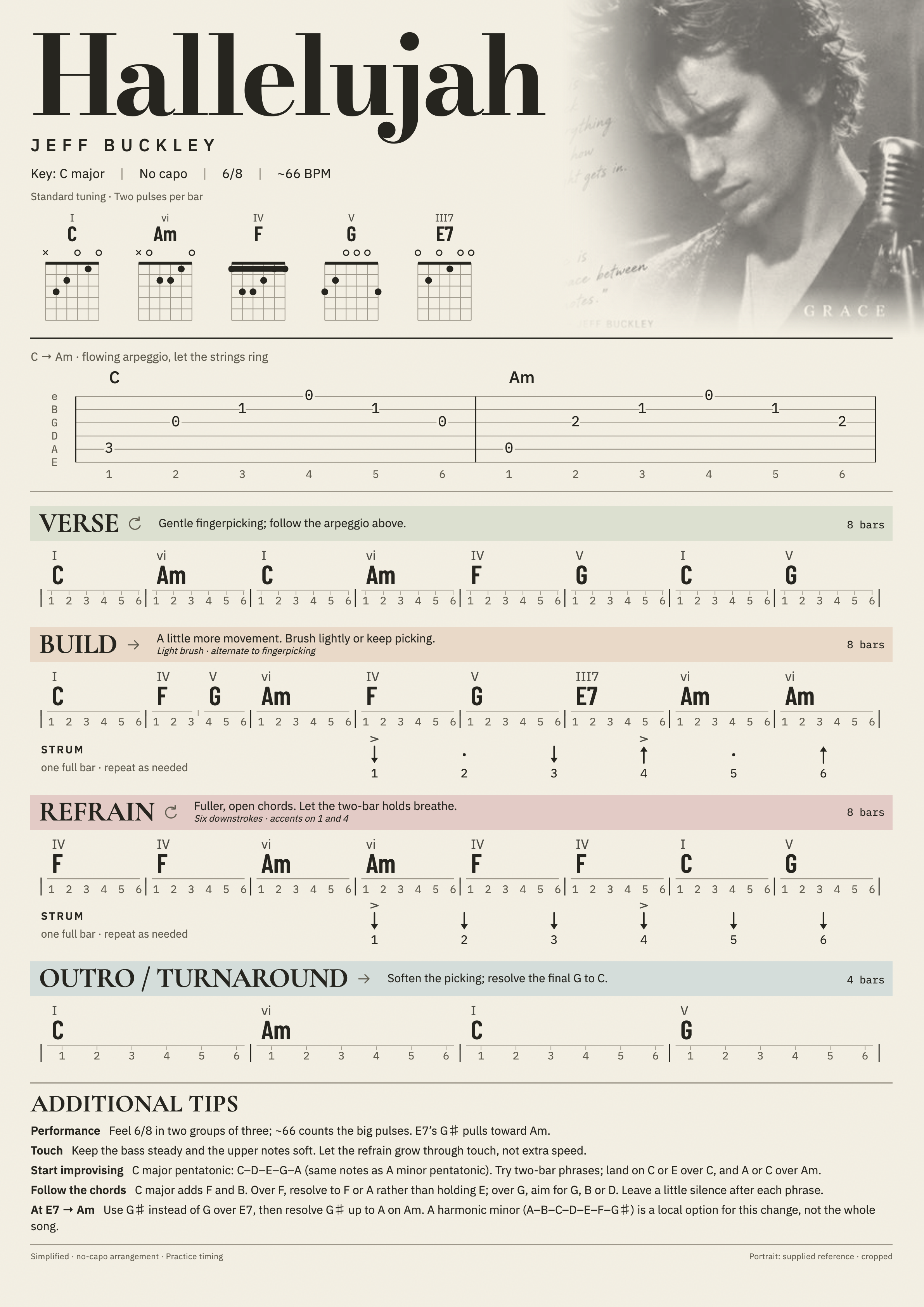
Hallelujah
Jeff Buckley
Simplified · no-capo arrangement
No checkout. No sign-up.
On your music stand.
The PDF is already set to A4. For the print view, choose portrait, 100% scale, no browser headers or footers, and enable background graphics.
Explore the sections freely. The sheet gives you the material; the arrangement is yours.
Sources & musical analysis
User-requested simplified no-capo C-major arrangement, inspired by Jeff Buckley’s Hallelujah (Grace, 1994).
Harmonic reference and accompaniment adaptation; not a note-for-note studio transcription.
Research record Retrospective reconstruction
Reconstructed from the saved song JSON, source list and earlier verification notes. The principal teaching articles were reopened and compared during this backfill. Remaining references retain their earlier scope, identified below; no new recording audition or complete tab audit was performed. Harmonic labels and practice choices below are explicit derivations from the displayed edition, with simplifications preserved rather than silently presented as studio facts. Claim-level evidence and fidelity records were added retrospectively from retained summaries; missing precise source locations are explicitly identified, and no claims were upgraded to supported.
Recording independently checked: No.
Passage fidelity
Verse · Practice adaptation
Preserved: The harmonic order and section selection in the previously generated edition.
Changed: Chord voicings and attacks are simplified; the exact displayed durations remain a practice adaptation rather than verified recording timing.
Checked: Measure totals, chord references and written repeat counts were structurally checked. Earlier research notes retained; no new audio audition or passage-specific corroboration.
Build · Practice adaptation
Preserved: The harmonic order and section selection in the previously generated edition.
Changed: Chord voicings and attacks are simplified; the exact displayed durations remain a practice adaptation rather than verified recording timing.
Checked: Measure totals, chord references and written repeat counts were structurally checked. Earlier research notes retained; no new audio audition or passage-specific corroboration.
Refrain · Practice adaptation
Preserved: The harmonic order and section selection in the previously generated edition.
Changed: Chord voicings and attacks are simplified; the exact displayed durations remain a practice adaptation rather than verified recording timing.
Checked: Measure totals, chord references and written repeat counts were structurally checked. Earlier research notes retained; no new audio audition or passage-specific corroboration.
Outro / Turnaround · Practice adaptation
Preserved: The harmonic order and section selection in the previously generated edition.
Changed: Chord voicings and attacks are simplified; the exact displayed durations remain a practice adaptation rather than verified recording timing.
Checked: Measure totals, chord references and written repeat counts were structurally checked. Earlier research notes retained; no new audio audition or passage-specific corroboration.
main-picking · Practice adaptation
Preserved: The complete displayed phrase and pitch selection of the earlier sheet.
Changed: Rhythm and/or chord-tone accompaniment are authored simplifications; exact recording articulation and duration are not asserted.
Checked: String/fret ranges, onset grid and bar boundaries validated; no new note-for-note or listening verification.
Claim-level evidence
Song · key inferred
C major is the selected tonal frame; This edition sounds in C major with standard tuning and no capo. The two teaching articles distinguish concert C from Buckley’s G-family capo-5 shapes. We retain concert pitch but simplify the voicings; removing the capo does not make this an exact studio guitar part.
[1] Earlier retained source summary; precise passage location not retained
C-family harmonic framework, compound meter, verse/build/refrain structure; Buckley vs Cohen distinctions. This retained summary is not a fresh claim-level check.
[2] Earlier retained source summary; precise passage location not retained
Simplified no-capo C-family shapes, six eighth-note strokes and accents on 1 and 4. This retained summary is not a fresh claim-level check.
Song · tuning inferred
Displayed tuning: E2 A2 D3 G3 B3 E4; capo 0. Retained edition choice; a new claim-level source check has not been performed.
[1] Earlier retained source summary; precise passage location not retained
C-family harmonic framework, compound meter, verse/build/refrain structure; Buckley vs Cohen distinctions. This retained summary is not a fresh claim-level check.
[2] Earlier retained source summary; precise passage location not retained
Simplified no-capo C-family shapes, six eighth-note strokes and accents on 1 and 4. This retained summary is not a fresh claim-level check.
Song · meter inferred
6/8 is the displayed meter, retained from the earlier preparation; exact source passage not retained.
[1] Earlier retained source summary; precise passage location not retained
C-family harmonic framework, compound meter, verse/build/refrain structure; Buckley vs Cohen distinctions. This retained summary is not a fresh claim-level check.
[2] Earlier retained source summary; precise passage location not retained
Simplified no-capo C-family shapes, six eighth-note strokes and accents on 1 and 4. This retained summary is not a fresh claim-level check.
Song · tempo inferred
66 dotted-quarter BPM is the approximate practice reference retained from the earlier edition, not a new recording measurement.
[1] Earlier retained source summary; precise passage location not retained
C-family harmonic framework, compound meter, verse/build/refrain structure; Buckley vs Cohen distinctions. This retained summary is not a fresh claim-level check.
[2] Earlier retained source summary; precise passage location not retained
Simplified no-capo C-family shapes, six eighth-note strokes and accents on 1 and 4. This retained summary is not a fresh claim-level check.
C · harmony inferred
C–E–G forms the tonic triad on degree 1 of C major: I. Its resting function anchors the selected sections.
[1] Earlier retained source summary; precise passage location not retained
C-family harmonic framework, compound meter, verse/build/refrain structure; Buckley vs Cohen distinctions. This retained summary is not a fresh claim-level check.
[2] Earlier retained source summary; precise passage location not retained
Simplified no-capo C-family shapes, six eighth-note strokes and accents on 1 and 4. This retained summary is not a fresh claim-level check.
C · voicing adapted
Edition grip, low to high: [null, 3, 2, 0, 1, 0]. Null is muted; 0 is open. An authored playable voicing, not a claim of the exact recorded guitar grip.
[1] Earlier retained source summary; precise passage location not retained
C-family harmonic framework, compound meter, verse/build/refrain structure; Buckley vs Cohen distinctions. This retained summary is not a fresh claim-level check.
[2] Earlier retained source summary; precise passage location not retained
Simplified no-capo C-family shapes, six eighth-note strokes and accents on 1 and 4. This retained summary is not a fresh claim-level check.
Am · harmony inferred
A–C–E is the minor triad on degree 6: vi. Shared C and E make movement between C and Am smooth without implying a change of global key.
[1] Earlier retained source summary; precise passage location not retained
C-family harmonic framework, compound meter, verse/build/refrain structure; Buckley vs Cohen distinctions. This retained summary is not a fresh claim-level check.
[2] Earlier retained source summary; precise passage location not retained
Simplified no-capo C-family shapes, six eighth-note strokes and accents on 1 and 4. This retained summary is not a fresh claim-level check.
Am · voicing adapted
Edition grip, low to high: [null, 0, 2, 2, 1, 0]. Null is muted; 0 is open. An authored playable voicing, not a claim of the exact recorded guitar grip.
[1] Earlier retained source summary; precise passage location not retained
C-family harmonic framework, compound meter, verse/build/refrain structure; Buckley vs Cohen distinctions. This retained summary is not a fresh claim-level check.
[2] Earlier retained source summary; precise passage location not retained
Simplified no-capo C-family shapes, six eighth-note strokes and accents on 1 and 4. This retained summary is not a fresh claim-level check.
F · harmony inferred
F–A–C is the major triad on degree 4: IV. F is a useful local landing note even though it is absent from C major pentatonic.
[1] Earlier retained source summary; precise passage location not retained
C-family harmonic framework, compound meter, verse/build/refrain structure; Buckley vs Cohen distinctions. This retained summary is not a fresh claim-level check.
[2] Earlier retained source summary; precise passage location not retained
Simplified no-capo C-family shapes, six eighth-note strokes and accents on 1 and 4. This retained summary is not a fresh claim-level check.
F · voicing adapted
Edition grip, low to high: [1, 3, 3, 2, 1, 1]. Null is muted; 0 is open. An authored playable voicing, not a claim of the exact recorded guitar grip.
[1] Earlier retained source summary; precise passage location not retained
C-family harmonic framework, compound meter, verse/build/refrain structure; Buckley vs Cohen distinctions. This retained summary is not a fresh claim-level check.
[2] Earlier retained source summary; precise passage location not retained
Simplified no-capo C-family shapes, six eighth-note strokes and accents on 1 and 4. This retained summary is not a fresh claim-level check.
G · harmony inferred
G–B–D is the major triad on degree 5: V. B can resolve to C as the harmony returns to the tonic.
[1] Earlier retained source summary; precise passage location not retained
C-family harmonic framework, compound meter, verse/build/refrain structure; Buckley vs Cohen distinctions. This retained summary is not a fresh claim-level check.
[2] Earlier retained source summary; precise passage location not retained
Simplified no-capo C-family shapes, six eighth-note strokes and accents on 1 and 4. This retained summary is not a fresh claim-level check.
G · voicing adapted
Edition grip, low to high: [3, 2, 0, 0, 0, 3]. Null is muted; 0 is open. An authored playable voicing, not a claim of the exact recorded guitar grip.
[1] Earlier retained source summary; precise passage location not retained
C-family harmonic framework, compound meter, verse/build/refrain structure; Buckley vs Cohen distinctions. This retained summary is not a fresh claim-level check.
[2] Earlier retained source summary; precise passage location not retained
Simplified no-capo C-family shapes, six eighth-note strokes and accents on 1 and 4. This retained summary is not a fresh claim-level check.
E7 · harmony inferred
E–G♯–B–D contains G♯ outside C major. The printed III7 describes its root and quality; its stronger functional reading is V7/vi, the applied dominant of Am. G♯ resolves upward to A. The sheet uses root-position E7 instead of the source’s inverted voicing.
[1] Earlier retained source summary; precise passage location not retained
C-family harmonic framework, compound meter, verse/build/refrain structure; Buckley vs Cohen distinctions. This retained summary is not a fresh claim-level check.
[2] Earlier retained source summary; precise passage location not retained
Simplified no-capo C-family shapes, six eighth-note strokes and accents on 1 and 4. This retained summary is not a fresh claim-level check.
E7 · voicing adapted
Edition grip, low to high: [0, 2, 0, 1, 0, 0]. Null is muted; 0 is open. An authored playable voicing, not a claim of the exact recorded guitar grip.
[1] Earlier retained source summary; precise passage location not retained
C-family harmonic framework, compound meter, verse/build/refrain structure; Buckley vs Cohen distinctions. This retained summary is not a fresh claim-level check.
[2] Earlier retained source summary; precise passage location not retained
Simplified no-capo C-family shapes, six eighth-note strokes and accents on 1 and 4. This retained summary is not a fresh claim-level check.
Verse · timing adapted
Practice timing in meter-denominator units per chord; bars: C: 6 | Am: 6 | C: 6 | Am: 6 | F: 6 | G: 6 | C: 6 | G: 6. Retained normalization; these exact durations have not been independently corroborated at the claim level.
[1] Earlier retained source summary; precise passage location not retained
C-family harmonic framework, compound meter, verse/build/refrain structure; Buckley vs Cohen distinctions. This retained summary is not a fresh claim-level check.
[2] Earlier retained source summary; precise passage location not retained
Simplified no-capo C-family shapes, six eighth-note strokes and accents on 1 and 4. This retained summary is not a fresh claim-level check.
Verse · harmony inferred
Selected chord order: C | Am | C | Am | F | G | C | G. Derived from the existing edition and retained source summaries; no new full-transcription check.
[1] Earlier retained source summary; precise passage location not retained
C-family harmonic framework, compound meter, verse/build/refrain structure; Buckley vs Cohen distinctions. This retained summary is not a fresh claim-level check.
[2] Earlier retained source summary; precise passage location not retained
Simplified no-capo C-family shapes, six eighth-note strokes and accents on 1 and 4. This retained summary is not a fresh claim-level check.
Build · timing adapted
Practice timing in meter-denominator units per chord; bars: C: 6 | F: 3 / G: 3 | Am: 6 | F: 6 | G: 6 | E7: 6 | Am: 6 | Am: 6. Retained normalization; these exact durations have not been independently corroborated at the claim level.
[1] Earlier retained source summary; precise passage location not retained
C-family harmonic framework, compound meter, verse/build/refrain structure; Buckley vs Cohen distinctions. This retained summary is not a fresh claim-level check.
[2] Earlier retained source summary; precise passage location not retained
Simplified no-capo C-family shapes, six eighth-note strokes and accents on 1 and 4. This retained summary is not a fresh claim-level check.
Build · harmony inferred
Selected chord order: C | F → G | Am | F | G | E7 | Am | Am. Derived from the existing edition and retained source summaries; no new full-transcription check.
[1] Earlier retained source summary; precise passage location not retained
C-family harmonic framework, compound meter, verse/build/refrain structure; Buckley vs Cohen distinctions. This retained summary is not a fresh claim-level check.
[2] Earlier retained source summary; precise passage location not retained
Simplified no-capo C-family shapes, six eighth-note strokes and accents on 1 and 4. This retained summary is not a fresh claim-level check.
Refrain · timing adapted
Practice timing in meter-denominator units per chord; bars: F: 6 | F: 6 | Am: 6 | Am: 6 | F: 6 | F: 6 | C: 6 | G: 6. Retained normalization; these exact durations have not been independently corroborated at the claim level.
[1] Earlier retained source summary; precise passage location not retained
C-family harmonic framework, compound meter, verse/build/refrain structure; Buckley vs Cohen distinctions. This retained summary is not a fresh claim-level check.
[2] Earlier retained source summary; precise passage location not retained
Simplified no-capo C-family shapes, six eighth-note strokes and accents on 1 and 4. This retained summary is not a fresh claim-level check.
Refrain · harmony inferred
Selected chord order: F | F | Am | Am | F | F | C | G. Derived from the existing edition and retained source summaries; no new full-transcription check.
[1] Earlier retained source summary; precise passage location not retained
C-family harmonic framework, compound meter, verse/build/refrain structure; Buckley vs Cohen distinctions. This retained summary is not a fresh claim-level check.
[2] Earlier retained source summary; precise passage location not retained
Simplified no-capo C-family shapes, six eighth-note strokes and accents on 1 and 4. This retained summary is not a fresh claim-level check.
Outro / Turnaround · timing adapted
Practice timing in meter-denominator units per chord; bars: C: 6 | Am: 6 | C: 6 | G: 6. Retained normalization; these exact durations have not been independently corroborated at the claim level.
[1] Earlier retained source summary; precise passage location not retained
C-family harmonic framework, compound meter, verse/build/refrain structure; Buckley vs Cohen distinctions. This retained summary is not a fresh claim-level check.
[2] Earlier retained source summary; precise passage location not retained
Simplified no-capo C-family shapes, six eighth-note strokes and accents on 1 and 4. This retained summary is not a fresh claim-level check.
Outro / Turnaround · harmony inferred
Selected chord order: C | Am | C | G. Derived from the existing edition and retained source summaries; no new full-transcription check.
[1] Earlier retained source summary; precise passage location not retained
C-family harmonic framework, compound meter, verse/build/refrain structure; Buckley vs Cohen distinctions. This retained summary is not a fresh claim-level check.
[2] Earlier retained source summary; precise passage location not retained
Simplified no-capo C-family shapes, six eighth-note strokes and accents on 1 and 4. This retained summary is not a fresh claim-level check.
main-picking · timing adapted
2 written measures on a subdivision-1 grid. The displayed onsets, gaps and durations are explicitly practice timing; no precise independent timing corroboration was retained.
[1] Earlier retained source summary; precise passage location not retained
C-family harmonic framework, compound meter, verse/build/refrain structure; Buckley vs Cohen distinctions. This retained summary is not a fresh claim-level check.
[2] Earlier retained source summary; precise passage location not retained
Simplified no-capo C-family shapes, six eighth-note strokes and accents on 1 and 4. This retained summary is not a fresh claim-level check.
main-picking · pitches adapted
C → Am · flowing arpeggio, let the strings ring Pitch order is retained from the earlier simplified selection. This record does not upgrade it to an independently verified studio phrase.
[1] Earlier retained source summary; precise passage location not retained
C-family harmonic framework, compound meter, verse/build/refrain structure; Buckley vs Cohen distinctions. This retained summary is not a fresh claim-level check.
[2] Earlier retained source summary; precise passage location not retained
Simplified no-capo C-family shapes, six eighth-note strokes and accents on 1 and 4. This retained summary is not a fresh claim-level check.
Key & tuning Harmonic interpretation
This edition sounds in C major with standard tuning and no capo. The two teaching articles distinguish concert C from Buckley’s G-family capo-5 shapes. We retain concert pitch but simplify the voicings; removing the capo does not make this an exact studio guitar part. [1] [2]
Chord functions
C–E–G forms the tonic triad on degree 1 of C major: I. Its resting function anchors the selected sections. [1] [2]
Harmonic interpretationA–C–E is the minor triad on degree 6: vi. Shared C and E make movement between C and Am smooth without implying a change of global key. [1] [2]
Harmonic interpretationF–A–C is the major triad on degree 4: IV. F is a useful local landing note even though it is absent from C major pentatonic. [1] [2]
Harmonic interpretationMeter, duration & feel Harmonic interpretation
The page normalizes the accompaniment to six eighth-note units per bar, felt as two groups of three. Verse and Build each contain eight written bars; Build retains the half-bar F/G change. The eight-bar refrain and four-bar turnaround are selected adaptations. Approximately 66 dotted-quarter BPM is a practice setting inherited from the earlier edition, not newly measured or independently confirmed here. The featured tab is a complete chord-tone picking study, not an exact intro transcription. [1] [2]
Choosing material for a looper Playing suggestion
The alternating C/Am material is a simple recurring bed, while the full build includes a directional E7→Am resolution that should stay intact. A loop crossing different sections needs matching chord durations; sharing a key alone does not guarantee compatibility. Keep any second layer sparse and harmonically aligned; melodic phrases can remain live. These are selection reasons, not a prescribed two-track performance. The icons identify verse/refrain cycles and directional build/ending passages in this edition; the latter remain available for personal looping experiments. [1] [2]
Improvisation choices Playing suggestion
Start from C major pentatonic (C D E G A), then use F and B from C major to target IV and V. Chord tones provide stronger landing points than indiscriminately running a scale. Over E7, introduce G♯ and resolve it to A on Am; A harmonic minor (A B C D E F G♯) is a local option for that resolution. These are derived practice suggestions, not reported choices from Buckley’s recorded improvisation. [1] [2]
Cross-checks & arrangement decisions
No capo and C-major chord shapes. Explicit user preference overrides studio capo 5; label the sheet simplified. [1] [2]
Verse and build duration. Use an explicit simplified 16-bar verse split into 8+8, with F and G sharing one bar in the build. Sustain the final Am instead of the source rest. [1] [2]
Refrain and turnaround. Use an eight-bar refrain followed by a separate four-bar simplified turnaround. This is a playable map, not the studio outro. [1]
Fingerpicking and strumming. Adapt the six-note bass–G–B–e–B–G pattern to each written chord; the light brush is a suggested alternative. [3] [2]
Tempo disagreements. Use approximately 66 dotted-quarter pulses per minute for this simplified arrangement. Other sources use different pulse units or versions. [4] [3]
Limits of this edition
- Recording was not independently auditioned in this session.
- Free studio intro, exact voicings, vocal melody and improvised outro are omitted.
- Tabs are chord-tone accompaniment adaptations, not claims of exact Buckley notes.
- Additional tips are authored improvisation suggestions derived from the displayed harmony, not claims about the artist’s recorded solo choices.
Image research & credit
Portrait: supplied reference · cropped
User-supplied docs/reference.jpg
Supplied by Mathias for this private reference; photographer and public redistribution rights not established.
The requested Jeff Buckley visual reference; only the portrait area is embedded, never its generated notation. Retrospectively documented.
Sources
- Spy Tunes — Hallelujah chord analysis ↗
C-family harmonic framework, compound meter, verse/build/refrain structure; Buckley vs Cohen distinctions.
Spy Tunes · Lineage: spy-tunes · Separately authored teaching article; text rechecked for this retrospective record. - Jon MacLennan — Hallelujah lesson ↗
Simplified no-capo C-family shapes, six eighth-note strokes and accents on 1 and 4.
Jon MacLennan · Lineage: jon-maclennan · Independent named guitar teacher; lesson text rechecked, with differing voicing detail. - Relax and Learn Guitar — Hallelujah ↗
A complete six-onset ascending/descending picking model; adapted here to no-capo chord shapes.
Relax and Learn Guitar · Lineage: relax-and-learn-guitar · Separate teaching PDF retained from the earlier research; not re-audited during this backfill. - Notendownload — simplified Hallelujah arrangement ↗
66 BPM as a simplified-arrangement reference, not a measured constant studio tempo.
Notendownload · Lineage: notendownload · Separate published arrangement metadata retained from the earlier research; not a measured recording tempo.