GUITAR / LOOPER-READY SHEET
Fast Car
Tracy Chapman
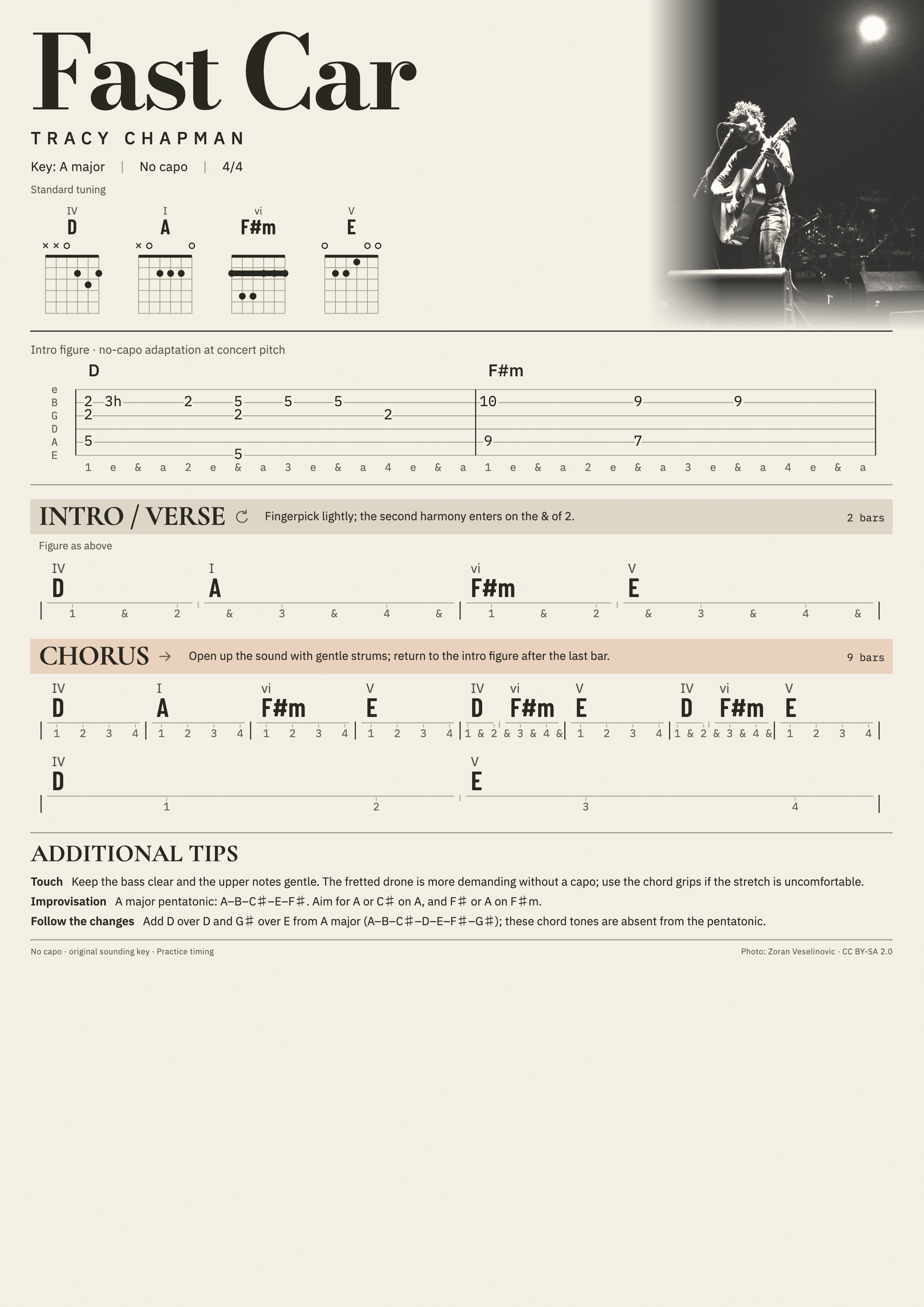
No capo · original sounding key
No checkout. No sign-up.
On your music stand.
For the print view, choose A4 paper, portrait, 100% scale, no browser headers or footers, and enable background graphics.
Explore the sections freely. The sheet gives you the material; the arrangement is yours.
Sources & musical analysis
1988 Tracy Chapman studio recording; no-capo arrangement in the original sounding key.
A compact playing reference, adapted for standard tuning without a capo.
Research record Collected while preparing this sheet
Compared independently authored guitar lessons and a recording analysis, then shifted capo-relative pitches to concert pitch without a capo. The record was not auditioned.
Recording independently checked: No.
Passage fidelity
Intro / Verse · Practice adaptation
Preserved: D A F♯m E, repeated over two bars.
Changed: Full accompaniment grips; durations are a practice normalization, especially the final chorus bar.
Checked: Compared the cited form and counted measure totals; no independent recording audition.
Chorus · Practice adaptation
Preserved: D A F♯m E followed by D F♯m E twice and D E.
Changed: Full accompaniment grips; durations are a practice normalization, especially the final chorus bar.
Checked: Compared the cited form and counted measure totals; no independent recording audition.
main-riff · Practice adaptation
Preserved: Two-bar harmonic cycle, opening hammer-on and upper string movement.
Changed: Frets shifted for no capo; A uses a low E string bass, and the drone is omitted in the second bar to avoid an unplayable stretch. Attack sequence is simplified.
Checked: Compared source diagrams and counted text tab; pitch and physical stretch need a player check.
Claim-level evidence
Song · key inferred
A major sounding key with no capo, retained from the cited recording analysis.
[1] Verse and chorus analysis
Lists D A F♯m E and describes faster verse changes and slower chorus.
[2] Verse
Gives two-bar C G / Em D shapes and second chord on the and of 2.
Song · tuning inferred
Standard E A D G B E tuning; no capo is a deliberate arrangement.
[3] Guitar Tab, intro bars 1–2
Gives capo-relative pitches and an eighth-note count grid; bass voicing differs among transcriptions.
[4] Fingerpicking Technique and Verse
Describes the opening hammer-on and the Cmaj7 C G Em D shape sequence.
Song · meter inferred
4/4 interpreted from the counted eighth-note grid.
[2] Verse
Gives two-bar C G / Em D shapes and second chord on the and of 2.
[3] Guitar Tab, intro bars 1–2
Gives capo-relative pitches and an eighth-note count grid; bass voicing differs among transcriptions.
D · harmony inferred
D: D–F♯–A; IV in A major. Standard full grip used for strumming; the picked figure uses reduced voicings.
[1] Verse and chorus analysis
Lists D A F♯m E and describes faster verse changes and slower chorus.
[2] Verse
Gives two-bar C G / Em D shapes and second chord on the and of 2.
D · voicing adapted
No-capo accompaniment shape [None, None, 0, 2, 3, 2]; a full grip replaces the sparse picked voicings.
[1] Verse and chorus analysis
Lists D A F♯m E and describes faster verse changes and slower chorus.
[4] Fingerpicking Technique and Verse
Describes the opening hammer-on and the Cmaj7 C G Em D shape sequence.
A · harmony inferred
A: A–C♯–E; I in A major. Standard full grip used for strumming; the picked figure uses reduced voicings.
[1] Verse and chorus analysis
Lists D A F♯m E and describes faster verse changes and slower chorus.
[2] Verse
Gives two-bar C G / Em D shapes and second chord on the and of 2.
A · voicing adapted
No-capo accompaniment shape [None, 0, 2, 2, 2, 0]; a full grip replaces the sparse picked voicings.
[1] Verse and chorus analysis
Lists D A F♯m E and describes faster verse changes and slower chorus.
[4] Fingerpicking Technique and Verse
Describes the opening hammer-on and the Cmaj7 C G Em D shape sequence.
F#m · harmony inferred
F#m: F♯–A–C♯; vi in A major. Standard full grip used for strumming; the picked figure uses reduced voicings.
[1] Verse and chorus analysis
Lists D A F♯m E and describes faster verse changes and slower chorus.
[2] Verse
Gives two-bar C G / Em D shapes and second chord on the and of 2.
F#m · voicing adapted
No-capo accompaniment shape [2, 4, 4, 2, 2, 2]; a full grip replaces the sparse picked voicings.
[1] Verse and chorus analysis
Lists D A F♯m E and describes faster verse changes and slower chorus.
[4] Fingerpicking Technique and Verse
Describes the opening hammer-on and the Cmaj7 C G Em D shape sequence.
E · harmony inferred
E: E–G♯–B; V in A major. Standard full grip used for strumming; the picked figure uses reduced voicings.
[1] Verse and chorus analysis
Lists D A F♯m E and describes faster verse changes and slower chorus.
[2] Verse
Gives two-bar C G / Em D shapes and second chord on the and of 2.
E · voicing adapted
No-capo accompaniment shape [0, 2, 2, 1, 0, 0]; a full grip replaces the sparse picked voicings.
[1] Verse and chorus analysis
Lists D A F♯m E and describes faster verse changes and slower chorus.
[4] Fingerpicking Technique and Verse
Describes the opening hammer-on and the Cmaj7 C G Em D shape sequence.
Intro / Verse · harmony inferred
D A F♯m E, repeated over two bars.
[1] Verse and chorus analysis
Lists D A F♯m E and describes faster verse changes and slower chorus.
[2] Verse
Gives two-bar C G / Em D shapes and second chord on the and of 2.
Intro / Verse · timing adapted
Two bars; each chord pair divided 1.5 and 2.5 beats.
[1] Verse and chorus analysis
Lists D A F♯m E and describes faster verse changes and slower chorus.
[2] Verse
Gives two-bar C G / Em D shapes and second chord on the and of 2.
Chorus · harmony inferred
D A F♯m E followed by D F♯m E twice and D E.
[1] Verse and chorus analysis
Lists D A F♯m E and describes faster verse changes and slower chorus.
[2] Verse
Gives two-bar C G / Em D shapes and second chord on the and of 2.
Chorus · timing adapted
Four full-bar chords, two 1.5/2.5-beat split bars each followed by E, and a final D/E bar split equally; final division is an adaptation.
[1] Verse and chorus analysis
Lists D A F♯m E and describes faster verse changes and slower chorus.
[2] Verse
Gives two-bar C G / Em D shapes and second chord on the and of 2.
main-riff · pitches adapted
Two-bar riff adapted from capo-relative pitches at concert pitch; the A root is played on low E fret 5, and labels describe the underlying harmony.
[3] Guitar Tab, intro bars 1–2
Gives capo-relative pitches and an eighth-note count grid; bass voicing differs among transcriptions.
[4] Fingerpicking Technique and Verse
Describes the opening hammer-on and the Cmaj7 C G Em D shape sequence.
main-riff · timing adapted
Two 4/4 measures with selected eighth-note attacks and opening hammer-on; simplified pulse, not a recording transcription.
[3] Guitar Tab, intro bars 1–2
Gives capo-relative pitches and an eighth-note count grid; bass voicing differs among transcriptions.
[4] Fingerpicking Technique and Verse
Describes the opening hammer-on and the Cmaj7 C G Em D shape sequence.
Key & tuning Harmonic interpretation
Studio sounding key A major; standard tuning. No capo in this edition. [1] [2]
Chord functions
D: D–F♯–A; IV in A major. Standard full grip used for strumming; the picked figure uses reduced voicings. [1] [2]
Harmonic interpretationA: A–C♯–E; I in A major. Standard full grip used for strumming; the picked figure uses reduced voicings. [1] [2]
Harmonic interpretationMeter, duration & feel Harmonic interpretation
4/4. Verse second chord anticipates beat 3 on the and of 2. Chorus starts with one chord per bar; later splits and final bar are normalized. Tempo changes, so no fixed studio tempo is asserted. [1] [2]
Choosing material for a looper Playing suggestion
The two-bar verse cycle is suitable as a loop; the chorus is a longer phrase with a different harmonic rhythm. A second layer should follow the same change points. [1] [2]
Improvisation choices Playing suggestion
A major: A B C♯ D E F♯ G♯. A major pentatonic: A B C♯ E F♯. Land on D over D, A or C♯ over A, F♯ over F♯m and G♯ over E; the pentatonic misses D and G♯. [1] [2]
Cross-checks & arrangement decisions
Sounding key and no-capo arrangement. Capo 2 G shapes sound in A; this edition retains A and uses no capo. [1] [2]
Riff voicing and timing. Transpose selected capo-relative frets to concert pitch and label the simplified timing. [3] [4]
Chorus form. Retain the distinct chorus; its final D/E duration is a practical approximation. [1] [2]
Limits of this edition
- Recording was not independently auditioned.
- The no-capo picking uses a partial fretted drone and has not been physically play-tested.
- The displayed rhythm and final chorus split are practice adaptations, not verified note-for-note transcription.
- The intro variation is omitted for space.
Image research & credit
Photo: Zoran Veselinovic · CC BY-SA 2.0
https://commons.wikimedia.org/wiki/File:Tracy-Chapman_1988_by_Zoran_Veselinovic.jpg ↗

Zoran Veselinovic, CC BY-SA 2.0; attribution and same-license terms apply; cropped for the page.
An image of Chapman performing in 1988, the year of the original recording.
Sources
- Ethan Hein analysis ↗
Verse and chorus harmony, key, studio tempo changes
MusicRadar · Lineage: hein · Independently authored analysis of the recording. - Fast Car guitar lesson ↗
Two-bar verse and the anticipation on the and of two
Jon MacLennan · Lineage: mac · Independently authored guitar lesson. - Fast Car guitar tab ↗
Counted guitar figure and no-capo-relative shape pitches
Bell & Co Music · Lineage: bell · Independently presented guitar transcription. - Fast Car guitar lesson ↗
Fingerpicking, harmonic shape sequence and intro variation
JustinGuitar · Lineage: justin · Separate guitar lesson by JustinGuitar.