GUITAR / LOOPER-READY SHEET
Complicated
Avril Lavigne
Independent revision · adapted acoustic accompaniment
No checkout. No sign-up.
On your music stand.
For the print view, choose A4 paper, portrait, 100% scale, no browser headers or footers, and enable background graphics.
Explore the sections freely. The sheet gives you the material; the arrangement is yours.
Sources & musical analysis
Reference: Let Go studio version (2002); acoustic reduction, not a note-for-note transcription.
Independent research completed before reading the earlier sheet. Acoustic reduction in F, three sections, explicitly adapted durations and strumming.
Research record Collected while preparing this sheet
Research started from external sources without reading the earlier sheet. Rock Out chart downloaded; page 1 rendered and visually inspected. E-Chords, Songsterr, GuitarTabsExplorer, Scarborough and Musicnotes metadata consulted. Community origins conservatively grouped. Confirmed scope: one page, photo A, three sections, no lead. Played durations declared adapted because only one chart is countable. No recording audition claimed.
Recording independently checked: No.
Passage fidelity
Verse / bridge · Practice adaptation
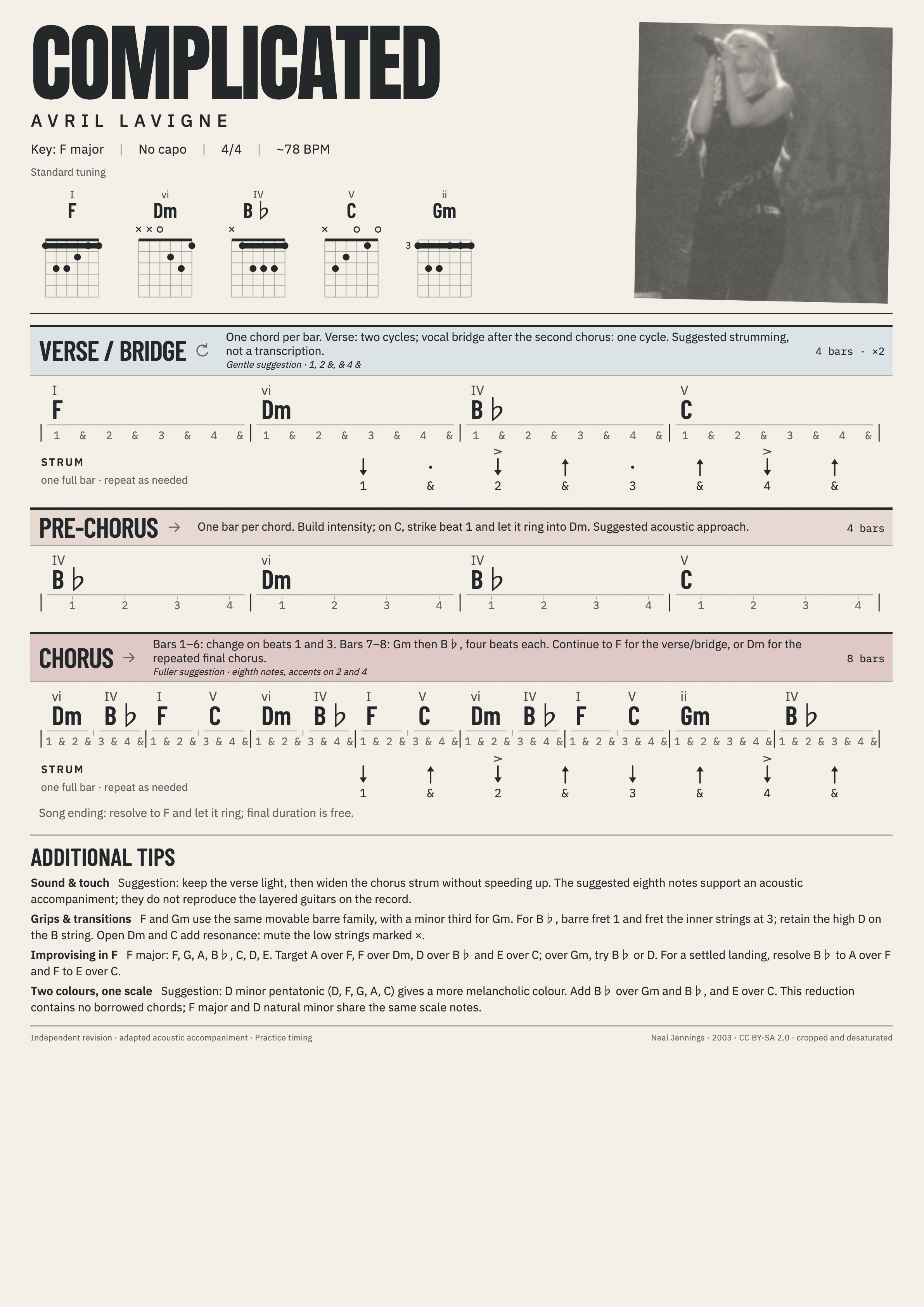
Preserved: F–Dm–B♭–C; same cycle for the vocal bridge. Retains the contrast between full-bar verse chords and half-bar chorus changes.
Changed: Suggested full chords and acoustic strumming. Electric doubles, intro lead and fills omitted. Condensed navigation, not a complete transcription.
Checked: Rock Out chart consulted and page 1 visually inspected; chord order compared with E-Chords and Songsterr. Four-quarter-note totals and change positions checked. No recording audition claimed.
Pre-chorus · Practice adaptation
Preserved: B♭–Dm–B♭–C. Retains the contrast between full-bar verse chords and half-bar chorus changes.
Changed: Suggested full chords and acoustic strumming. Electric doubles, intro lead and fills omitted. Condensed navigation, not a complete transcription.
Checked: Rock Out chart consulted and page 1 visually inspected; chord order compared with E-Chords and Songsterr. Four-quarter-note totals and change positions checked. No recording audition claimed.
Chorus · Practice adaptation
Preserved: Dm–B♭–F–C three times, then Gm–B♭. Retains the contrast between full-bar verse chords and half-bar chorus changes.
Changed: Suggested full chords and acoustic strumming. Electric doubles, intro lead and fills omitted. Condensed navigation, not a complete transcription.
Checked: Rock Out chart consulted and page 1 visually inspected; chord order compared with E-Chords and Songsterr. Four-quarter-note totals and change positions checked. No recording audition claimed.
Claim-level evidence
Song · key inferred
F major, EADGBE tuning, no capo; matching shapes and sounding pitches, no transposition. GuitarZero2Hero metadata states F Major; Rock Out opens the verse on F and chorus on Dm. Relative-minor colour without a change of key signature.
[5] Original Published Key
The arranger’s product page states F Major.
[1] Page 1, Verse / Chorus
Verse starts on F, chorus on Dm; harmony uses F, Dm, B♭, C and Gm.
Song · tuning supported
Standard EADGBE tuning; no capo for this acoustic reduction.
[3] Tuning / Capo
Standard (EADGBE), Capo OFF.
[6] Tuning and Chords
Standard EADGBE; shapes Dm xx0231, F 133211, C x32010 and Bb x13331.
Song · meter inferred
4/4 inferred: each full chart bar has four positions; each half-bar chord occupies two positions.
[1] Page 1, Verse and Chorus
F plus three dots fills a verse bar; Dm, dot, Bb, dot fills a chorus bar.
Song · tempo inferred
Working reference: 78 quarter notes per minute, not measured against the recording. BPM documented; pulse unit inferred from the chart’s four-beat bars.
[4] Page 1, heading
78 BPM displayed without a pulse unit.
[1] Page 1, Verse / Chorus
Four positions per bar; two per chord in the chorus.
F · harmony inferred
F = I in F major; diagram pitches, low to high: F–C–F–A–C–F. Root position. Major tonic of the verse; B♭–F gives a plagal colour.
[1] Page 1, Verse / Pre-Chorus / Chorus
F appears in the chart; degree and chord tones are derived analysis.
[2] Verse, PRECHORUS and CHORUS
Corresponding F harmony appears; chorus also uses power chords, as acknowledged in the arrangement limitations.
F · voicing adapted
133211 barre gives a root F bass and a closed grip that can be stopped cleanly; heavier than source Verse A’s xx3211. Pitches checked in EADGBE: F–C–F–A–C–F.
[2] Verse A, Pre-Chorus A; Gm / Bb diagram after chorus
Acoustic shapes F xx3211, Dm xx0231, Bb x13331 and C x32010 are readable; Gm 355333 and Bb 113331 appear in the first chorus-ending diagram.
[6] Chords at end of page
F 133211, Dm xx0231, C x32010, Bb x13331. Comparison concerns shapes, not the conflicting chord sequence.
Dm · harmony inferred
Dm = vi in F major; diagram pitches, low to high: D–A–D–F. Root position. Relative minor and chorus opening; this does not establish a modulation.
[1] Page 1, Verse / Pre-Chorus / Chorus
Dm appears in the chart; degree and chord tones are derived analysis.
[2] Verse, PRECHORUS and CHORUS
Corresponding Dm harmony appears; chorus also uses power chords, as acknowledged in the arrangement limitations.
Dm · voicing adapted
xx0231 matches the source shape; control the ringing open D through muting. Pitches checked in EADGBE: D–A–D–F.
[2] Verse A, Pre-Chorus A; Gm / Bb diagram after chorus
Acoustic shapes F xx3211, Dm xx0231, Bb x13331 and C x32010 are readable; Gm 355333 and Bb 113331 appear in the first chorus-ending diagram.
[6] Chords at end of page
F 133211, Dm xx0231, C x32010, Bb x13331. Comparison concerns shapes, not the conflicting chord sequence.
B♭ · harmony inferred
B♭ = IV in F major; diagram pitches, low to high: B♭–F–B♭–D–F. Root position. Major subdominant; shares D and F with Dm.
[1] Page 1, Verse / Pre-Chorus / Chorus
B♭ appears in the chart; degree and chord tones are derived analysis.
[2] Verse, PRECHORUS and CHORUS
Corresponding B♭ harmony appears; chorus also uses power chords, as acknowledged in the arrangement limitations.
B♭ · voicing adapted
x13331 retains D on the B string and high F. The source chorus sometimes doubles low F (113331); omitted here to keep B♭ in the bass. Pitches checked in EADGBE: B♭–F–B♭–D–F.
[2] Verse A, Pre-Chorus A; Gm / Bb diagram after chorus
Acoustic shapes F xx3211, Dm xx0231, Bb x13331 and C x32010 are readable; Gm 355333 and Bb 113331 appear in the first chorus-ending diagram.
[6] Chords at end of page
F 133211, Dm xx0231, C x32010, Bb x13331. Comparison concerns shapes, not the conflicting chord sequence.
C · harmony inferred
C = V in F major; diagram pitches, low to high: C–E–G–C–E. Root position. Major dominant containing E natural; moves to Dm through V–vi.
[1] Page 1, Verse / Pre-Chorus / Chorus
C appears in the chart; degree and chord tones are derived analysis.
[2] Verse, PRECHORUS and CHORUS
Corresponding C harmony appears; chorus also uses power chords, as acknowledged in the arrangement limitations.
C · voicing adapted
x32010 matches the source open shape; a deliberate contrast with the closed barre grips. Pitches checked in EADGBE: C–E–G–C–E.
[2] Verse A, Pre-Chorus A; Gm / Bb diagram after chorus
Acoustic shapes F xx3211, Dm xx0231, Bb x13331 and C x32010 are readable; Gm 355333 and Bb 113331 appear in the first chorus-ending diagram.
[6] Chords at end of page
F 133211, Dm xx0231, C x32010, Bb x13331. Comparison concerns shapes, not the conflicting chord sequence.
Gm · harmony inferred
Gm = ii in F major; diagram pitches, low to high: G–D–G–B♭–D–G. Root position. Diatonic minor supertonic broadens the chorus ending; Gm–B♭ shares B♭ and D.
[1] Page 1, Verse / Pre-Chorus / Chorus
Gm appears in the chart; degree and chord tones are derived analysis.
[2] Verse, PRECHORUS and CHORUS
Corresponding Gm harmony appears; chorus also uses power chords, as acknowledged in the arrangement limitations.
Gm · voicing adapted
355333 matches the source chorus-ending grip; movable F-family barre with a minor third. Pitches checked in EADGBE: G–D–G–B♭–D–G.
[2] Verse A, Pre-Chorus A; Gm / Bb diagram after chorus
Acoustic shapes F xx3211, Dm xx0231, Bb x13331 and C x32010 are readable; Gm 355333 and Bb 113331 appear in the first chorus-ending diagram.
[6] Chords at end of page
F 133211, Dm xx0231, C x32010, Bb x13331. Comparison concerns shapes, not the conflicting chord sequence.
Verse / bridge · harmony supported
F–Dm–B♭–C; same cycle for the vocal bridge. Full chords are an acoustic reduction.
[1] Page 1, Verse ; page 2, Bridge
F–Dm–B♭–C; same cycle for the vocal bridge.
[2] Verse and Bridge
F–Dm–B♭–C; same cycle for the vocal bridge. Chorus also includes voicings without thirds.
Verse / bridge · timing adapted
Four-bar cycle: F 4, Dm 4, B♭ 4, C 4 quarter notes; two cycles for full verses, one for the vocal bridge. Suggested strum on 1, 2, 2&, 3&, 4, 4&; half a quarter note from the last attack to the next downbeat. Durations taken from one countable chart; studio accuracy not confirmed by two lineages or listening.
[1] Page 1, Verse ; page 2, Bridge
Barlines and dots establish the selected durations; the chart does not specify strumming.
[2] Verse / Bridge
Compatible chord order; text and spacing do not establish independent measured durations.
Pre-chorus · harmony supported
B♭–Dm–B♭–C. Full chords are an acoustic reduction.
[1] Page 1, Pre-Chorus
B♭–Dm–B♭–C.
[2] PRECHORUS and Pre-Chorus A
B♭–Dm–B♭–C. Chorus also includes voicings without thirds.
Pre-chorus · timing adapted
Four bars: B♭ 4, Dm 4, B♭ 4, C 4 quarter notes. Suggested reduction: verse strum on the first three chords, then C struck on beat 1 and held into Dm. Durations taken from one countable chart; studio accuracy not confirmed by two lineages or listening.
[1] Page 1, Pre-Chorus
Barlines and dots establish the selected durations; the chart does not specify strumming.
[2] PRECHORUS
Compatible chord order; text and spacing do not establish independent measured durations.
Chorus · harmony supported
Dm–B♭–F–C three times, then Gm–B♭. Full chords are an acoustic reduction.
[1] Page 1, Chorus
Dm–B♭–F–C three times, then Gm–B♭.
[2] CHORUS and Gm / Bb diagram
Dm–B♭–F–C three times, then Gm–B♭. Chorus also includes voicings without thirds.
Chorus · timing adapted
Eight bars: [Dm 2, B♭ 2 | F 2, C 2] three times; Gm 4, then B♭ 4. Suggested alternating eighth-note strum, accents on 2 and 4. Return to F for verse/bridge or Dm for the repeated final chorus. Durations taken from one countable chart; studio accuracy not confirmed by two lineages or listening.
[1] Page 1, Chorus
Barlines and dots establish the selected durations; the chart does not specify strumming.
[2] CHORUS
Compatible chord order; text and spacing do not establish independent measured durations.
Key & tuning Harmonic interpretation
F major, EADGBE tuning, no capo; matching shapes and sounding pitches, no transposition. GuitarZero2Hero metadata states F Major; Rock Out opens the verse on F and chorus on Dm. Relative-minor colour without a change of key signature. [5] [1] [3]
Chord functions
F = I in F major; diagram pitches, low to high: F–C–F–A–C–F. Root position. Major tonic of the verse; B♭–F gives a plagal colour. [1] [2]
Harmonic interpretationDm = vi in F major; diagram pitches, low to high: D–A–D–F. Root position. Relative minor and chorus opening; this does not establish a modulation. [1] [2]
Harmonic interpretationB♭ = IV in F major; diagram pitches, low to high: B♭–F–B♭–D–F. Root position. Major subdominant; shares D and F with Dm. [1] [2]
Harmonic interpretationMeter, duration & feel Harmonic interpretation
4/4; 78 quarter notes per minute as an unmeasured reference. Verse: four bars twice; pre-chorus: four bars; chorus: eight bars, changes on 1 and 3 for six bars, then one bar each of Gm and B♭. Strums are suggestions; pre-chorus C may be held. [1] [4] [2]
Choosing material for a looper Playing suggestion
Suggestion: the four-bar verse closes through C–F; two cycles cover a full verse. The complete chorus lasts eight bars; retain Gm–B♭ rather than replacing it with another four-chord cycle. Do not layer fixed verse and chorus loops: their chords change at different rates. At most two simultaneous parts suffice; no recording sequence prescribed. [1] [2]
Improvisation choices Playing suggestion
Suggestions: F major F G A B♭ C D E; target thirds A over F, F over Dm, D over B♭, E over C and B♭ over Gm. D minor pentatonic D F G A C offers another colour but omits the thirds B♭ of Gm and E of C. B♭ over F and F over C create tension; resolve for a settled landing. No chromatic chords in this reduction and no claims about a recorded solo. [1] [2]
Cross-checks & arrangement decisions
Charts disagree on the pre-chorus and chorus ending.. Use B♭–Dm–B♭–C and the Gm–B♭ ending; reject the early chart’s Dm–F–B♭–C variant and ending without Gm. [1] [2] [3] [6]
Durations, rhythm and intro.. Retain Rock Out durations as a documented adaptation; ASCII spacing does not establish verified timing. Omit intro and lead within the confirmed scope. [1] [2] [4]
Limits of this edition
- Studio recording not auditioned in this session. Teaching chart and secondary transcriptions consulted without verification by ear.
- Durations taken from one countable chart; acoustic strums are suggestions, not a transcription of the recording.
- 78 BPM documented by Scarborough; quarter-note pulse inferred.
- Intro deliberately omitted: chord charts and guitar lines disagree; no lead tab invented.
- Fills and electric chorus accompaniment investigated on E-Chords but omitted without corroborated rhythm.
- 2003 concert photograph; same shot as an existing local asset, reused following the explicit choice of photo A.
Image research & credit
Neal Jennings · 2003 · CC BY-SA 2.0 · cropped and desaturated
https://commons.wikimedia.org/wiki/File:Avril_Lavigne_on_13_April_2003.jpg ↗

Neal Jennings, CC BY-SA 2.0. Attribution, a licence link and disclosure of changes required. Cropped/desaturated image under the same licence.
Photo A selected after inspecting two distinct photographs (2002 and 2003). Full original downloaded and cropped closely. A 2003 concert, not the 2002 studio session.
Sources
- Complicated — structure chart ↗
Verse, pre-chorus and chorus bars; Gm–B♭ ending and bridge.
Rock Out! Music School · Lineage: rock-out-school-chart · School teaching chart; no attribution to an identifiable community tab. - Complicated — tabs, Vinicius A. Miranda ↗
Harmony, fret positions and guitar-part inventory; rhythm not quantified.
E-Chords · Lineage: vinicius-miranda-compilation · Submitted by Vinicius A. Miranda; several versions on one page, counted as one lineage. - Complicated — chords ↗
Standard tuning and section order; the consulted page does not establish measured durations.
Songsterr · Lineage: community-chord-charts · Author not displayed; may share an origin with other community charts. Supplemental corroboration, not independent timing evidence. - Complicated — song chart ↗
78 BPM, chord order and Gm at the chorus ending; no countable durations.
Scarborough Ukes · Lineage: community-chord-charts · Compilation without an identified transcriber; conservatively grouped with community charts. - Complicated — MK0106882 ↗
Published key F major; arrangement includes easy and advanced versions.
GuitarZero2Hero / Musicnotes · Lineage: guitarzero2hero-arrangement · Published under the arranger’s name. Only product metadata consulted; the complete score was neither purchased nor transcribed. - Complicated — chords ↗
Tuning and open/barre shapes; contradicts other sources on the pre-chorus and chorus ending.
GuitarTabsExplorer · Lineage: jesse-upward-early-chart · Same chart as the early transcription signed Jesse Upward on GuitarTabs.cc; one lineage, not additional corroboration.