GUITAR / LOOPER-READY SHEET
Coco
Lorenzo
Légende vivante · 2022 · acoustic practice study
No checkout. No sign-up.
On your music stand.
For the print view, choose A4 paper, portrait, 100% scale, no browser headers or footers, and enable background graphics.
Explore the sections freely. The sheet gives you the material; the arrangement is yours.
Sources & musical analysis
Lorenzo — Coco, Légende vivante (2022); simplified acoustic practice arrangement
No-capo F#-major acoustic study. One shared cycle; A# major is the secondary dominant, with A#7 as an optional colour.
Research record Collected while preparing this sheet
Compared a community chart against recording-linked Chordify detection, a separately produced studio cover’s metadata and Spotify-derived tempo/meter statistics. UkuTabs appears to share the chart material and was not counted independently. Resolved wrong key/grip labels, retained A# major and documented seventh/minor variants. Searched for guitar lessons and riffs; no auditioned or independently verified complete phrase was available, so authored a clearly labelled full-cycle arpeggio rather than copying a lead. Inspected three licensed artist images and selected the clearest portrait.
Recording independently checked: No.
Passage fidelity
Intro / verse / chorus · Practice adaptation
Preserved: Complete F#–A#–D#m–B cycle, major secondary dominant and final IV-to-I return.
Changed: One full 4/4 practice bar per chord; authored acoustic voicings and picking/strumming. A#7 is optional, not mandatory; vocal pickups and production breaks omitted.
Checked: Compared independent chord families and key/tempo metadata, corrected invalid chart fingerings, calculated pitches and bar totals. Recording not auditioned.
ringing-cycle · Practice adaptation
Preserved: Complete F#–A#–D#m–B cycle, major secondary dominant and final IV-to-I return.
Changed: One full 4/4 practice bar per chord; authored acoustic voicings and picking/strumming. A#7 is optional, not mandatory; vocal pickups and production breaks omitted.
Checked: Compared independent chord families and key/tempo metadata, corrected invalid chart fingerings, calculated pitches and bar totals. Recording not auditioned.
Claim-level evidence
Song · key supported
F# major and G-flat major are enharmonic names for the same reference pitch. Reject the chart’s Key C header; retain the actual F#-based chord symbols.
[3] Original-reference key and tempo metadata
G-flat major, 133 BPM; independently produced studio cover.
[4] Song Metrics and description
F#/Gb major, 133 BPM, four beats per bar; Spotify-derived data.
[2] Chord summary and grid
F# major; repeated F#–A#7–D#m–B, some A# and occasional A#m detections; reported 130 BPM.
Song · tuning adapted
Choose standard EADGBE without capo, preserving the reference chord pitches through barre grips; original session tuning has not been established.
[1] Intro, Verse 1/2, Chorus, Break and outro
Recurring F#–A#–D#m–B. Header says Key C and supplied A# grip is 113311; these labels conflict with the actual chord symbols.
[2] Chord summary and grid
F# major; repeated F#–A#7–D#m–B, some A# and occasional A#m detections; reported 130 BPM.
Song · tempo supported
Use approximately 133 quarter-note BPM from studio-cover metadata and Spotify-derived metrics. Chordify’s 130 is not selected.
[3] Original-reference key and tempo metadata
G-flat major, 133 BPM; independently produced studio cover.
[4] Song Metrics and description
F#/Gb major, 133 BPM, four beats per bar; Spotify-derived data.
Song · meter inferred
Four quarter beats per practice bar, consistent with SongBPM’s four-beat meter. Exact recording barlines are not auditioned.
[4] Song Metrics and description
F#/Gb major, 133 BPM, four beats per bar; Spotify-derived data.
F# · harmony inferred
F#: F# A# C#; I relative to F# major. Chord tones belong to F# major; no inferred key change is required.
[1] Intro, Verse 1/2, Chorus, Break and outro
Recurring F#–A#–D#m–B. Header says Key C and supplied A# grip is 113311; these labels conflict with the actual chord symbols.
[2] Chord summary and grid
F# major; repeated F#–A#7–D#m–B, some A# and occasional A#m detections; reported 130 BPM.
F# · voicing adapted
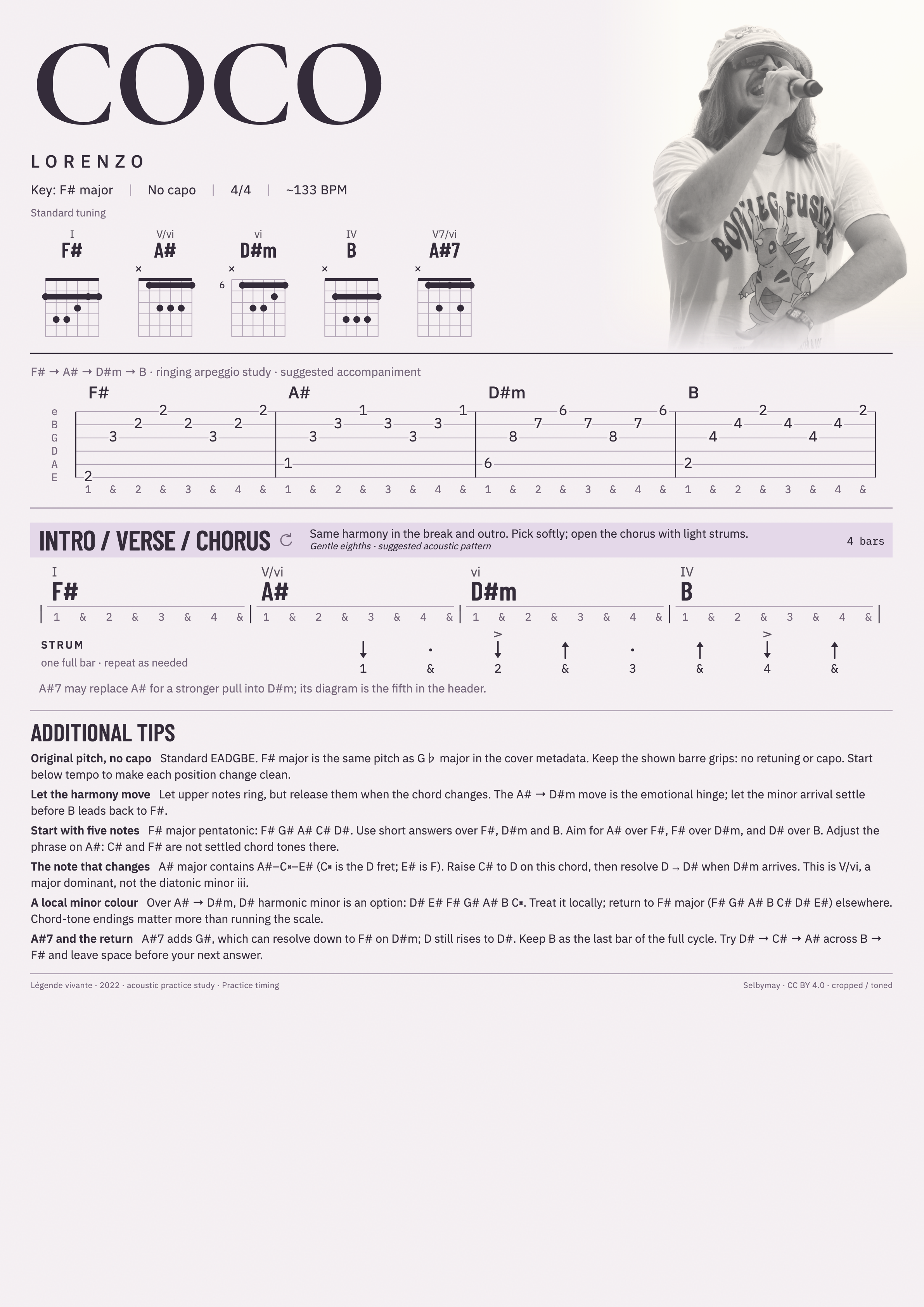
Calculated standard-tuning grip [2, 4, 4, 3, 2, 2], low to high. Sounded pitch classes must belong to F# A# C#. A# uses x13331, correcting source 113311; mute low E on fifth-string-root shapes to avoid unintended inversions. A#7 is an optional substitution.
[1] Intro, Verse 1/2, Chorus, Break and outro
Recurring F#–A#–D#m–B. Header says Key C and supplied A# grip is 113311; these labels conflict with the actual chord symbols.
[2] Chord summary and grid
F# major; repeated F#–A#7–D#m–B, some A# and occasional A#m detections; reported 130 BPM.
A# · harmony inferred
A#: A# C## E#; V/vi relative to F# major. C## is D and E# is F on the fretboard. Major third raises the diatonic C# to C## and resolves to D#.
[1] Intro, Verse 1/2, Chorus, Break and outro
Recurring F#–A#–D#m–B. Header says Key C and supplied A# grip is 113311; these labels conflict with the actual chord symbols.
[2] Chord summary and grid
F# major; repeated F#–A#7–D#m–B, some A# and occasional A#m detections; reported 130 BPM.
A# · voicing adapted
Calculated standard-tuning grip [None, 1, 3, 3, 3, 1], low to high. Sounded pitch classes must belong to A# C## E#. A# uses x13331, correcting source 113311; mute low E on fifth-string-root shapes to avoid unintended inversions. A#7 is an optional substitution.
[1] Intro, Verse 1/2, Chorus, Break and outro
Recurring F#–A#–D#m–B. Header says Key C and supplied A# grip is 113311; these labels conflict with the actual chord symbols.
[2] Chord summary and grid
F# major; repeated F#–A#7–D#m–B, some A# and occasional A#m detections; reported 130 BPM.
D#m · harmony inferred
D#m: D# F# A#; vi relative to F# major. Chord tones belong to F# major; no inferred key change is required.
[1] Intro, Verse 1/2, Chorus, Break and outro
Recurring F#–A#–D#m–B. Header says Key C and supplied A# grip is 113311; these labels conflict with the actual chord symbols.
[2] Chord summary and grid
F# major; repeated F#–A#7–D#m–B, some A# and occasional A#m detections; reported 130 BPM.
D#m · voicing adapted
Calculated standard-tuning grip [None, 6, 8, 8, 7, 6], low to high. Sounded pitch classes must belong to D# F# A#. A# uses x13331, correcting source 113311; mute low E on fifth-string-root shapes to avoid unintended inversions. A#7 is an optional substitution.
[1] Intro, Verse 1/2, Chorus, Break and outro
Recurring F#–A#–D#m–B. Header says Key C and supplied A# grip is 113311; these labels conflict with the actual chord symbols.
[2] Chord summary and grid
F# major; repeated F#–A#7–D#m–B, some A# and occasional A#m detections; reported 130 BPM.
B · harmony inferred
B: B D# F#; IV relative to F# major. Chord tones belong to F# major; no inferred key change is required.
[1] Intro, Verse 1/2, Chorus, Break and outro
Recurring F#–A#–D#m–B. Header says Key C and supplied A# grip is 113311; these labels conflict with the actual chord symbols.
[2] Chord summary and grid
F# major; repeated F#–A#7–D#m–B, some A# and occasional A#m detections; reported 130 BPM.
B · voicing adapted
Calculated standard-tuning grip [None, 2, 4, 4, 4, 2], low to high. Sounded pitch classes must belong to B D# F#. A# uses x13331, correcting source 113311; mute low E on fifth-string-root shapes to avoid unintended inversions. A#7 is an optional substitution.
[1] Intro, Verse 1/2, Chorus, Break and outro
Recurring F#–A#–D#m–B. Header says Key C and supplied A# grip is 113311; these labels conflict with the actual chord symbols.
[2] Chord summary and grid
F# major; repeated F#–A#7–D#m–B, some A# and occasional A#m detections; reported 130 BPM.
A#7 · harmony inferred
A#7: A# C## E# G#; V7/vi relative to F# major. C## is D and E# is F on the fretboard. Major third raises the diatonic C# to C## and resolves to D#.
[1] Intro, Verse 1/2, Chorus, Break and outro
Recurring F#–A#–D#m–B. Header says Key C and supplied A# grip is 113311; these labels conflict with the actual chord symbols.
[2] Chord summary and grid
F# major; repeated F#–A#7–D#m–B, some A# and occasional A#m detections; reported 130 BPM.
A#7 · voicing adapted
Calculated standard-tuning grip [None, 1, 3, 1, 3, 1], low to high. Sounded pitch classes must belong to A# C## E# G#. A# uses x13331, correcting source 113311; mute low E on fifth-string-root shapes to avoid unintended inversions. A#7 is an optional substitution.
[1] Intro, Verse 1/2, Chorus, Break and outro
Recurring F#–A#–D#m–B. Header says Key C and supplied A# grip is 113311; these labels conflict with the actual chord symbols.
[2] Chord summary and grid
F# major; repeated F#–A#7–D#m–B, some A# and occasional A#m detections; reported 130 BPM.
Intro / verse / chorus · harmony adapted
Select the chart’s F#–A#–D#m–B cycle. Treat A#7 detection as an optional dominant-seventh enrichment, not an extra harmonic section. Occasional A#m detections are not promoted to verified substitutions.
[1] Intro, Verse 1/2, Chorus, Break and outro
Recurring F#–A#–D#m–B. Header says Key C and supplied A# grip is 113311; these labels conflict with the actual chord symbols.
[2] Chord summary and grid
F# major; repeated F#–A#7–D#m–B, some A# and occasional A#m detections; reported 130 BPM.
Intro / verse / chorus · timing adapted
Four 4/4 practice bars, one chord per bar: F#4 | A#4 | D#m4 | B4. Even eighth-note picking and the printed strum are authored accompaniment, not verified studio attack timing.
[1] Intro, Verse 1/2, Chorus, Break and outro
Recurring F#–A#–D#m–B. Header says Key C and supplied A# grip is 113311; these labels conflict with the actual chord symbols.
[2] Chord summary and grid
F# major; repeated F#–A#7–D#m–B, some A# and occasional A#m detections; reported 130 BPM.
ringing-cycle · pitches adapted
A complete four-chord arpeggio study uses the exact header grips: bass, G, B, high E, B, G, B, high E strings for each chord. Notes calculated from standard tuning; no signature-riff claim.
[1] Intro, Verse 1/2, Chorus, Break and outro
Recurring F#–A#–D#m–B. Header says Key C and supplied A# grip is 113311; these labels conflict with the actual chord symbols.
[2] Chord summary and grid
F# major; repeated F#–A#7–D#m–B, some A# and occasional A#m detections; reported 130 BPM.
ringing-cycle · timing adapted
Four complete 4/4 bars with eighth-note onsets 0,.5,1,1.5,2,2.5,3,3.5 in every bar; durations .5 engraving units. Let ring as described. This is an explicit practice adaptation.
[1] Intro, Verse 1/2, Chorus, Break and outro
Recurring F#–A#–D#m–B. Header says Key C and supplied A# grip is 113311; these labels conflict with the actual chord symbols.
[2] Chord summary and grid
F# major; repeated F#–A#7–D#m–B, some A# and occasional A#m detections; reported 130 BPM.
Key & tuning Harmonic interpretation
F# major, enharmonic to G-flat major; standard EADGBE and no capo preserve the reference pitch. Reject chart Key C. A# is a local dominant of D#m, not evidence that the whole song changes key. [1] [2] [3] [4]
Chord functions
F#: F# A# C#; I relative to F# major. Chord tones belong to F# major; no inferred key change is required. [1] [2]
Harmonic interpretationA#: A# C## E#; V/vi relative to F# major. C## is D and E# is F on the fretboard. Major third raises the diatonic C# to C## and resolves to D#. [1] [2]
Harmonic interpretationD#m: D# F# A#; vi relative to F# major. Chord tones belong to F# major; no inferred key change is required. [1] [2]
Harmonic interpretationMeter, duration & feel Harmonic interpretation
Approximately 133 quarter-note BPM in 4/4; a four-bar practice cycle, one chord per bar. Arpeggio and strum are suggestions, not exact recorded rhythm. [1] [2] [3] [4]
Choosing material for a looper Playing suggestion
Retain all four chords so A# resolves into D#m and B returns to F#. The same harmony can be softer in verses and broader in refrains without duplicate grids. Leave room for one melodic response; no more than two simultaneous layers or prescribed recording steps. [1] [2] [3] [4]
Improvisation choices Playing suggestion
Start with F# major pentatonic over the diatonic chords; on A# target A#, C## and E# instead of holding C# or F#. D# harmonic minor is a local option for A#–D#m, with C## resolving to D#. A#7 adds G# resolving to F#. These are authored suggestions. [1] [2] [3] [4]
Cross-checks & arrangement decisions
Incorrect chart metadata and grip. F#/Gb major agrees across metadata and actual chord names. Key C is rejected. A# is x13331; the supplied 113311 is not an A#-major grip. [1] [3] [4]
A# versus A#7 and A#m. Use chart A# major; offer A#7 as a compatible dominant extension. Occasional detected A#m is not independently verified and is omitted from this simplified study. [1] [2]
Tempo. Select about 133 quarter-note BPM over the detected 130. Exact guitar attacks remain adapted. [3] [4] [2]
Limits of this edition
- Recording and the discovered biaz uk tutorial video were not auditioned. No exact studio picking or lead transcription is claimed.
- No independently verified complete riff/solo phrase was established. Prioritize harmonic and improvisation guidance; no filler lead tab.
- One recurring progression abstracts vocal pickups, production stops and any unverified chord variants. The studio-cover page is metadata evidence, not original audio.
Image research & credit
Selbymay · CC BY 4.0 · cropped / toned
https://commons.wikimedia.org/wiki/File:NDLE2023Lorenzo_1.jpg ↗

Selbymay, 30 June 2023, CC BY 4.0 https://creativecommons.org/licenses/by/4.0/. Cropped by the header, desaturated and faded; attribution retained.
Inspected close artist portrait from the year after Légende vivante. Rejected distant 2017 Bobital and 2023 We Love Green candidates for print clarity. No claim to depict the recording session.
Sources
- Coco — community chord chart ↗
F#–A#–D#m–B across intro, verses, chorus, break and outro; printed key/fingerings require correction.
GuitarTabsExplorer · Lineage: anonymous-coco-four-chord-chart · Anonymous chart; matching UkuTabs wording/order treated conservatively as the same origin. - Coco — recording-linked chord detection ↗
F# key and recurring cycle, with A#7/A# variants; occasional A#m detections conflict with chart.
Chordify · Lineage: chordify-coco-detection · Independent automated detection; not a human transcription and not proof of exact guitar attacks. - Coco — studio cover metadata ↗
Original-reference G-flat major and 133 BPM; acoustic-guitar track listed.
Tency Music / Version Karaoké · Lineage: tency-coco-studio-cover · Independent studio re-recording; original-reference metadata only, not the original audio. - Coco — song metrics ↗
F#/Gb major, 133 BPM and four beats per bar.
SongBPM · Lineage: spotify-coco-metrics · Spotify-derived metrics, separate from studio-cover production; other mirrors of these metrics are not independent.