GUITAR / LOOPER-READY SHEET
Canon in D
Johann Pachelbel
Ground bass & opening voices · standard-guitar study
No checkout. No sign-up.
On your music stand.
For the print view, choose A4 paper, portrait, 100% scale, no browser headers or footers, and enable background graphics.
Explore the sections freely. The sheet gives you the material; the arrangement is yours.
Sources & musical analysis
Ground bass & opening voices · standard-guitar study
Ground bass & opening voices · standard-guitar study
Research record Collected while preparing this sheet
Inspected mfiles violin-1 score page 1, Berlin manuscript opening and Musopen work description. Retained the complete first 16-note violin statement and eight-note ground. Doubled all source durations, lowered the melody an octave and raised the otherwise unavailable low D2. Added an original broken-chord accompaniment. No single recording or modern solo-guitar arrangement is represented. Later virtuosic variations omitted to keep the two complete opening cycles readable. Mutopia edition credits Jim Paterson and was not counted as an independent mfiles corroboration.
Recording independently checked: No.
Passage fidelity
Ground cycle · Practice adaptation
Preserved: All eight ground roots and their order.
Changed: Durations doubled; chord grips are our continuo reduction.
Checked: Checked complete 16-beat cycle, final A→D join and diagram pitches.
opening-voice · Practice adaptation
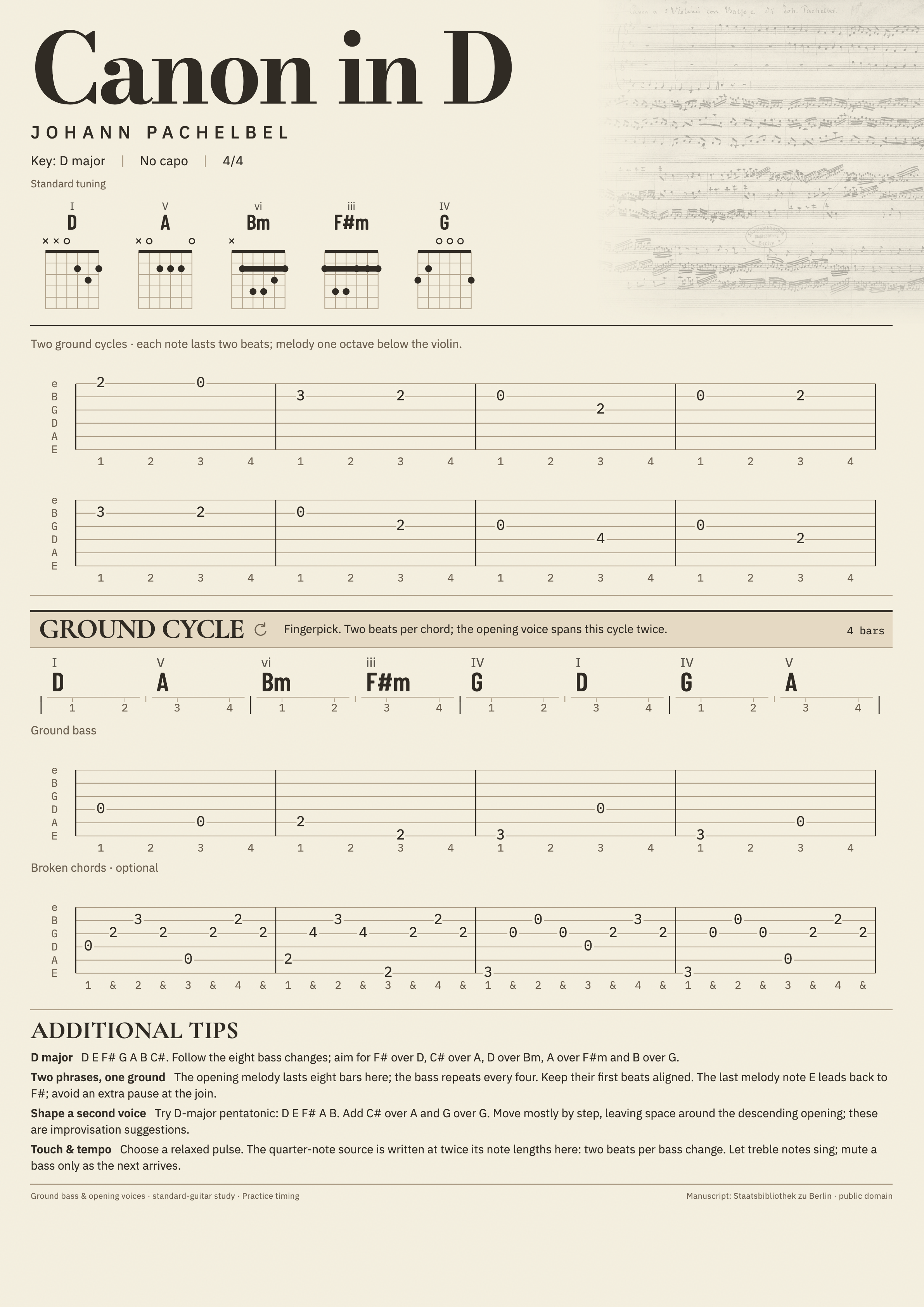
Preserved: F# E D C# B A B C# | D C# B A G F# G E.
Changed: Melody lowered one octave, every quarter note doubled to a half note; no pitches dropped.
Checked: Compared source opening where applicable; checked EADGBE fret pitches, every onset and complete cycle lengths.
ground-bass · Practice adaptation
Preserved: D A B F# G D G A.
Changed: Second D raised from D2 to D3 to avoid retuning; all source durations doubled.
Checked: Compared source opening where applicable; checked EADGBE fret pitches, every onset and complete cycle lengths.
broken-chords · Practice adaptation
Preserved: Only chord tones from the eight corresponding grips.
Changed: Entire four-bar accompaniment authored; bass–G–B–G eighth-note attacks per half-bar, not a sourced Pachelbel riff.
Checked: Compared source opening where applicable; checked EADGBE fret pitches, every onset and complete cycle lengths.
Claim-level evidence
Song · key supported
D major; no transposition of pitch classes.
[1] Original-version description; violin-1 PDF page 1, opening after two-bar rest
Eight-note ground lasts two source bars; violin begins F# E D C# B A B C# then D C# B A G F# G E in quarter notes.
[3] Page 1, top violin line and continuo opening
Two-sharp key signature; matching descending opening and repeating D A B F# G D G A bass.
Song · tuning adapted
Standard E2 A2 D3 G3 B3 E4, no capo, selected for this guitar reduction; original is strings/continuo.
[1] Original-version description; violin-1 PDF page 1, opening after two-bar rest
Eight-note ground lasts two source bars; violin begins F# E D C# B A B C# then D C# B A G F# G E in quarter notes.
Song · meter adapted
4/4 with note lengths doubled relative to the consulted two-bar ground edition.
[1] Original-version description; violin-1 PDF page 1, opening after two-bar rest
Eight-note ground lasts two source bars; violin begins F# E D C# B A B C# then D C# B A G F# G E in quarter notes.
[3] Page 1, top violin line and continuo opening
Two-sharp key signature; matching descending opening and repeating D A B F# G D G A bass.
D · harmony inferred
D: D F# A; I in D major. Root-position chordal reduction above the corresponding ground bass; the original contrapuntal texture is richer.
[1] Original-version description; violin-1 PDF page 1, opening after two-bar rest
Eight-note ground lasts two source bars; violin begins F# E D C# B A B C# then D C# B A G F# G E in quarter notes.
[3] Page 1, top violin line and continuo opening
Two-sharp key signature; matching descending opening and repeating D A B F# G D G A bass.
D · voicing adapted
Author-selected EADGBE grip [None, None, 0, 2, 3, 2], low to high; muted/open strings and pitch classes checked against D F# A. No triad-only part used.
[1] Original-version description; violin-1 PDF page 1, opening after two-bar rest
Eight-note ground lasts two source bars; violin begins F# E D C# B A B C# then D C# B A G F# G E in quarter notes.
A · harmony inferred
A: A C# E; V in D major. Root-position chordal reduction above the corresponding ground bass; the original contrapuntal texture is richer.
[1] Original-version description; violin-1 PDF page 1, opening after two-bar rest
Eight-note ground lasts two source bars; violin begins F# E D C# B A B C# then D C# B A G F# G E in quarter notes.
[3] Page 1, top violin line and continuo opening
Two-sharp key signature; matching descending opening and repeating D A B F# G D G A bass.
A · voicing adapted
Author-selected EADGBE grip [None, 0, 2, 2, 2, 0], low to high; muted/open strings and pitch classes checked against A C# E. No triad-only part used.
[1] Original-version description; violin-1 PDF page 1, opening after two-bar rest
Eight-note ground lasts two source bars; violin begins F# E D C# B A B C# then D C# B A G F# G E in quarter notes.
Bm · harmony inferred
Bm: B D F#; vi in D major. Root-position chordal reduction above the corresponding ground bass; the original contrapuntal texture is richer.
[1] Original-version description; violin-1 PDF page 1, opening after two-bar rest
Eight-note ground lasts two source bars; violin begins F# E D C# B A B C# then D C# B A G F# G E in quarter notes.
[3] Page 1, top violin line and continuo opening
Two-sharp key signature; matching descending opening and repeating D A B F# G D G A bass.
Bm · voicing adapted
Author-selected EADGBE grip [None, 2, 4, 4, 3, 2], low to high; muted/open strings and pitch classes checked against B D F#. No triad-only part used.
[1] Original-version description; violin-1 PDF page 1, opening after two-bar rest
Eight-note ground lasts two source bars; violin begins F# E D C# B A B C# then D C# B A G F# G E in quarter notes.
F#m · harmony inferred
F#m: F# A C#; iii in D major. Root-position chordal reduction above the corresponding ground bass; the original contrapuntal texture is richer.
[1] Original-version description; violin-1 PDF page 1, opening after two-bar rest
Eight-note ground lasts two source bars; violin begins F# E D C# B A B C# then D C# B A G F# G E in quarter notes.
[3] Page 1, top violin line and continuo opening
Two-sharp key signature; matching descending opening and repeating D A B F# G D G A bass.
F#m · voicing adapted
Author-selected EADGBE grip [2, 4, 4, 2, 2, 2], low to high; muted/open strings and pitch classes checked against F# A C#. No triad-only part used.
[1] Original-version description; violin-1 PDF page 1, opening after two-bar rest
Eight-note ground lasts two source bars; violin begins F# E D C# B A B C# then D C# B A G F# G E in quarter notes.
G · harmony inferred
G: G B D; IV in D major. Root-position chordal reduction above the corresponding ground bass; the original contrapuntal texture is richer.
[1] Original-version description; violin-1 PDF page 1, opening after two-bar rest
Eight-note ground lasts two source bars; violin begins F# E D C# B A B C# then D C# B A G F# G E in quarter notes.
[3] Page 1, top violin line and continuo opening
Two-sharp key signature; matching descending opening and repeating D A B F# G D G A bass.
G · voicing adapted
Author-selected EADGBE grip [3, 2, 0, 0, 0, 3], low to high; muted/open strings and pitch classes checked against G B D. No triad-only part used.
[1] Original-version description; violin-1 PDF page 1, opening after two-bar rest
Eight-note ground lasts two source bars; violin begins F# E D C# B A B C# then D C# B A G F# G E in quarter notes.
Ground cycle · harmony inferred
D–A–Bm–F#m–G–D–G–A, I–V–vi–iii–IV–I–IV–V, follows the eight bass roots.
[1] Original-version description; violin-1 PDF page 1, opening after two-bar rest
Eight-note ground lasts two source bars; violin begins F# E D C# B A B C# then D C# B A G F# G E in quarter notes.
[3] Page 1, top violin line and continuo opening
Two-sharp key signature; matching descending opening and repeating D A B F# G D G A bass.
Ground cycle · timing adapted
Exactly two quarter-note beats per chord: four 4/4 measures; A ends beat 4 and the next D begins the next cycle.
[1] Original-version description; violin-1 PDF page 1, opening after two-bar rest
Eight-note ground lasts two source bars; violin begins F# E D C# B A B C# then D C# B A G F# G E in quarter notes.
[3] Page 1, top violin line and continuo opening
Two-sharp key signature; matching descending opening and repeating D A B F# G D G A bass.
opening-voice · pitches adapted
F# E D C# B A B C# | D C# B A G F# G E. Melody lowered one octave, every quarter note doubled to a half note; no pitches dropped.
[1] Original-version description; violin-1 PDF page 1, opening after two-bar rest
Eight-note ground lasts two source bars; violin begins F# E D C# B A B C# then D C# B A G F# G E in quarter notes.
[3] Page 1, top violin line and continuo opening
Two-sharp key signature; matching descending opening and repeating D A B F# G D G A bass.
opening-voice · timing adapted
Melody lowered one octave, every quarter note doubled to a half note; no pitches dropped. Complete measures retained, ending exactly at the cycle boundary.
[1] Original-version description; violin-1 PDF page 1, opening after two-bar rest
Eight-note ground lasts two source bars; violin begins F# E D C# B A B C# then D C# B A G F# G E in quarter notes.
[3] Page 1, top violin line and continuo opening
Two-sharp key signature; matching descending opening and repeating D A B F# G D G A bass.
ground-bass · pitches adapted
D A B F# G D G A. Second D raised from D2 to D3 to avoid retuning; all source durations doubled.
[1] Original-version description; violin-1 PDF page 1, opening after two-bar rest
Eight-note ground lasts two source bars; violin begins F# E D C# B A B C# then D C# B A G F# G E in quarter notes.
[3] Page 1, top violin line and continuo opening
Two-sharp key signature; matching descending opening and repeating D A B F# G D G A bass.
ground-bass · timing adapted
Second D raised from D2 to D3 to avoid retuning; all source durations doubled. Complete measures retained, ending exactly at the cycle boundary.
[1] Original-version description; violin-1 PDF page 1, opening after two-bar rest
Eight-note ground lasts two source bars; violin begins F# E D C# B A B C# then D C# B A G F# G E in quarter notes.
[3] Page 1, top violin line and continuo opening
Two-sharp key signature; matching descending opening and repeating D A B F# G D G A bass.
broken-chords · pitches adapted
Only chord tones from the eight corresponding grips. Entire four-bar accompaniment authored; bass–G–B–G eighth-note attacks per half-bar, not a sourced Pachelbel riff.
[1] Original-version description; violin-1 PDF page 1, opening after two-bar rest
Eight-note ground lasts two source bars; violin begins F# E D C# B A B C# then D C# B A G F# G E in quarter notes.
[3] Page 1, top violin line and continuo opening
Two-sharp key signature; matching descending opening and repeating D A B F# G D G A bass.
broken-chords · timing adapted
Entire four-bar accompaniment authored; bass–G–B–G eighth-note attacks per half-bar, not a sourced Pachelbel riff. Complete measures retained, ending exactly at the cycle boundary.
[1] Original-version description; violin-1 PDF page 1, opening after two-bar rest
Eight-note ground lasts two source bars; violin begins F# E D C# B A B C# then D C# B A G F# G E in quarter notes.
[3] Page 1, top violin line and continuo opening
Two-sharp key signature; matching descending opening and repeating D A B F# G D G A bass.
Key & tuning Harmonic interpretation
D major, confirmed by work metadata and the two-sharp score. EADGBE, no capo; concert key preserved. This is our guitar reduction of the composition, not a specific recording. [1] [2] [3]
Chord functions
D: D F# A; I in D major. Root-position chordal reduction above the corresponding ground bass; the original contrapuntal texture is richer. [1] [3]
Harmonic interpretationA: A C# E; V in D major. Root-position chordal reduction above the corresponding ground bass; the original contrapuntal texture is richer. [1] [3]
Harmonic interpretationBm: B D F#; vi in D major. Root-position chordal reduction above the corresponding ground bass; the original contrapuntal texture is richer. [1] [3]
Harmonic interpretationMeter, duration & feel Harmonic interpretation
Source quarter-note bass changes become half notes: four 4/4 bars per eight-chord cycle. Opening violin line spans two cycles/eight bars. No canonical BPM is asserted. [1] [2] [3]
Choosing material for a looper Playing suggestion
The four-bar ground repeats beneath both halves of the eight-bar opening. Repeat complete cycles; a delayed melodic entry is optional, not a prescribed three-track canon. [1] [2] [3]
Improvisation choices Playing suggestion
D major contains D E F# G A B C#. All basic chords are diatonic; aim for the active chord third and use passing notes between stable tones. [1] [2] [3]
Cross-checks & arrangement decisions
Arrangement and tuning. D major, confirmed by work metadata and the two-sharp score. EADGBE, no capo; concert key preserved. This is our guitar reduction of the composition, not a specific recording. [1] [2] [3]
Limits of this edition
- Score/tab research only; no recording audition was performed.
- Guitar fingering and accompaniment are study adaptations, not a complete performance transcription.
Image research & credit
Manuscript: Staatsbibliothek zu Berlin · public domain
https://commons.wikimedia.org/wiki/File:Pachelbel%27s_Canon_-_Mus.MS_16481-8_Page_1.jpg ↗

Anonymous historic copy; Staatsbibliothek zu Berlin scan, via IMSLP/Wikimedia Commons. Public domain. Desaturated and faded in header.
The surviving Canon manuscript directly identifies the work. Decorative facsimile only; every playable note below is generated SVG.
Sources
- Canon in D — original version ↗
Ground cycle, 2-bar source form, original instrumentation; violin-1 PDF inspected for opening pitches and rhythm.
mfiles · Lineage: jim-paterson-mfiles · Independently authored reference; shared composition is not a copied transcription. No mirror counted as corroboration. - Canon and Gigue in D major ↗
D-major identity, three-voice canon and independent repeating ground bass; not precise guitar voicing evidence.
Musopen · Lineage: musopen-editorial · Independently authored reference; shared composition is not a copied transcription. No mirror counted as corroboration. - Canon manuscript Mus.MS 16481-8, page 1 ↗
Primary score inspected: opening descending violin notes and repeating bass. Also the decorative artwork source.
Staatsbibliothek zu Berlin / Wikimedia Commons · Lineage: berlin-canon-manuscript · Independently authored reference; shared composition is not a copied transcription. No mirror counted as corroboration.